

Crypto history is full of explosive moments: sudden liquidity waves, viral narratives, parabolic charts. But the deepest infrastructure shifts almost never look like that at the beginning. They look procedural. Technical. Regulatory. Slow.
Dusk Foundation is anchored in that second category — the part of blockchain development focused not on speculative velocity, but on how real financial systems might eventually operate on-chain.
Its core thesis is simple but demanding: the next phase of adoption will not be driven primarily by traders or gamers, but by capital markets — tokenized securities, bonds, funds, and real-world assets that must function inside legal frameworks while preserving decentralization and cryptographic integrity.
That is a harder problem than fast swaps or NFT mints. And that difficulty is precisely what defines Dusk’s importance.
1. The Structural Problem Dusk Is Addressing
Traditional finance runs on three pillars:
Confidentiality — counterparties cannot expose every balance or trade.
Auditability — regulators and auditors must be able to verify activity.
Finality — settlement must be predictable and legally defensible.
Public blockchains historically optimized for openness and censorship resistance. Every transaction visible, every wallet traceable. This is powerful for transparency, but incompatible with most institutional workflows.
Banks, funds, and issuers cannot operate on rails where sensitive positions are broadcast to the world, nor on systems where regulatory reporting must be improvised.
Dusk’s relevance begins here. Its architecture is aimed at resolving that contradiction by enabling:
• Selective disclosure instead of total transparency
• Cryptographic proofs rather than blind trust
• Compliance logic embedded at the protocol layer
• On-chain settlement that can mirror off-chain legal processes
In other words, it is attempting to make blockchains usable for markets that are measured in trillions, not millions.
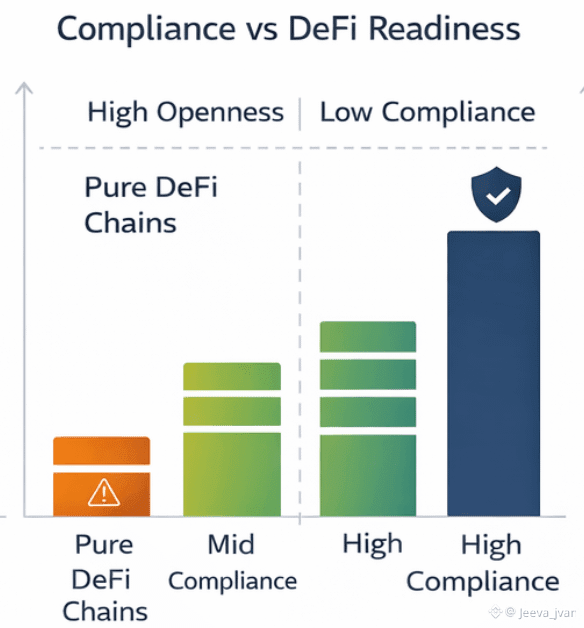
2. Privacy as a Regulatory Tool — Not an Escape Hatch
In much of crypto, privacy has been framed as resistance: hiding from oversight, obfuscating flows, bypassing intermediaries.
Dusk approaches privacy from a very different angle.
For regulated finance, privacy is not optional — it is required.
Corporate positions, investor identities, and proprietary strategies cannot be publicly indexed without destroying market function.
Dusk’s cryptographic stack focuses on confidential transactions that remain verifiable. Regulators or authorized auditors can confirm that rules are followed, that assets are backed, and that limits are respected — without exposing sensitive data to the entire network.
This reframes privacy from a political stance into a market primitive.
That shift matters.
It is what allows tokenized equities or debt instruments to exist on public infrastructure without forcing institutions to abandon the legal and operational constraints they already live under.
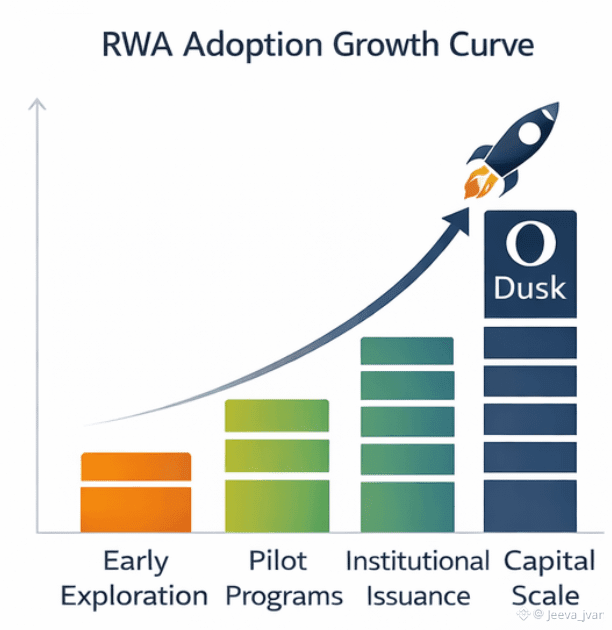
3. Why RWAs Are Central to the Thesis
Real-world assets (RWAs) — treasuries, credit products, commodities, real estate claims, structured notes — are often described as crypto’s next frontier because they connect blockchain rails to global capital pools.
But RWAs are unforgiving.
They require:
• Identity frameworks
• Jurisdictional controls
• Reporting standards
• Transfer restrictions
• Corporate governance hooks
• Settlement certainty
Most chains treat these features as application-level add-ons.
Dusk’s strategy pushes them closer to the protocol itself.
This is what separates speculative ecosystems from financial-market infrastructure.
The former optimizes for experimentation; the latter must optimize for durability, legal compatibility, and operational clarity.
If RWAs truly scale, the dominant platforms may not be the most visible ones today — but the ones regulators and issuers are already comfortable integrating with.
4. Validator Economics and Network Discipline
Institutional finance does not tolerate flaky infrastructure.
Downtime, censorship, inconsistent settlement, or unclear incentives are not acceptable when large-value instruments are moving through the system.
Dusk’s validator model is designed around economic alignment and reliability — rewarding uptime and correct behavior while penalizing malicious or negligent operation.
This emphasis on discipline is not glamorous, but it is foundational.
It mirrors how clearing houses, custodians, and settlement networks operate in traditional markets: predictable incentives, strict penalties, and high barriers to misconduct.
Such structures are rarely celebrated during bull runs.
They become invaluable when markets are stressed.
5. Developer Tooling and Institutional Integration
Another under-appreciated element of Dusk’s positioning is its focus on integration rather than disruption.
Instead of forcing enterprises to rebuild entire stacks from scratch, the project emphasizes:
• APIs and SDKs for compliance-aware issuance
• Middleware for settlement workflows
• Interfaces for asset registries
• Compatibility with legacy systems
This is crucial.
Most financial institutions will not abandon decades of infrastructure overnight. They adopt gradually, plugging new rails into existing reporting systems, custody frameworks, and risk engines.
By lowering the friction to experimentation and deployment, Dusk is attempting to become an invisible layer beneath financial activity — not a flashy front-end destination, but the plumbing underneath.
6. Strategic Importance in the Next Market Cycle
Crypto narratives move in waves:
First comes experimentation.
Then speculation.
Only later comes institutionalization.
Dusk is built for that third phase.
If regulatory clarity continues to expand and tokenization frameworks mature across major jurisdictions, demand will shift toward chains that already speak the language of:
• auditors
• issuers
• compliance officers
• settlement desks
• regulators
That is not a retail-driven story.
It is a slow-burn infrastructure story — the kind that compounds quietly until it suddenly feels indispensable.
7. Why the “Quiet Build” Matters
Projects oriented toward capital markets often appear under-represented in headline cycles because their success is measured differently.
Not in meme velocity.
Not in daily volume spikes.
But in:
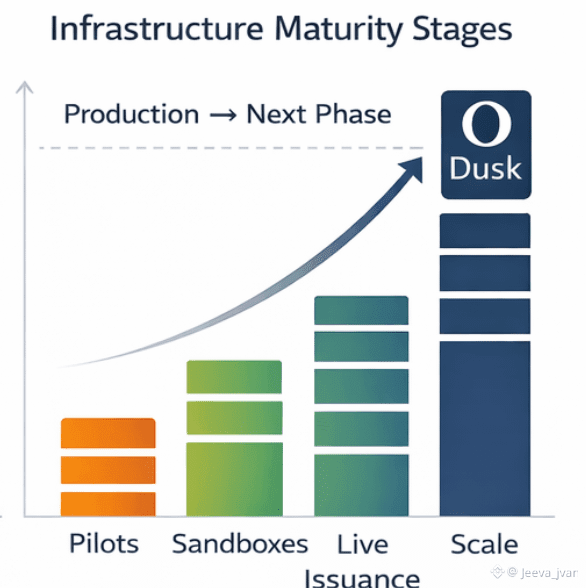
• pilot programs with institutions
• regulatory engagement
• issuance frameworks
• production-grade tooling
• reliability over years, not weeks
Dusk’s philosophy suggests a bet that crypto’s most enduring value will not come from recreating casinos on-chain — but from rebuilding how assets are issued, settled, and governed globally.
Final Perspective
Dusk Foundation is not trying to win the current narrative cycle.
It is trying to be standing when the market’s center of gravity shifts from speculation to settlement.
If tokenized finance truly moves “slowly, then all at once,” the networks that dominate that second phase will likely be the ones that spent the quiet years solving legal, cryptographic, and institutional problems before anyone was watching.
Infrastructure doesn’t trend early.
It trends when the world finally needs it.
