

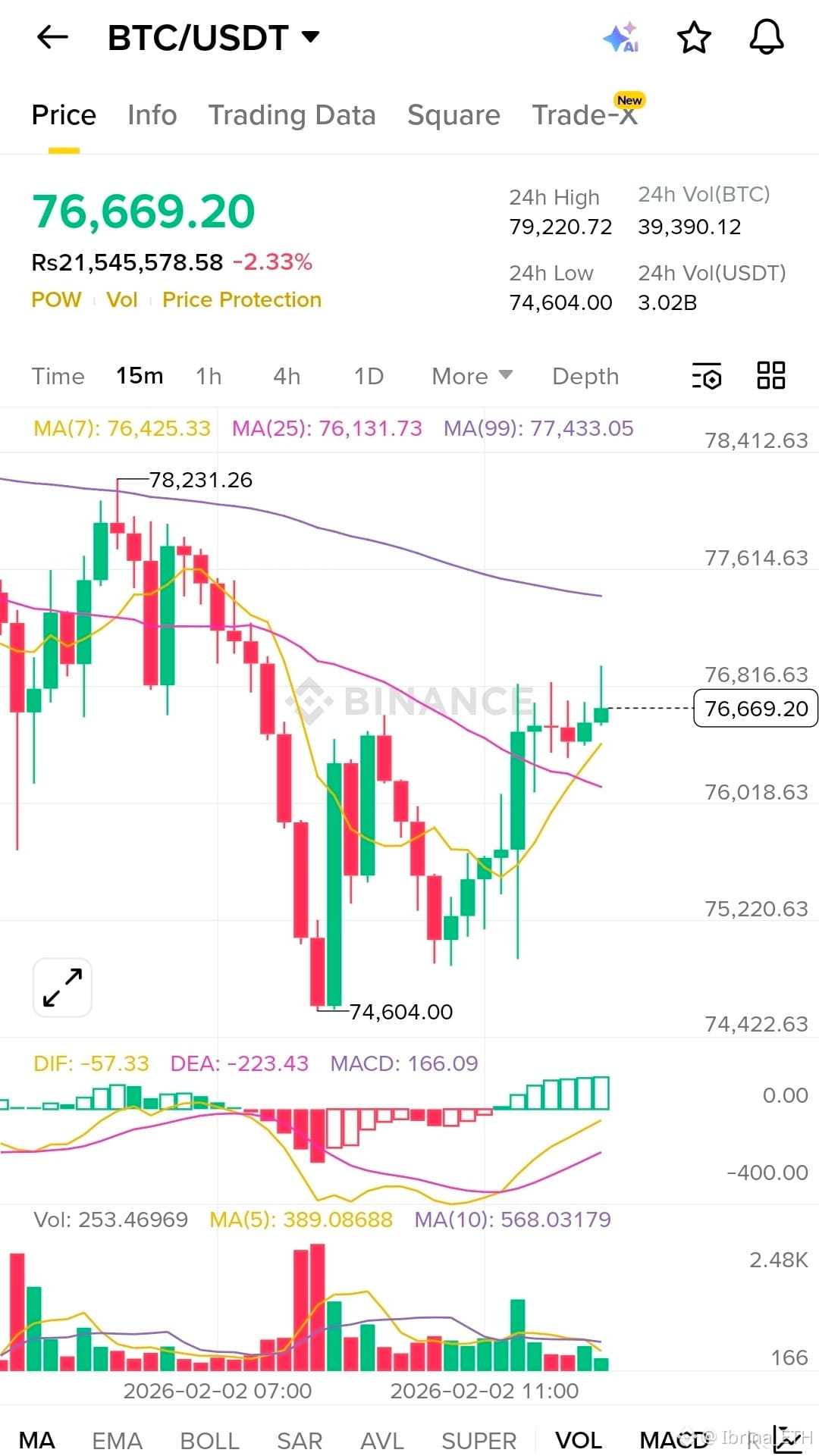
Once Bitcoin slips below a certain level, the real damage doesn’t show up on the chart immediately. It shows up quietly — in how people start thinking. Right now, that level is $70K. Above it, confidence feels natural and effortless. Below it, confidence doesn’t collapse all at once. It fades. Slowly. Almost invisibly. Buying becomes hesitant. Dip buyers pause instead of acting. Leverage stops being bold. This is how markets change direction without making noise.
Many people believe Bitcoin will always bounce back quickly, simply because it has done so before. But those recoveries happened under very different conditions — when belief was fresh and new capital was ready to step in. A clean break below $70K would send a different message. It would quietly tell the market that a level many believed was “safe” was never guaranteed. Markets don’t punish price movements. They punish assumptions people stop questioning.
What makes this moment deceptive is how normal everything looks. There’s no panic. No violent liquidation. No surge in volume. And that’s exactly why it matters. When markets drift lower in silence, it usually means positions are being adjusted beneath the surface. Weak hands don’t get forced out — they walk away on their own. And selling driven by lost conviction is far harder to undo than selling driven by fear.
People often speculate about Satoshi Nakamoto and what might happen if those coins ever moved. But the real risk has never been the act of selling. The real risk is what such a moment would symbolize. Satoshi represents patience, long-term belief, and absence. If that symbol is ever shaken — even slightly — the impact wouldn’t be immediate price action. It would be something deeper: trust. And markets take much longer to rebuild trust than to recover price.
This is why returning from $70K to $100K wouldn’t be a simple climb. It wouldn’t just require buyers. It would require belief to return. Buyers would need proof, not hope. After major levels fail, rallies don’t get rejected because of weakness — they get rejected because the market becomes selective. Sellers wait. Buyers hesitate. Momentum slows.
Markets bounce quickly after fear. They hesitate longest after doubt. Right now, Bitcoin isn’t experiencing panic. It’s experiencing uncertainty. And uncertainty is the most uncomfortable phase, because nothing feels clearly wrong — yet nothing feels safe either.
This isn’t a crash. It’s something more subtle. A test of patience. A test of positioning. A test of understanding. Those who only watch price will feel restless. Those who understand structure will notice that the most important shifts usually happen before price makes them obvious.
Breaking $70K wouldn’t end Bitcoin. But it would change the journey. The path back to $100K would become slower, more deliberate, and far more selective. Markets always choose the harder road once too many people assume the easy one is guaranteed.
What matters now isn’t prediction. It’s preparation. Bitcoin has a habit of moving against certainty first and rewarding patience later. Knowing the difference between those two moments is what separates reaction from strategy.
So the real question isn’t whether $70K is just another number.
It’s whether this is the level where belief quietly starts to bend.