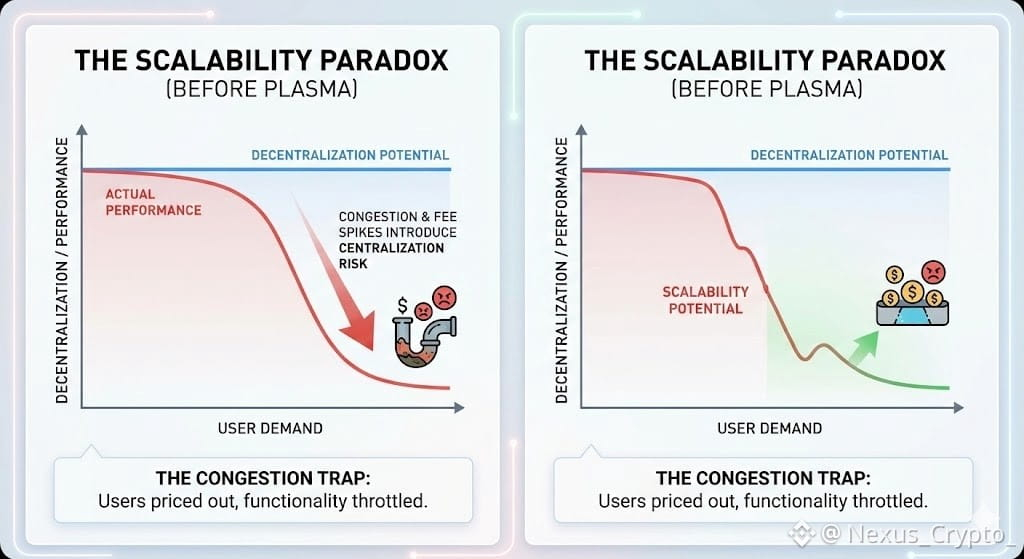
Blockchain technology was created to eliminate the need for trust. Today, users can hold their own assets, control private keys, and interact with permissionless financial systems without intermediaries. Yet a paradox remains at the core of decentralized infrastructure. Applications may be trustless by design, but the moment real users arrive, congestion, rising fees, and degraded performance quietly reintroduce centralization pressures. This scalability paradox threatens the long-term promise of decentralized systems.
Plasma is designed to resolve this contradiction at the protocol level.
The Hidden Cost of Success
When a decentralized application succeeds, demand increases. Blocks fill up, fees rise, and transactions fail. Users are priced out, developers throttle functionality, and teams are pushed toward centralized execution paths to maintain usability. These compromises are rarely visible at first, but they accumulate over time.
This pattern repeats across ecosystems. DeFi protocols become unusable during volatility. NFT platforms stall during high-traffic launches. Games struggle with responsiveness. In each case, decentralization remains intact in theory, but breaks down in practice. Scalability, not ideology, becomes the limiting factor.
Why Traditional Scaling Falls Short
Many scaling solutions focus on improving performance by introducing new layers of complexity or trust. Centralized sequencers, opaque execution environments, and off-chain shortcuts can reduce costs, but they weaken the guarantees that make blockchain valuable. Developers are forced to choose between performance and decentralization.
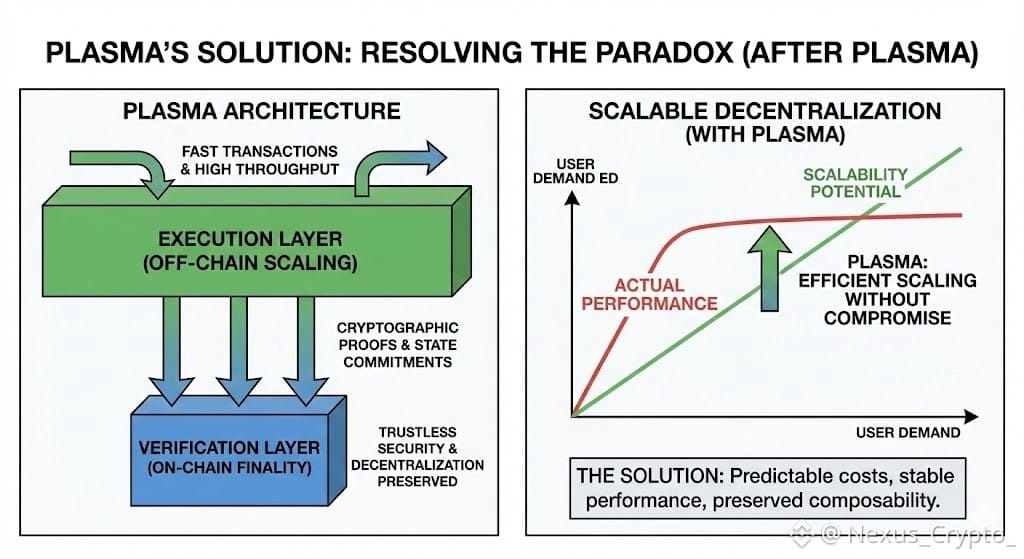
Plasma approaches scalability differently. Rather than forcing all execution onto the base layer or outsourcing trust, Plasma separates execution from verification. This allows applications to scale efficiently while maintaining cryptographic guarantees on-chain.
Execution Without Centralization
In Plasma’s model, transactions are processed in scalable execution environments designed to handle high throughput. Crucially, these executions are not trusted blindly. Final state commitments are verified on-chain, ensuring correctness and accountability. Any participant can independently verify outcomes using cryptographic proofs.
This architecture preserves the security and transparency expected from decentralized systems while dramatically reducing base-layer congestion. Execution becomes efficient, but verification remains trustless.
Ending the Congestion Spiral
Congestion is not just a performance issue; it is a centralization vector. When fees become unpredictable, only well-capitalized actors can participate. Smaller users are excluded, and applications become less accessible. Plasma addresses congestion at its source by minimizing unnecessary base-layer interactions.
By distributing execution load, Plasma enables:
Predictable transaction costs
Stable performance during demand spikes
Reduced competition for block space
Improved user experience across applications
This ensures that applications remain usable precisely when activity is highest.
Preserving Composability at Scale
One of blockchain’s greatest strengths is composability—the ability for independent applications to interact seamlessly. Congestion undermines this property. Failed transactions, delayed confirmations, and fee volatility break atomic execution and fragment liquidity.
Plasma preserves composability by ensuring that applications do not interfere with one another under load. Execution isolation combined with on-chain verification allows complex, interconnected systems to function reliably even during peak demand. Developers can build modular applications without defensively engineering around network limits.
A Developer-First Infrastructure
For developers, scalability uncertainty is one of the most costly constraints. Plasma removes this uncertainty by providing predictable execution behavior. High-frequency applications become viable without architectural compromises. Teams can focus on product design rather than congestion mitigation.
Plasma integrates cleanly with on-chain logic, enabling developers to scale without sacrificing security, transparency, or composability. Entire categories of performance-related failure modes common in monolithic execution environments are eliminated.
Completing the Decentralization Stack
Decentralized money and finance are already here. What has been missing is infrastructure that allows these systems to operate at scale without reverting to centralized shortcuts. Plasma fills this gap by ensuring that decentralization holds under real-world demand.
This is not scalability as an add-on feature. It is scalability as a foundational property. By embedding execution efficiency and trustless verification at the protocol level, Plasma enables decentralized systems to grow without contradiction.
Conclusion
The future of blockchain depends on whether decentralization can survive success. If systems only work when usage is low, the promise of permissionless infrastructure remains incomplete. Plasma resolves the scalability paradox by allowing applications to scale efficiently while preserving trustlessness.
We have built programmable money and decentralized finance.
Plasma ensures they can scale without compromise.