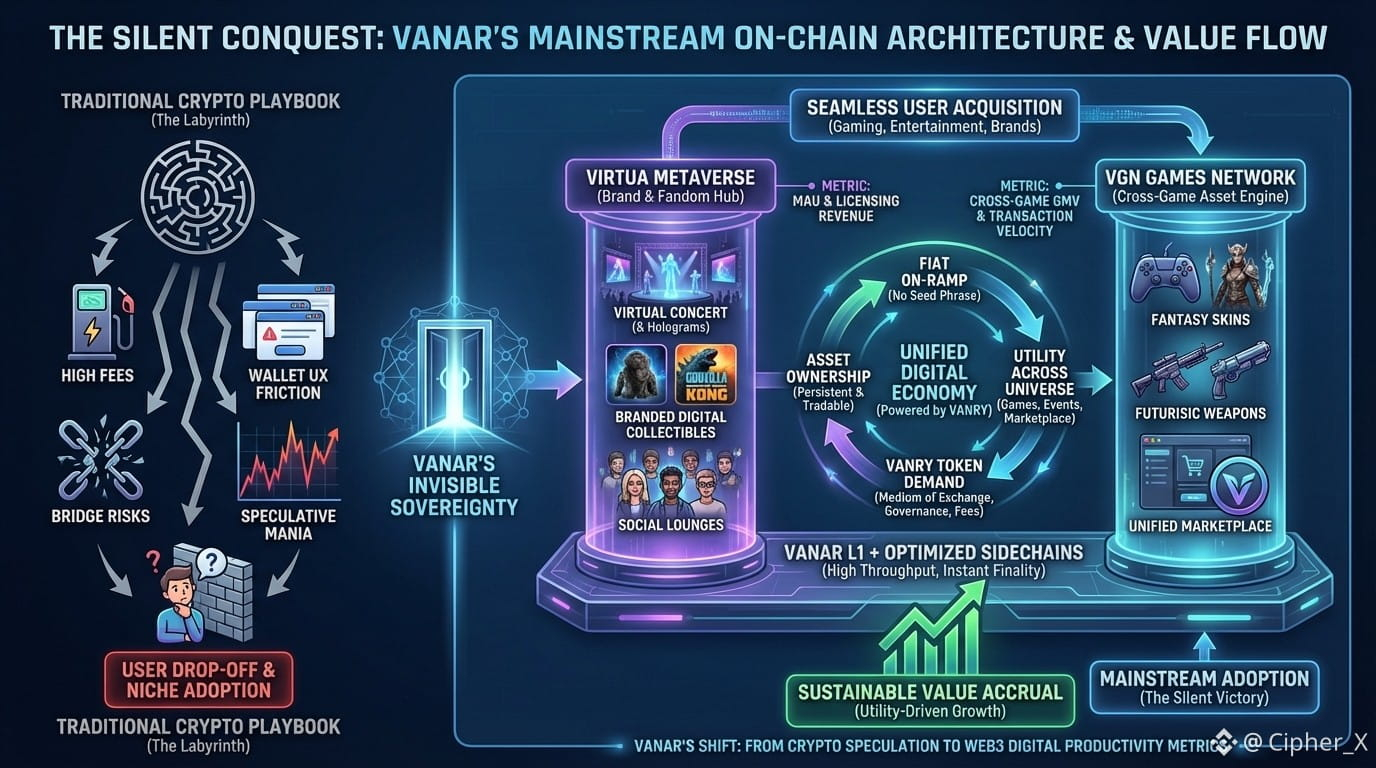
The most significant events in this industry are rarely the loudest. While attention frantically chases the latest memecoin mania or the hot new DeFi primitive promising unsustainable yields, a more profound, more permanent shift is being architected in the background. It’s a shift that doesn't scream "decentralize everything" but quietly asks, "What would make sense for someone who has never heard of a seed phrase?" This is the territory of Vanar, and to dismiss it as just another Layer-1 blockchain is to fundamentally misunderstand the strategic siege it is laying on the entire concept of mainstream adoption. Vanar isn't trying to win over crypto-natives. It is methodically building a parallel digital economy for the next billion users who may never know, or care, that they are on-chain. This is not an incremental improvement; it is a philosophical rebellion against everything that has held Web3 back.
Let’s be brutally honest: the user experience of crypto remains a catastrophic failure for mainstream audiences. Gas fees, wallet pop-ups, chain switches, bridge hacks this is the labyrinth we’ve built and then wondered why nobody wants to come play. The prevailing strategy has been to build slightly better labyrinths. Vanar’s approach is different: remove the walls entirely. The team’s background in gaming, entertainment, and brands isn't a marketing footnote; it's the core of their technical and economic design. They understand that for a game developer with 10 million users, even a 0.1% drop-off from a confusing crypto onboarding process is an unacceptable loss of 10,000 players. Therefore, Vanar’s architecture is built from the first principle of invisible sovereignty the benefits of blockchain (true digital ownership, verifiable scarcity, interoperable assets) must be delivered without forcing the user to confront the machinery.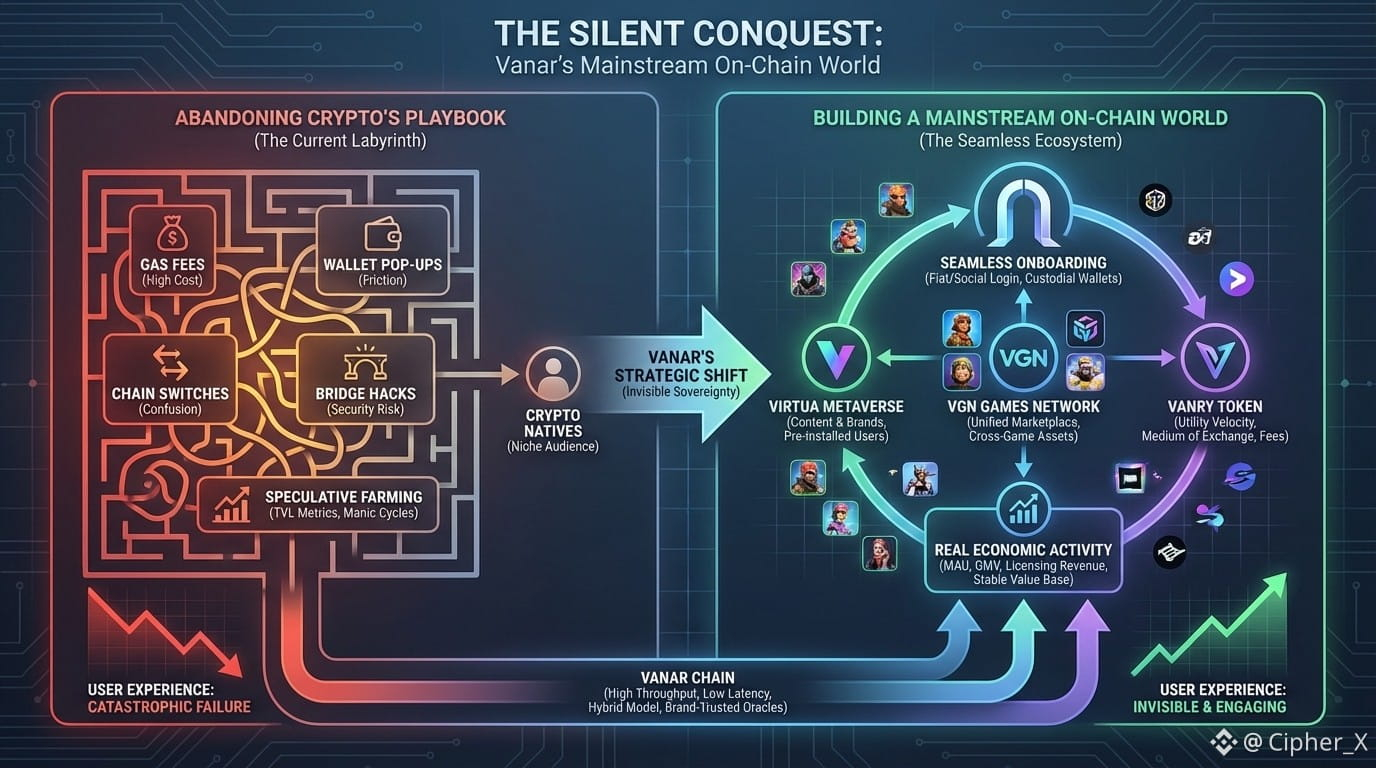
This begins with a technical stack that prioritizes developer sanity over cryptographic purity. While specifics evolve, the ethos is clear: EVM-compatibility for breadth, but with a relentless focus on throughput and finality that meets the demands of real-time gaming and high-frequency brand interactions. Think less about competing with the raw TPS of other L1s, and more about the latency profile. A player selling a skin in a marketplace cannot wait 12 seconds for a block confirmation; the feel must be instant, with settlement happening securely in the background. This likely involves a sophisticated hybrid model perhaps an optimized L1 for core asset settlement coupled with application-specific sidechains or state channels that handle game logic at lightning speed. The goal isn't to win the spec sheet battle on Twitter, but to create an environment where a AAA game studio doesn't have to completely re-architect its netcode to integrate digital ownership.
The real genius, however, isn't just in the chain. It's in the product suite. Virtua Metaverse and the VGN games network aren't just "dapps on Vanar"; they are the primary distribution channels and economic sinks for the entire ecosystem. This is a critical, overlooked mechanic. Most blockchains launch and then beg for developers to come build. Vanar effectively owns the initial demand. Virtua isn't some vague, barren digital space; it's a branded, content-rich metaverse platform with partnerships (like with Legendary Entertainment for Godzilla vs. Kong) that bring immediate, engaged communities. These users aren't coming to "use blockchain." They are coming to collect exclusive digital figures, attend virtual events, and own virtual land. The blockchain is merely the silent ledger that makes these assets persistent, tradable, and composable across the Vanar universe. This is user acquisition at scale, pre-installed.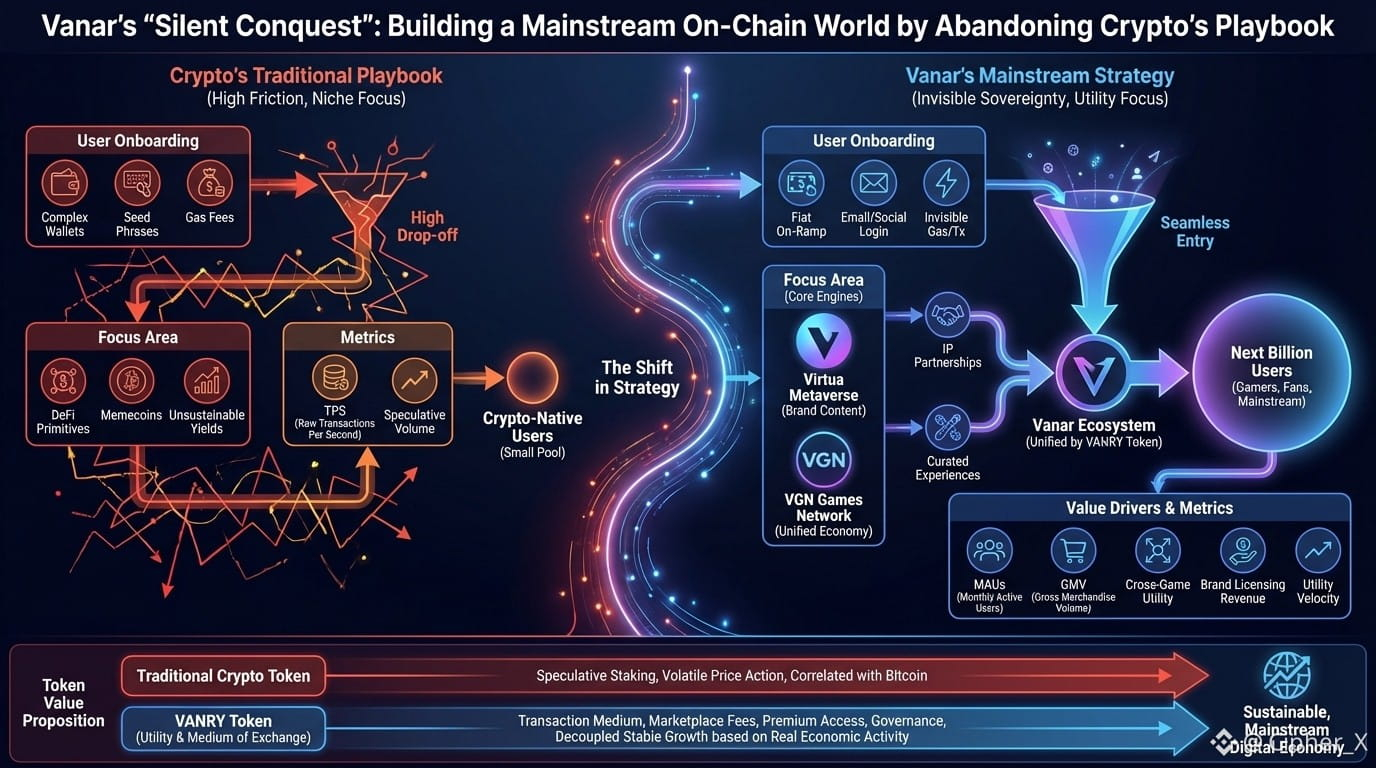
Similarly, VGN is not just a game portal. It is a potential curation and liquidity engine for in-game assets. Imagine a unified marketplace, powered by the VANRY token, where a character skin earned in a fantasy RPG could be listed and discovered by a player of a futuristic shooter, with the underlying blockchain ensuring provable rarity and ownership. This creates a network effect that is vertical, not horizontal. The value accrual isn't from one game to another similar game, but across genres and experiences, all unified by the VANRY token as the medium of exchange and governance. This turns the typical "play-to-earn" model on its head. It’s not about earning a token to cash out; it's about earning or buying an asset that holds and potentially increases its utility across an expanding universe of entertainment. The tokenomics of VANRY, therefore, must be designed not for speculative staking yields, but for utility velocity its use in transactions, marketplace fees, and premium access across Vanar’s product suite.
This brings us to the most contentious and analytically profound point: Vanar’s success may be inversely correlated with the average crypto trader’s perception of it. If they execute perfectly, the VANRY token’s price action might look "boring" by DeFi deg standards. Its volatility could be lower, its correlations with Bitcoin might weaken, and its value drivers will be utterly alien. They won't be based on Total Value Locked in lending protocols, but on metrics like: monthly active users across Virtua and VGN games, the gross merchandise volume (GMV) of the cross-game asset marketplace, the fiat-on-ramp volume from non-crypto-native users, and the licensing revenue from brands minting digital collectibles on the chain. These are Web2 metrics, and that’s the point. The chain’s security and prosperity become a function of real economic activity, not cyclical speculative farming.
Consider the oracle problem from Vanar’s perspective. For a pure DeFi chain, oracles are needed for asset prices. For Vanar, the oracle needs are far more diverse and complex. A game might need verifiable, on-chain randomness for loot boxes (a huge legal and trust requirement). A metaverse platform might need to bring in real-world event data or verify off-chain achievements. The design of Vanar’s data feeds likely needs to be more flexible and trusted than a decentralized network of anonymous nodes pulling from CoinGecko. They may lean towards a hybrid, reputation-based model with known brand partners acting as data providers a heresy in pure decentralization circles, but a practical necessity for enterprise adoption where liability matters.
The long-term risk here isn't technical; it's cultural and economic. By building a walled garden of first-party products (Virtua, VGN), is Vanar risking centralization? Absolutely. But this is the essential trade-off they are making. They are betting that for mass adoption, a curated, high-quality, and seamless experience is worth more than permissionless access. The open, permissionless frontier of their chain will exist for third-party developers, but the flagship experiences that drive the network effect will be managed. This will be anathema to crypto purists, but it’s a language that Fortune 500 brands and major game publishers understand instinctively. They aren't signing deals with "the decentralized collective"; they are signing deals with the Vanar legal entity, with SLAs, compliance assurances, and a point of contact.
So, what does market relevance look like for Vanar today? It’s not found on the charts of perpetual swaps. It’s found in the deal flow. Watch for announcements not about technical upgrades, but about new game studios integrating VGN, or major entertainment brands launching digital collectible campaigns on Virtua. Each of these is a direct pipeline of tens of thousands, potentially millions, of users who will be onboarded with a fiat credit card and a simple username/password (custodial wallets, of course, handled seamlessly by Vanar). Their first interaction with a digital asset they truly own will be frictionless. They may not even call it an NFT; it will just be their "Virtual Godzilla" or their "Legendary Sword."
The capital flows into VANRY, then, will follow a different rhythm. Instead of front-running a mainnet launch or a token unlock, savvy capital will be tracking user growth and partnership announcements, trying to model the future fee generation of the network. It will be a fundamentally different analysis, more akin to evaluating a growth tech stock than a crypto asset. This decoupling from the manic-depressive cycles of crypto speculation could be its greatest strength, providing a stable base of value from which to build.
In the end, Vanar represents a quiet but monumental bet: that the future of blockchain is not as a replacement for the internet, but as an enabling, invisible layer for the next generation of digital entertainment and brand engagement. It is a bet that the killer app isn't decentralized finance, but digital fandom. It is building for a user whose identity is "gamer" or "fan," not "degen." This path is fraught with challenges balancing curation with openness, maintaining performance at scale, and navigating the regulatory minefield of global entertainment. But if it succeeds, the impact will be profound. It won’t feel like a revolution to the user. It will just feel… seamless. And in that seamless, engaging, fun experience, the ideology of true digital ownership will have silently won, not through a manifesto, but through a better game, a cooler collectible, and a metaverse that people actually want to visit. That is a conquest that happens not with a bang, but with the quiet, persistent hum of millions of users logging in to play, completely unaware of the silent chain beneath their feet.