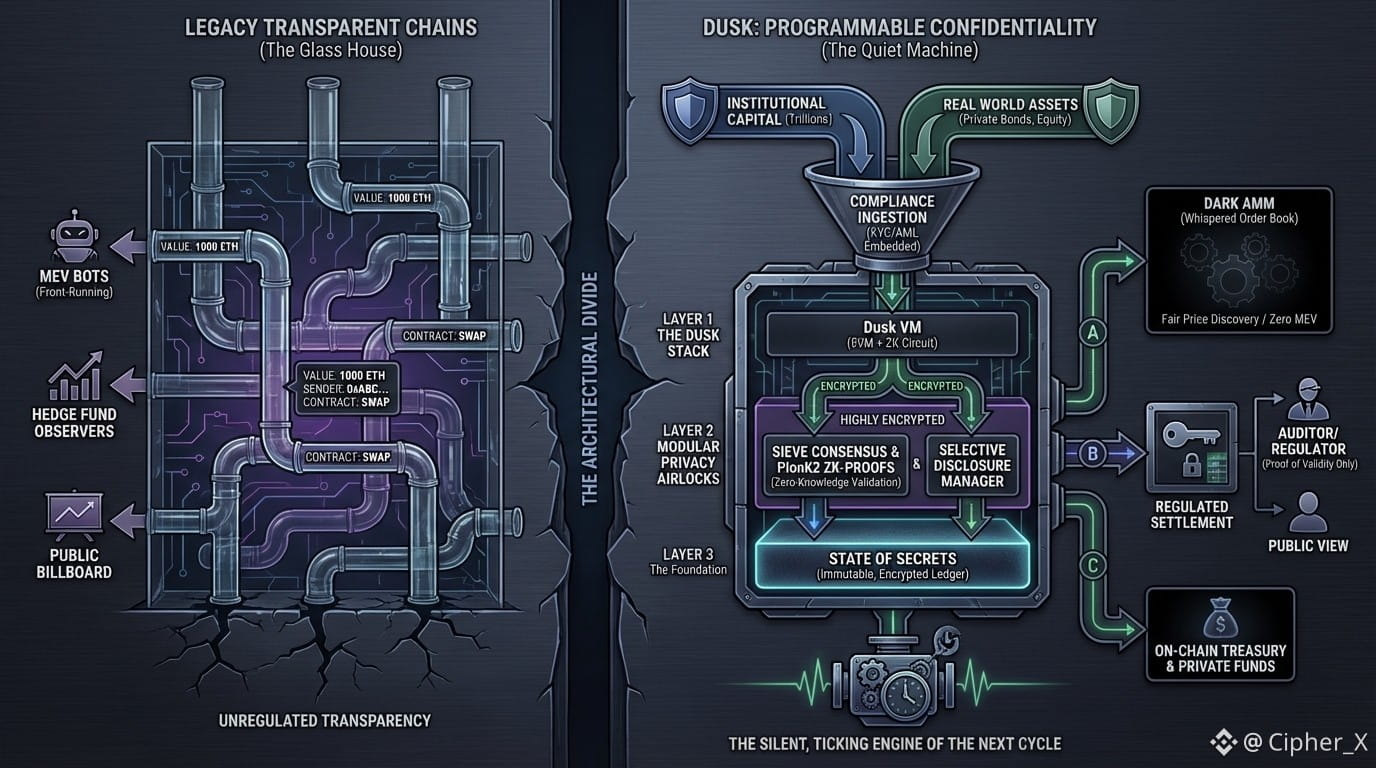
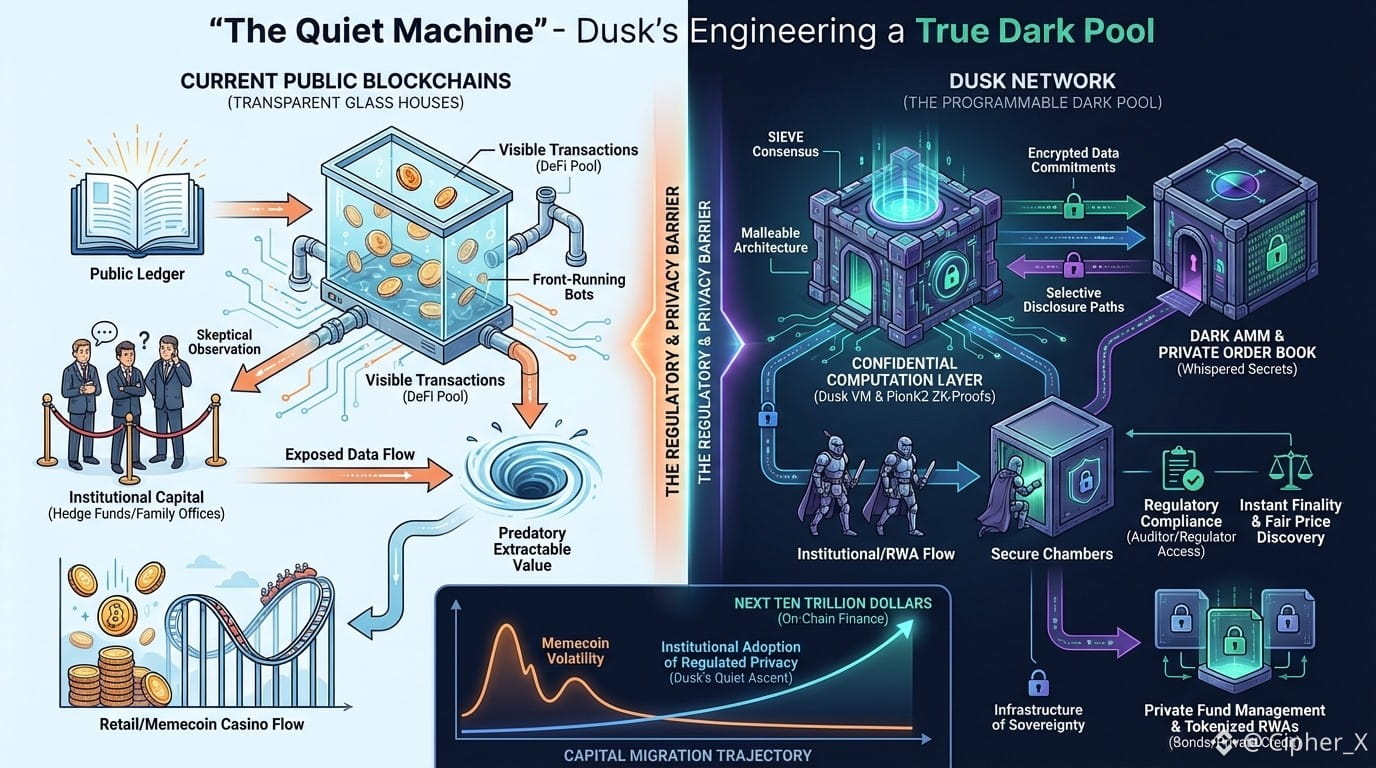
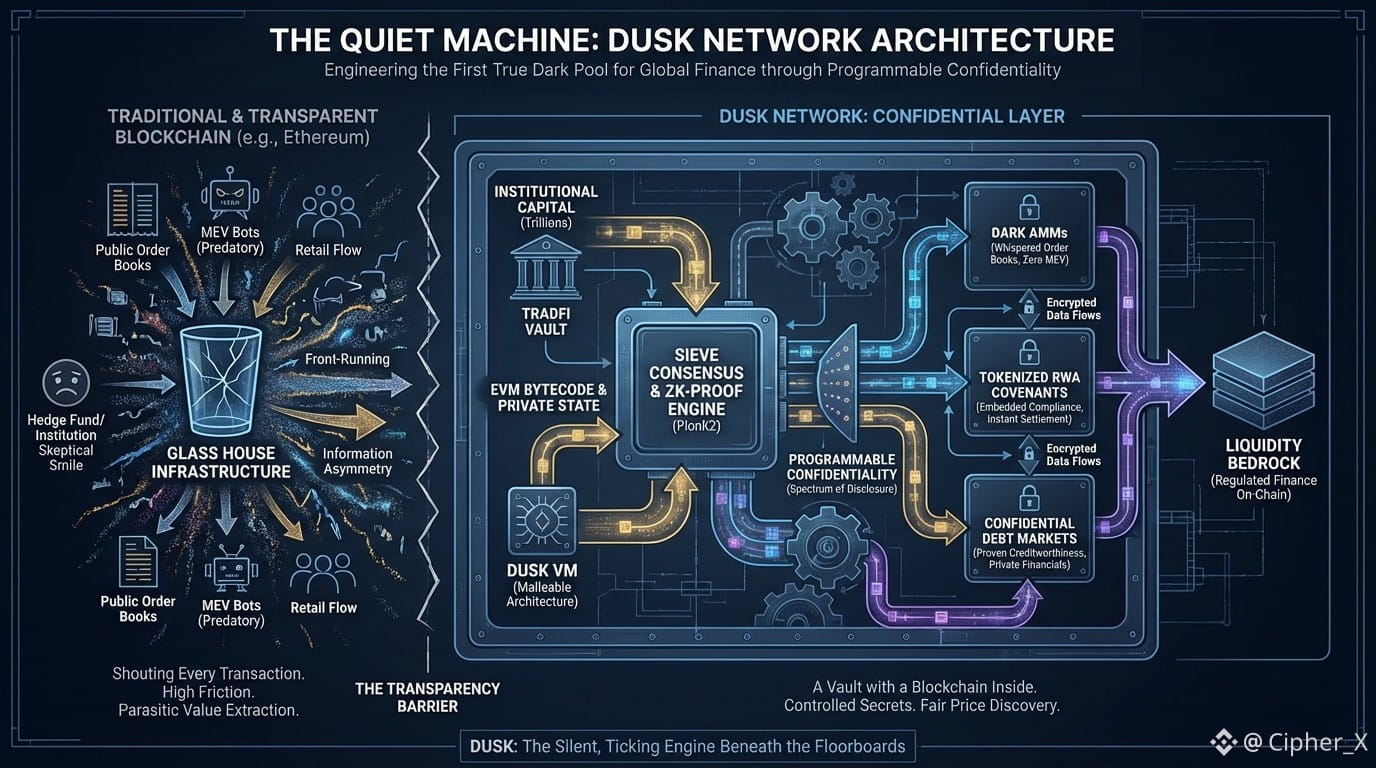
Let’s start with a heresy. The single most significant barrier to the next ten trillion dollars entering crypto isn’t regulation, volatility, or even the ghosts of FTX. It’s a failure of architectural imagination. We’ve been building glass houses in a world that trades in secrets. We shout every transaction, every position, every smart contract interaction onto an immutable, transparent ledger, and then wonder why the institutions who built fortunes on information asymmetry the hedge funds, the family offices, the asset managers watch from the sidelines with polite, skeptical smiles. They don’t need a faster horse; they need a vault with a blockchain inside. This is the vacuum into which Dusk doesn’t just step, but materializes. Founded in 2018, Dusk isn’t merely another “institutional L1.” It is a philosophical and technical wager that the future of finance on-chain isn’t about exposing everything, but about controlling who sees what, when, and under what sovereign authority. I’ve watched this space cycle through narratives like disposable costumes, but my conviction grows that Dusk’s approach to regulated privacy is the silent, ticking engine beneath the floorboards of the next cycle.
The Anatomy of a Controlled Secret
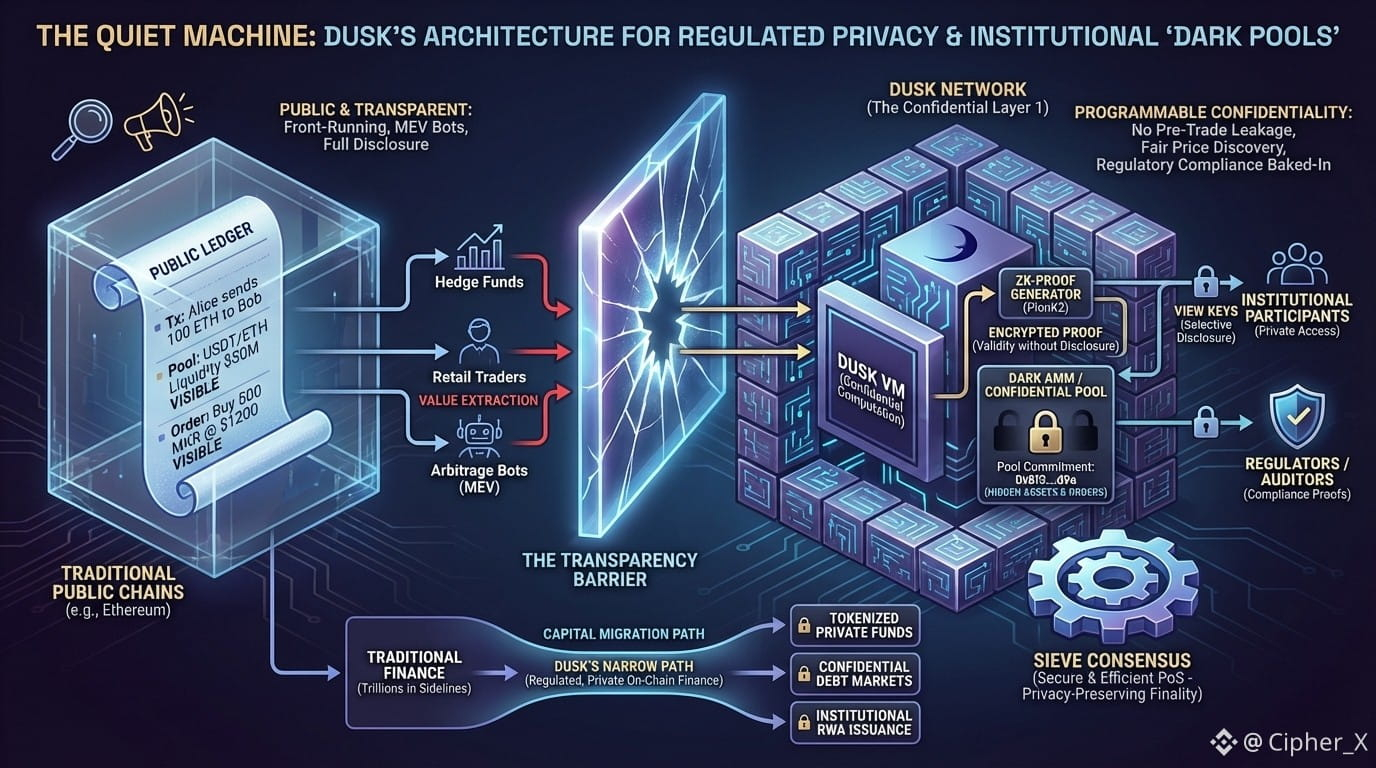
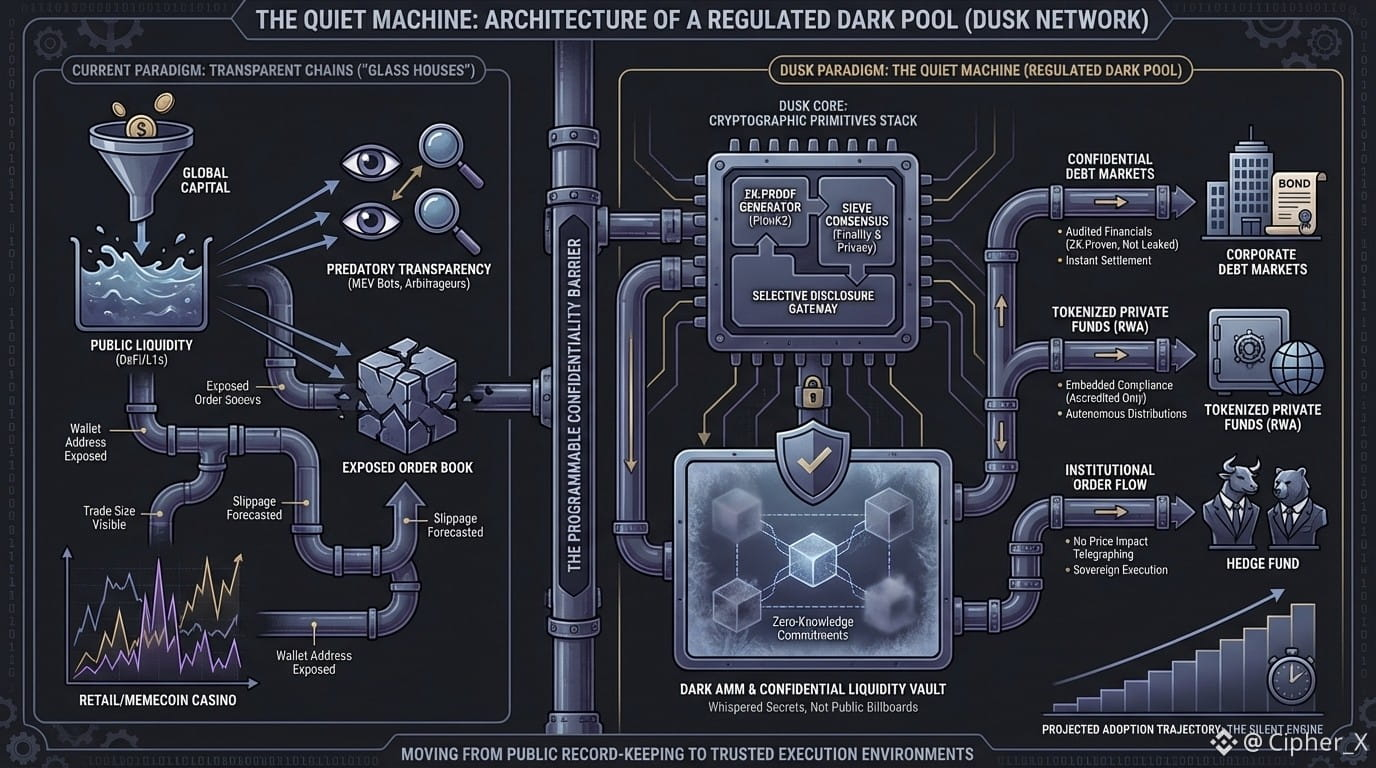
To understand Dusk, you must first dismantle a common misconception: that privacy in blockchain is a monolith, a binary switch between transparent and anonymous. This is a child’s understanding. The real world, especially the regulated financial world, operates on a spectrum of disclosure. A bond trade between two banks is private to the market but disclosed to their auditors and regulators. A securities settlement is private until it’s not, requiring proof of validity to a clearinghouse. Dusk’s specialty, what I call “programmable confidentiality,” is built for this granular reality. Its core isn’t a single feature, but a stack of cryptographic primitives most notably the PlonK2 zero-knowledge proof system and the concept of selective disclosure woven into its very consensus mechanism, SIEVE (Secure and Efficient Proof-of-Stake).
Here’s what that means in the blood and bone of on-chain logic. On Ethereum, a DeFi liquidity pool’s reserves are an open book; front-running is a sport. On Dusk, a liquidity pool can exist as a cryptographic commitment. You can prove you have contributed liquidity without revealing the amount, or you can prove a trade is solvent without revealing the price impact before execution. The state of the chain is validated by nodes using zero-knowledge proofs, ensuring everything is correct, but not everything is visible. This allows for what I’ve started to term “dark AMMs” automated market makers where the order book is a whispered secret among participants, not a public billboard for arbitrage bots. The economic behavior this unlocks is profound. It means institutional-sized orders can move without telegraphing intent, eliminating the parasitic extractable value that has become a tax on all transparent-chain DeFi. It’s not about hiding illicit activity; it’s about restoring fair price discovery in a world of predatory transparency.
The Infrastructure of Sovereignty: More than Modular, It’s Malleable
Dusk’s literature speaks of a “modular architecture,” a term that’s become painfully diluted. In their case, it’s not a buzzword but a surgical description. Think of it not as Lego blocks, but as a series of airlocks and secure chambers. Their Virtual Machine, the Dusk VM, isn’t EVM-compatible by accident; it’s a deliberate choice for reach, but it treats EVM bytecode as one input into a much more complex confidential computation. The true innovation is in how their data availability layer and consensus are designed for secrets.
In a typical L1, data availability means “is the data there for everyone?” On Dusk, it means “is the encrypted data there, and can the authorized parties decrypt it under the agreed-upon conditions?” This shifts the fundamental premise of an L1 from a public record-keeper to a trusted execution environment with blockchain finality. When they talk about tokenizing real-world assets (RWAs), they’re not talking about slapping a QR code on a bond and putting it on-chain. They’re talking about embedding the legal covenants, the investor eligibility checks (Are you accredited? Are you on a sanctions list?), and the dividend payment schedules into the asset’s very code all executed confidentially. The asset becomes a self-contained, compliant financial instrument, not just a tokenized picture of one.
From my analysis of their testnet activity and developer chatter, the most compelling applications brewing aren’t the obvious ones. It’s not “private Uniswap.” It’s things like confidential debt markets for corporations, where a company can tokenize a private bond offering, prove its creditworthiness via zk-proofs of audited financials (without leaking the financials), and distribute it to a pre-vetted pool of buyers. The settlement is instant, the ownership is immutable, and the regulatory reporting is baked in and automated. This isn’t DeFi aping TradFi. This is building a parallel, natively digital capital market with better mechanics.
The Capital Flow Conundrum and Dusk’s Narrow Path
Now, let’s get mercenary. Where is the money? The current market is schizophrenic. On one side, capital is piling into the memecoin casino, a pure game of greater fool theory. On the other, there’s a slow, deliberate, and enormous migration toward what’s being called “on-chain Treasury bonds” and RWAs. Look at the growth of US Treasury tokenization on chains like Ethereum and Stellar it’s in the billions and climbing fast. This is dry, institutional money testing the waters. But it’s doing so on chains that are fundamentally ill-suited for the next step. Once you move beyond simple tokenization of a T-bill (which is just a digital IOU) to more complex instruments like private credit, asset-backed securities, or even confidential trading of public equities, transparency becomes a deal-breaker.
Dusk is positioning itself in the narrow, deep channel between these two flows. It’s not chasing the retail degens; its gas fees and architectural complexity are a natural barrier. It’s courting the builders who serve that second, quieter, and vastly richer pool of capital. My prediction, based on the trajectory of developer grants and enterprise partnerships they’re hinting at, is that Dusk’s first killer app will be something profoundly unsexy to the average crypto Twitter user: a platform for issuing and managing tokenized private funds. Imagine a Blackstone-style fund, but where investor subscriptions, NAV calculations, and quarterly distributions are all handled autonomously and confidentially on-chain. The efficiency gain is staggering. The audit trail is perfect. The privacy for the high-net-worth investor is preserved.
The Existential Risk: Not Adoption, but Abstraction
Dusk’s biggest challenge isn’t technical; they’ve already built the machine. The risk is one of abstraction layer capture. Could Ethereum, with its massive liquidity and developer mindshare, simply build a privacy-centric L2 or a sophisticated confidential rollup that obviates the need for a dedicated chain like Dusk? Possibly. But here’s the counter-argument I’m wrestling with: privacy and compliance aren’t features you bolt on. They are foundational properties of a state machine. The consensus mechanism itself must be designed for it. A privacy rollup on a transparent L1 still has to post data somewhere, creating a trust vector. Dusk’s entire chain, from the ground up, is a coherent system for secrecy with accountability. It’s a harder, purer path. In a world where regulatory scrutiny is turning to the L2 stack itself, that purity could be its ultimate defense and its unique selling proposition.
Living Inside the Machine: A Personal Take
Having spent weeks digging through their technical papers and the sparse, but telling, on-chain data from their incentivized testnets, I’ll offer a personal, perhaps contentious, observation. Dusk feels less like a “crypto project” and more like a team of cryptographers and financial engineers who saw a fundamental design flaw in the open-book nature of blockchains and decided to fix it with the rigor of an academic and the pragmatism of a Swiss banker. There’s no hype cycle around them, no cult of personality. The charts, when they eventually come, won’t show explosive, memetic pumps. They’ll show a steady, stair-step climb as each institutional-grade application goes live and attracts its own dedicated, deep pool of capital. The token economics themselves are telling: staking is designed not for yield farmers, but for providing security to these high-value financial settlements.
The future I see Dusk enabling is one where the term “regulated DeFi” stops being an oxymoron. It becomes simply finance. A world where the most significant economic activity on-chain is invisible to you and me, humming away in a layer of confidential computation, settling billion-dollar deals between permissioned parties, and creating a liquidity bedrock so solid and so private that the public, transparent DeFi we know today can actually build on top of it as a consumer-facing layer. Dusk, in this vision, isn’t the front-end. It’s the dark, deep, cold, and utterly essential foundation. The quiet machine that makes the noise above possible. Watch the builders, not the traders. The silence, not the shout. That’s where the real engine is starting to turn.