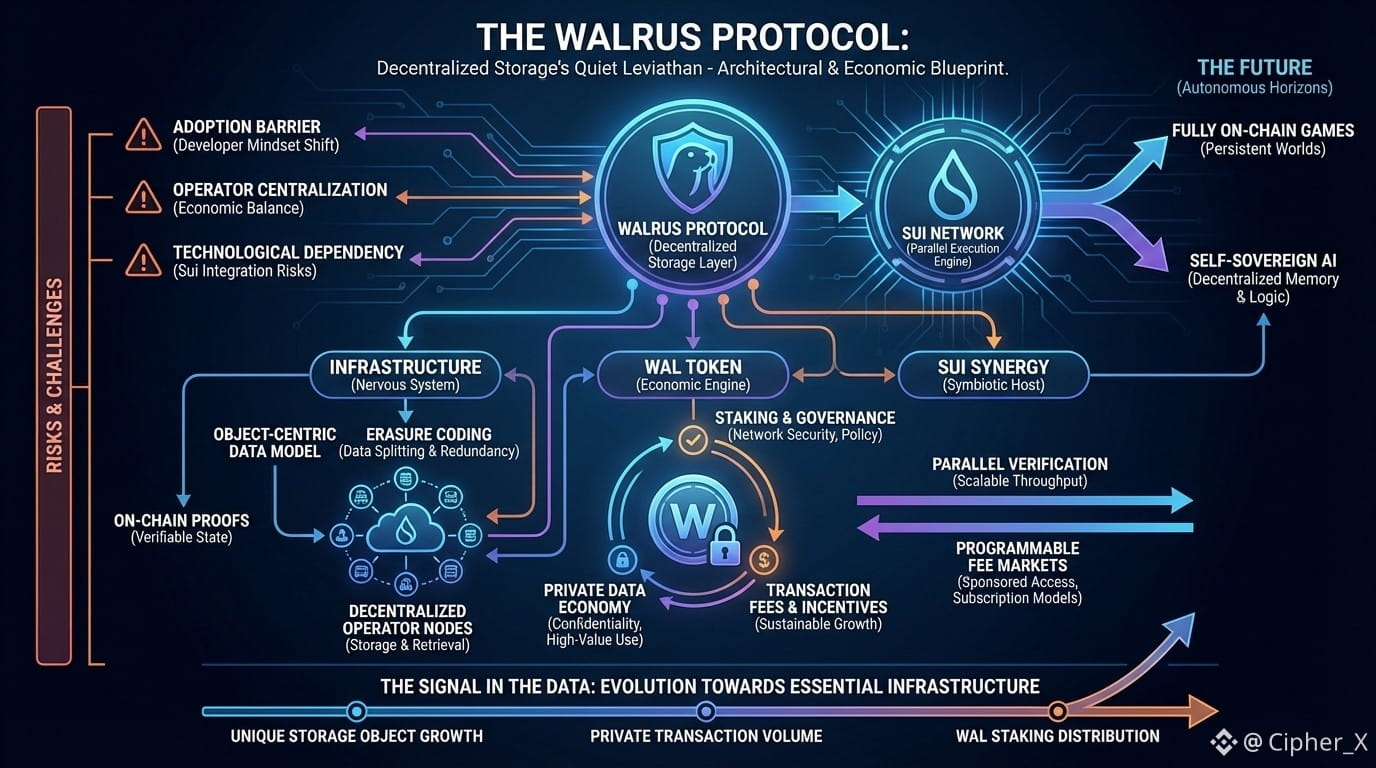
Let’s cut through the noise. The real battle for the soul of the next web isn’t being fought on the speculative frontlines of meme coins or the latest Layer-2 wars. It’s being waged in the silent, cold depths of data storage. This is where blockchains either evolve into sovereign, self-sustaining organisms or remain forever stunted, reliant on the very centralized architectures they were built to overthrow. Into this critical fray swims the Walrus Protocol on Sui, a creature whose technical elegance and economic design suggest it’s not just another decentralized storage solution it’s a quiet leviathan building the foundational bone structure for a truly private, efficient, and autonomous digital future. I’ve watched storage narratives come and go, from the early promises of IPFS to the token-driven surges of various “decentralized AWS” projects. Most fail on a simple, brutal economic reality: storing data on-chain is prohibitively expensive, and incentivizing a robust, permanent network off-chain is fiendishly difficult. Walrus, I believe, is threading a needle many didn’t even see.
The Infrastructure: Not a Hard Drive, But a Nervous System
First, we must discard the mental model of Walrus as a simple “Sui Dropbox.” That’s like calling Ethereum a spreadsheet. Walrus leverages Sui’s object-centric data model—a paradigm shift from the account-based ledger of Ethereum to treat each piece of data, each file, as a first-class, ownable asset. This isn’t a trivial detail; it’s the core of its genius. On traditional smart contract platforms, storing a large file means either paying astronomical gas fees to shove bytes into contract storage or, more commonly, storing a hash on-chain while the actual data lives somewhere else (like IPFS). That “somewhere else” is the perennial weak link: a mutable, unpinned, potentially vanishing link.
Walrus integrates storage into Sui’s state at a fundamental level. It uses erasure coding, a technique familiar from projects like Filecoin and Storj, but its implementation is deeply native. A large file is split into chunks, encoded with redundant pieces, and distributed across a decentralized network of operators. Lose a few nodes? The data reconstructs itself. This provides the durability. But here’s where it gets interesting: the proofs of storage, the cryptographic receipts that verify these chunks are persistently held, are themselves Sui objects. They are live, tradable, composable assets on the ledger. This means the state of your stored data isn’t a side channel report; it’s the central, verifiable reality of the chain itself. The storage layer isn’t a separate protocol bolted on; it’s woven into Sui’s consensus about what exists in the world. For a developer, this changes everything. Your dApp’s logic and its core data can exist in the same state context, enabling complex, data intensive applications from privacy-preserving medical records to immersive decentralized gaming worlds that are simply impossible or ludicrously expensive elsewhere.
WAL: The Economic Engine of a Private Ocean
Now, to the token, WAL. In most storage projects, the token is a simple payment rail and incentive mechanism for stakers and storage providers. Walrus envisions something more profound: WAL as the binding agent of a private, sovereign data economy. The protocol’s focus on private transactions isn’t just a privacy feature; it’s an economic necessity for high-value, enterprise-grade adoption. Imagine a law firm storing privileged discovery documents, or a hedge fund archiving proprietary trading models. They need guarantees beyond encryption; they need the metadata, the access patterns, the very existence of the storage transaction to be obscured. Walrus provides this by leveraging Sui’s capabilities for confidential transfers and objects.
This privacy transforms WAL’s utility. It’s not just a commodity for buying storage space; it’s the key to a private data vault. Staking WAL isn’t merely about earning yield; it’s about acquiring a stake in the security and privacy of the network itself a network that will attract a premium clientele. The governance power that comes with staking WAL will decide critical parameters: privacy standards, slashing conditions for operators who misbehave, and the economic policy for a network that must balance cheap storage with robust incentives. This creates a flywheel: demand for private storage drives demand for WAL, which secures the network, which attracts more high-value users, and so on. It’s a stark contrast to the race to the bottom pricing of public storage, where tokens often become inflationary sinks.
The Sui Synergy: A Symbiotic Relationship
You cannot understand Walrus without understanding its symbiotic host, Sui. Sui’s parallel execution engine is a game-changer for a storage protocol. In a monolithic blockchain like Ethereum, a busy network can make even checking a storage proof prohibitively slow and expensive. On Sui, these verification operations can run in parallel, unblocked by unrelated DeFi trades or NFT mints. This means the Walrus protocol can scale its verification capacity linearly with Sui’s validator set, a critical feature for mainstream adoption.
Furthermore, Sui’s object model allows for exquisite fee market design. A complex dApp that constantly reads and writes to Walrus storage can have its fees sponsored, or structured in novel ways, because the data objects themselves can hold the logic for their own access and payment. This unlocks subscription models, corporate billing, and other real-world mechanics that are clunky at best on other chains. Walrus isn’t just on Sui; it’s of Sui. Its success is a direct function of Sui’s architectural advantages, making it a primary lever for Sui’s own ecosystem growth. As a trader, this is a paired bet: conviction in Walrus is, implicitly, conviction in Sui’s unique technical thesis.
The Future: Beyond Storage, Towards Autonomy
This is where my analysis ventures into the speculative, but it’s speculation grounded in the protocol’s design. Walrus isn’t just for storing static files. Its infrastructure decentralized, persistent, private, and tightly integrated with a high-performance smart contract platform is the bedrock for something larger: autonomous worlds and self-sovereign AI.
Consider a fully on-chain game, an MMO where every player’s item, every patch of land, every character’s history is a persistent object. The storage requirements are monstrous. Walrus provides the only viable model for this on Sui. More intriguingly, think about AI agents. The future will be populated by autonomous AI that acts on-chain making trades, negotiating contracts, creating content. These agents need a place to store their memory, their learned experiences, their operational data, that is as decentralized and secure as their transaction ledger. A centralized AWS S3 bucket for an AI’s memory is a single point of failure and control. Walrus offers a home for an AI’s soul. This isn’t science fiction; it’s the logical endpoint of composable, object-oriented blockchain architecture. WAL, in this light, becomes the currency that fuels the persistence of the autonomous digital economy.
The Risks: The Devil in the Deep
No analysis is complete without a cold look at the abyss. Walrus faces formidable challenges. First, adoption risk. The decentralized storage market is already crowded. Network effects are powerful; developers build where the users are, and users go where the applications are. Walrus must attract a critical mass of builders who are willing to architect applications fundamentally differently to leverage its unique strengths. This is a harder sell than simply offering cheaper storage.
Second, operator centralization risk. The economics must perfectly balance to prevent a small number of large, professional storage providers from dominating the network, recreating the centralized cloud structure it seeks to replace. The Sui team’s other projects have shown thoughtful tokenomics, but this is a perpetual tug-of-war.
Third, and most critical, technological dependency risk. Walrus’s brilliance is its deep integration with Sui. This is also its greatest vulnerability. Any critical bug, scalability hiccup, or loss of developer momentum on Sui directly imperils Walrus. It is a magnificent flagship for Sui’s navy, but it sails only if the fleet thrives.
The Signal in the Data
As I write this, the on-chain data for nascent projects like Walrus is still sparse a frontier. The metrics to watch won’t be simple TVL or token price. Look for the growth of unique storage objects, the volume of private storage transactions, and the distribution of WAL staking. Is it concentrating or spreading? Watch the developer activity on Sui related to large-data dApps. The first major, successful application that uses Walrus not as an afterthought but as its core database will be the canary in the coal mine, signaling a paradigm shift. That’s the inflection point where the narrative moves from “promising protocol” to “essential infrastructure.”
The Final Dive
In the end, the Walrus Protocol represents a mature, almost philosophical approach to blockchain’s problems. It’s not chasing hype; it’s doing the hard, unglamorous work of building a spine. In a market drunk on the short-term sugar of speculation, Walrus is a bet on protein on the long-term structural needs of a mature digital society. Its combination of deep technical integration with Sui, a thoughtful privacy-first economic model for WAL, and a vision that extends far beyond simple file storage marks it as a project of uncommon depth and ambition.
Will it succeed? That depends on Sui’s broader ascent and Walrus’s own ability to execute and attract the pioneers who will build the impossible upon it. But one thing is clear: in the cold, dark depths where the future of data is being decided, the Walrus is not just swimming. It’s architecting the very ocean. And for those of us looking for investments with generational potential, that’s the kind of creature worth following into the deep.