
There is a strange loneliness hidden inside modern finance. It lives in spreadsheets filled with names that never sleep, in transactions that remember everything forever, in systems that demand transparency but forget compassion. Somewhere between efficiency and exposure, we lost something human. And it is precisely in that emotional fracture that Dusk Network was born.
In 2018, Dusk did not arrive with fireworks. It arrived with a question that felt almost uncomfortable to ask out loud: what if financial systems could see less, yet understand more? What if privacy was not a loophole, not a threat, not a hiding place—but a form of care?
Because finance is not abstract. It is rent paid on time. It is a business loan that keeps a family employed. It is an inheritance wrapped in grief. It is trust, and trust bruises easily.
Blockchains promised truth. They promised openness, immutability, radical honesty. And for a while, that felt like justice. But as the years passed, the cracks appeared. Total transparency began to look like total exposure. Every move traceable. Every balance visible. Every participant reduced to an address that never forgets. For individuals, this became risk. For institutions bound by law, it became impossible.
Dusk emerged not as a rejection of blockchain ideals, but as a reconciliation. A refusal to accept that we must choose between accountability and privacy, between regulation and dignity. It was built for a world where banks exist, where laws matter, where compliance is not optional—and where people still deserve protection.
The heart of Dusk is not speed or hype. It is restraint.
Its architecture is designed to whisper instead of shout. Transactions can be validated without being exposed. Rules can be enforced without being revealed in full. Through cryptographic proofs, the network can say “this is compliant” without explaining everything about everyone. This is selective disclosure—not secrecy, but consent encoded into math.
That distinction matters more than it sounds. In real finance, confidentiality is not about hiding wrongdoing. It is about preventing harm. Front-running. Data leaks. Competitive sabotage. Personal exposure. Dusk understands this not as a technical edge, but as a moral boundary.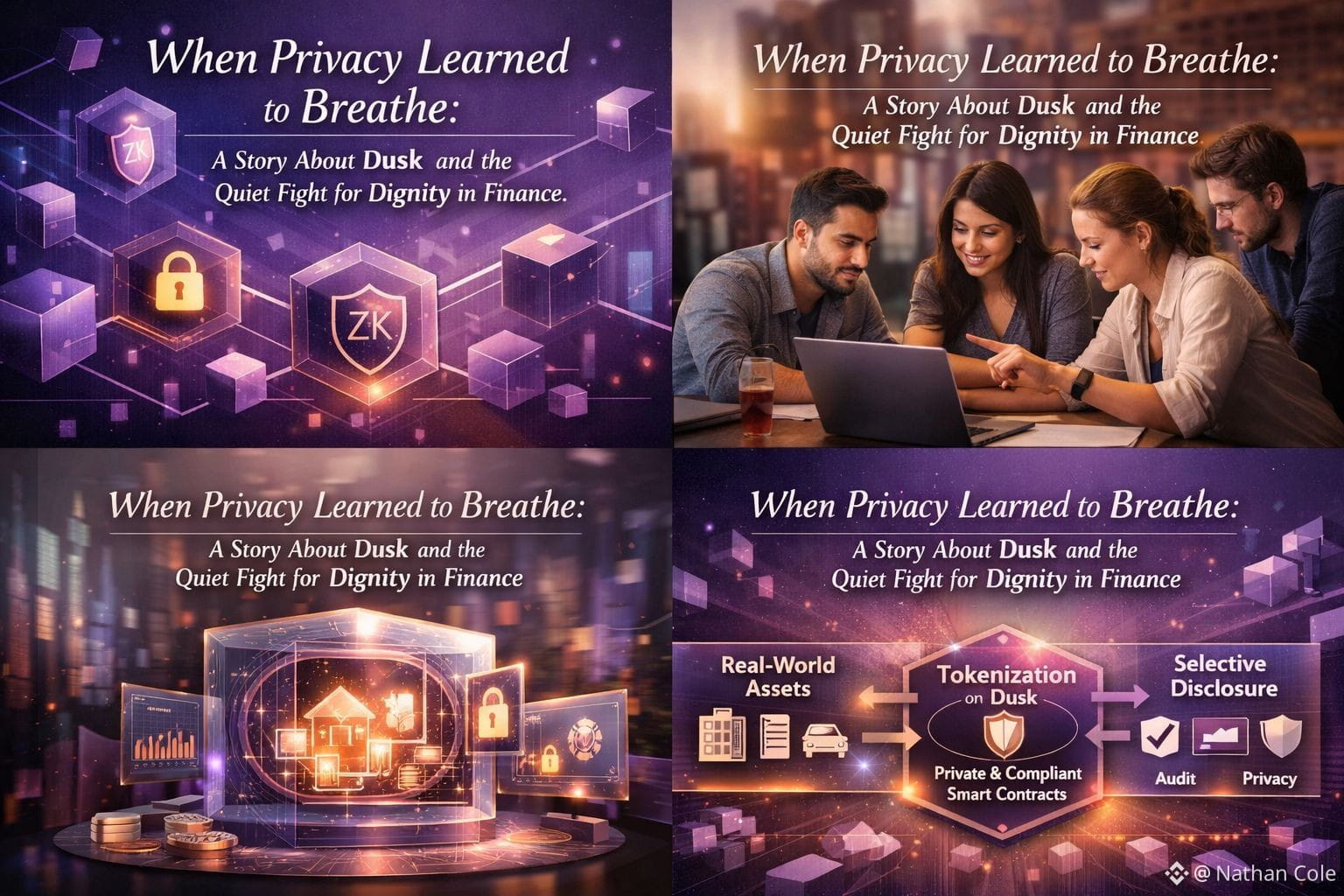
Under the surface, zero-knowledge proofs work tirelessly—proofs that carry truth without carrying baggage. Proof-of-Stake consensus keeps the system grounded, sustainable, aligned with long-term responsibility rather than short-term chaos. Smart contracts are not treated like public diaries, but like sealed agreements—executing faithfully, revealing only what must be revealed.
Even the DUSK token follows this philosophy. It is not designed to scream value; it is designed to support it. To secure the network. To reward participation. To quietly hold the system together while it grows into itself. Its evolution from temporary representations to a native existence reflects patience, not urgency. Continuity over spectacle.
What truly sets Dusk apart, though, is its willingness to face reality instead of running from it. This is a blockchain that speaks to regulators without flinching. That understands European financial frameworks. That imagines a future where cryptographic proof can sit comfortably on a regulator’s desk, not as a threat, but as evidence.
Nowhere is this more emotionally charged than in tokenized real-world assets. Homes. Bonds. Funds. Ownership. These are not numbers—they are people’s lives. Tokenization promises efficiency and access, but it also risks turning private financial moments into public records. Dusk’s vision is gentler: assets can move on-chain without stripping away their humanity. Ownership can be proven without exposure. Compliance can be demonstrated without surveillance.
This is not fast work. It is slow, deliberate, often frustrating. It means conversations with lawyers who don’t trust code yet. Regulators who don’t trust promises. Institutions that have been burned before. It means rewriting whitepapers, adjusting architectures, admitting tradeoffs. It means choosing credibility over applause.
Behind every protocol decision are people wrestling with responsibility. Developers asking whether a feature protects users or merely impresses peers. Cryptographers debating proof efficiency because milliseconds matter when systems scale. Builders who know that if privacy fails once, trust may never return.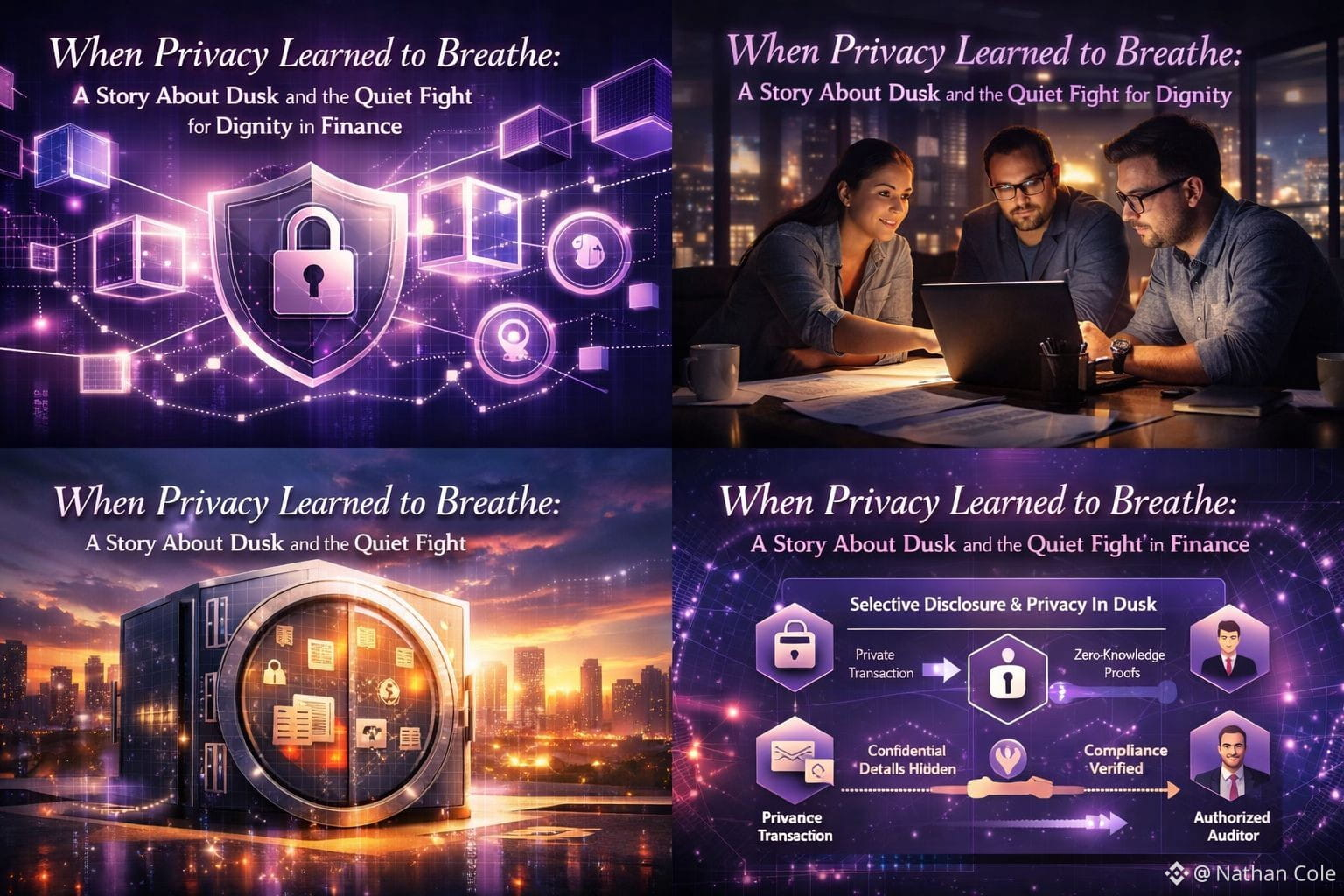
Skepticism surrounds privacy-focused systems—and it should. Power deserves scrutiny. Dusk does not escape this pressure; it absorbs it. Its transparency about its design choices, limitations, and evolution signals something rare in this space: humility.
What makes Dusk emotionally resonant is not perfection, but intention. It is a project that treats privacy not as a weapon, but as a shield. Not as rebellion, but as respect. It understands that financial systems are not just machines—they are environments people must live inside.
If Dusk succeeds, it will not be because it dominated headlines. It will be because someone somewhere was able to participate in finance without fear. Without being overexposed. Without feeling watched. It will be because institutions finally had infrastructure that let them obey the law without betraying their clients. It will be because privacy stopped being a luxury and became a baseline.
In a world obsessed with visibility, Dusk is learning how to look away at the right moments. And sometimes, that is the most human thing technology can do.
