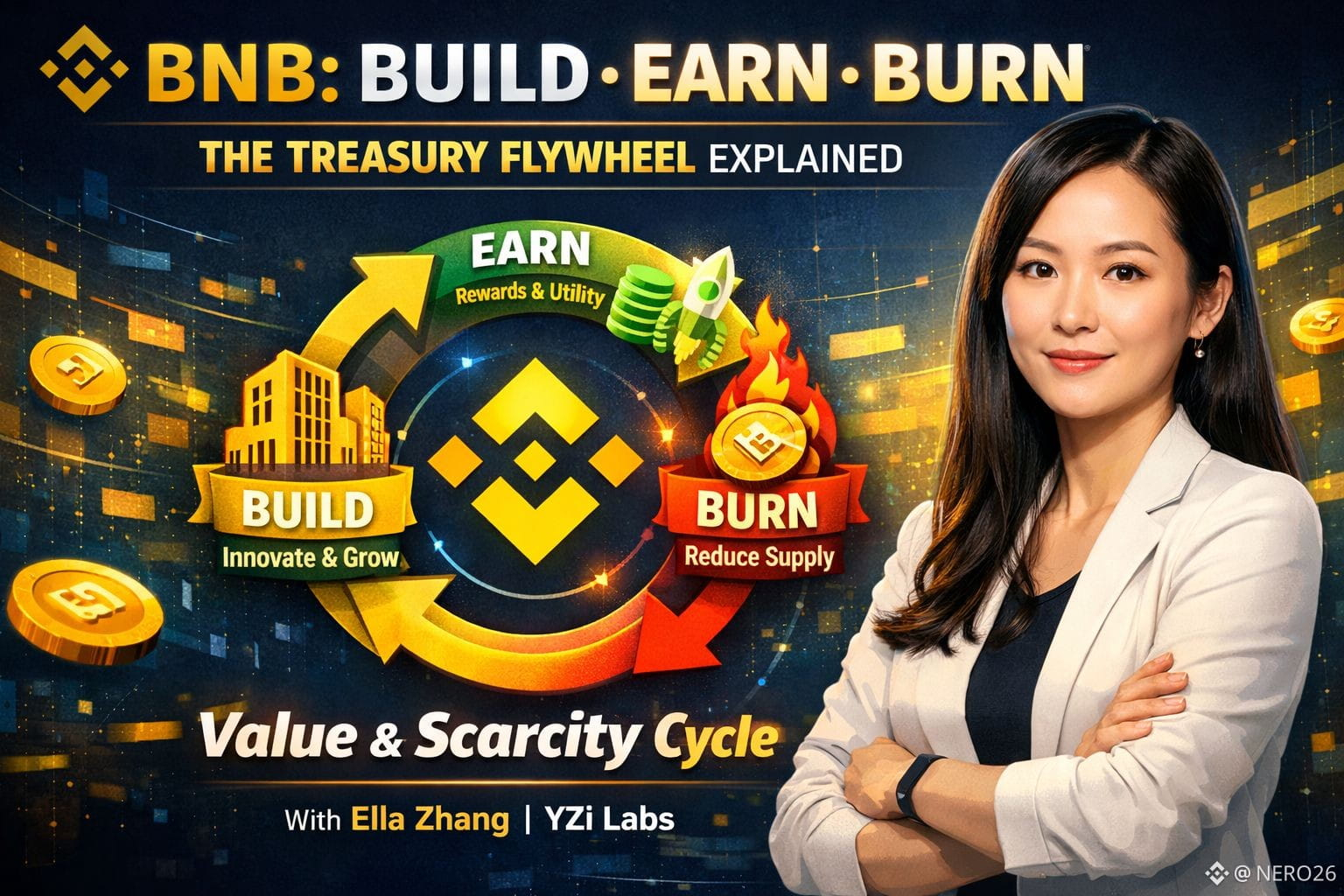
At its core, the BNB Treasury Flywheel describes a self-reinforcing value loop where Build → Earn → Burn dynamics both grow usage and support long-term scarcity/value creation for BNB:
🟡 1. Build — More Ecosystem Usage
The flywheel starts with builders and users:
Projects, developers, and apps build on BNB Chain.
As the ecosystem grows (DeFi, AI, trading interfaces, RWA tokenization, wallets), more real economic activity happens on-chain — meaning transactions, fees, stake, governance participation, etc.
This build phase is supported by ecosystem incentives like the $1B Builder Fund from YZI Labs that backs long-term projects across sectors such as DeFi, AI, real-world assets, and more — reinforcing innovation on BNB Chain infrastructure. �
BNB Chain
🟡 2. Earn — Rewards & Economic Demand
When there’s more activity:
BNB utility increases as users pay gas, stake, participate in Launchpool/Launchpad rewards, and interact with services.
Holders earn benefits (discounts, rewards through programs, yield-like incentives, ecosystem participation), which strengthens demand and keeps tokens circulating within the ecosystem rather than being sold off.
This phase is what makes BNB more than a speculative token: it becomes an economic instrument within its own network — directly tied to usage and incentives. �
YZi Labs
🟡 3. Burn — Deflation and Scarcity
The final flywheel component is token burning:
BNB has dual burn mechanisms — an Auto-Burn tied to on-chain activity and price, and BEP-95 real-time burns (burning a portion of gas fees).
Over time, these burns reduce circulating supply, increasing scarcity and potentially supporting price appreciation, especially when demand stays strong.
This burn element loops back into demand: as supply shrinks while real usage increases, BNB becomes structurally more valuable within the flywheel model. �
ChainCatcher
🔁 How the Flywheel Reinforces Long-Term Value
When these three elements — Build, Earn, Burn — cycle continuously:
Builders are rewarded for choosing BNB Chain (more dApps, features, users).
Users and holders benefit from real utility and rewards, boosting demand.
Scarcity increases over time via burns, cementing the tokenomics thesis.
Together this creates a “positive feedback loop” — more real use cases drive demand, demand sends more network activity that gets burned, and reduced supply reinforces future demand expectations. �
Binance
⚙️ Why It’s Called a “Treasury” Flywheel
The term Treasury Flywheel emphasizes that BNB isn’t just reactive to short-term speculation:
It incorporates institutional and governance frameworks (e.g., digital asset treasuries, funds holding BNB as an asset class).
It views BNB as a strategic asset, akin to an institutional reserve or treasury allocation, not just a utility token — broadening its investor appeal over time. �
Binance
🧠 Big Picture
So, the Build → Earn → Burn Treasury Flywheel is:
✔️ Ecosystem growth that drives real economic activity
✔️ Token demand (Earn) reinforced through utility and incentives
✔️ Supply pressure (Burn) that increases scarcity and value support
✔️ A self-reinforcing cycle aimed at sustainable long-term value, not pure speculation
It’s less about hype and more about structural tokenomics + ecosystem adoption + institutional framing — a model meant to support BNB’s continued role as a core Web3 token. �
Binance$ALLO #TrumpEndsShutdown #USIranStandoff #KevinWarshNominationBullOrBear #xAICryptoExpertRecruitment #TrumpProCrypto