Most people in crypto spend their time thinking about tokens, prices, and transactions. Very few people stop and ask a more basic question, where does all this stuff actually live?
Images, game files, social posts, user data, application history, none of this fits neatly inside a blockchain. So even when something looks decentralized on the surface, there is often a quiet dependency on normal servers somewhere in the background. If those servers go away, a lot of Web3 suddenly feels very fragile.
This is the space where Walrus (WAL) sits.
Walrus is the token behind the Walrus Protocol, a decentralized storage system built on the Sui blockchain. But it makes more sense to think of Walrus as a long term data system rather than a typical crypto project. It is trying to answer a slow, unglamorous question, how do we keep data alive, accessible, and neutral over time, without trusting a single company to babysit it?
Why this problem matters more than people admit
In Web3, ownership is often more emotional than real. You might own an NFT, but the image could disappear if a server shuts down. You might use a decentralized app, but its frontend or database might be hosted on centralized infrastructure. Even governance discussions often live on platforms that can be turned off overnight.
This creates a weird gap between the story we tell and the systems we actually use.
Walrus exists because data is heavy, messy, and long lived. Blockchains are great at coordination and verification, but terrible at holding large files. Instead of forcing everything onto the chain, Walrus accepts this reality and builds around it.
At a broader level, Walrus is trying to make decentralized applications feel less temporary. Less like experiments that work as long as the team is around, and more like systems that can quietly keep going.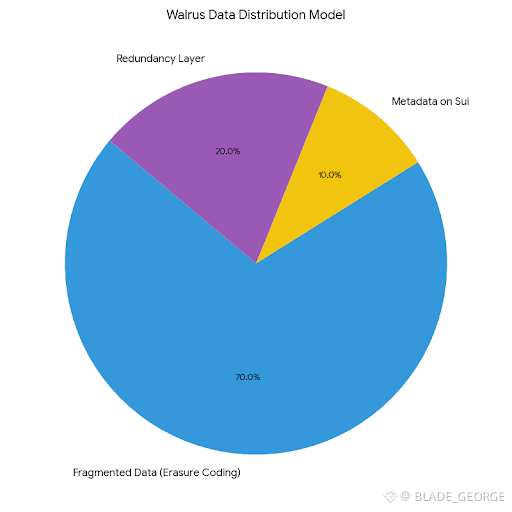
How Walrus works, explained like a human
Walrus splits responsibility into two parts.
The Sui blockchain handles coordination. It keeps track of who is storing what, how long data is supposed to remain available, and how payments and penalties are enforced. Think of it as the rulebook and the referee.
The actual data lives off chain. Files are broken into pieces, encoded, and spread across many independent storage providers. No single node holds the whole file. Even if some providers disappear, the data can still be recovered.
This is where erasure coding comes in. Instead of making endless copies of the same file, Walrus spreads risk. As long as enough fragments remain, the original data can be reconstructed. This makes storage more resilient and more affordable over time.
The system is designed so that users and applications do not need blind trust. There are ways to check that data is still there, without downloading everything or trusting promises.
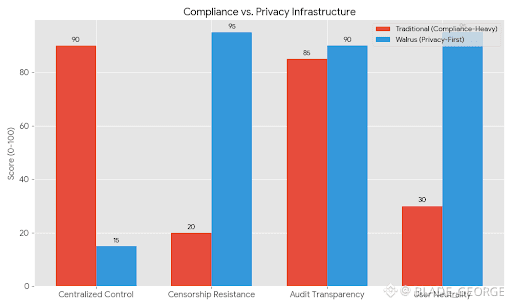
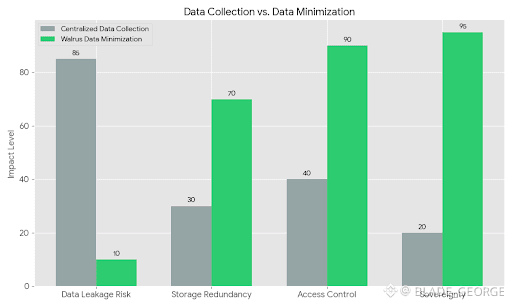
Privacy is not marketed as magic. It comes from structure. Fragmented data is harder to inspect, harder to censor, and harder to control. Developers can then build their own access rules on top of that foundation.
What WAL is actually for
The WAL token exists to keep the system honest.
If you want to store data on Walrus, you pay in WAL. If you provide storage and keep data available, you earn WAL. This sounds simple, but it is important. The token only has meaning if people are actually using the network.
Storage providers may be required to stake WAL. If they fail to do their job, they risk losing it. This shifts behavior from trust based relationships to incentive based ones.
WAL is also used for governance. Changes to how the system works can be decided collectively. This matters because storage is not something you want to change recklessly. Once data is stored, people depend on it.
From a long term point of view, WAL is not protected by hype. If Walrus is not useful, the token has no reason to matter. That makes it less exciting in the short term, but more honest as a system.
The ecosystem, quietly forming
Walrus is not trying to be everything for everyone.
Its most natural users are applications that need data to stick around. NFTs that want their media to survive. Games that do not want all assets on centralized servers. Social apps that want users to truly own their content. AI and research projects that need datasets that cannot be quietly altered or removed.
Storage creates a different kind of network effect. Once data is stored, moving it is painful. If developers trust Walrus early and keep using it, that trust compounds over time.
This is why retention matters more than announcements. A storage network does not need excitement. It needs patience.
Where things seem to be going
The direction for Walrus appears focused on stability rather than speed.
Better reliability. Clearer guarantees around data availability. Tooling that makes developers forget they are even using a decentralized storage system.
Over time, Walrus could connect more deeply with identity, encryption, and permission systems. Storage becomes more meaningful when access is programmable and verifiable.
In a modular blockchain world, Walrus fits naturally as the place where data lives while other layers handle execution and settlement.
The hard parts and real risks
None of this is easy.
Decentralized storage is expensive to maintain if incentives are misaligned. If rewards drop, providers may leave. If costs rise, users may go elsewhere. This balance needs constant care.
Competition is real. Centralized storage is incredibly efficient, and other decentralized networks already exist. Walrus has to justify itself through resilience and neutrality, not raw speed.
There is also ecosystem risk. Walrus benefits from Sui, but it cannot afford to depend entirely on one narrative or one community.
And governance is always tricky. Storage systems need predictability. Too much change scares users. Too little change freezes progress.
A grounded way to think about Walrus
Walrus is not trying to be loud.
It is trying to be the kind of system that works quietly in the background, year after year, while everything else changes. It treats data as something that should outlast teams, trends, and market cycles.
If Web3 is serious about ownership, then data has to be treated with the same care as money. Walrus is one attempt to do that, by focusing on incentives, coordination, and long term survival instead of excitement.
Its real success will not show up in short term charts. It will show up when people stop thinking about where their data is stored, because they trust that it will still be there tomorrow.