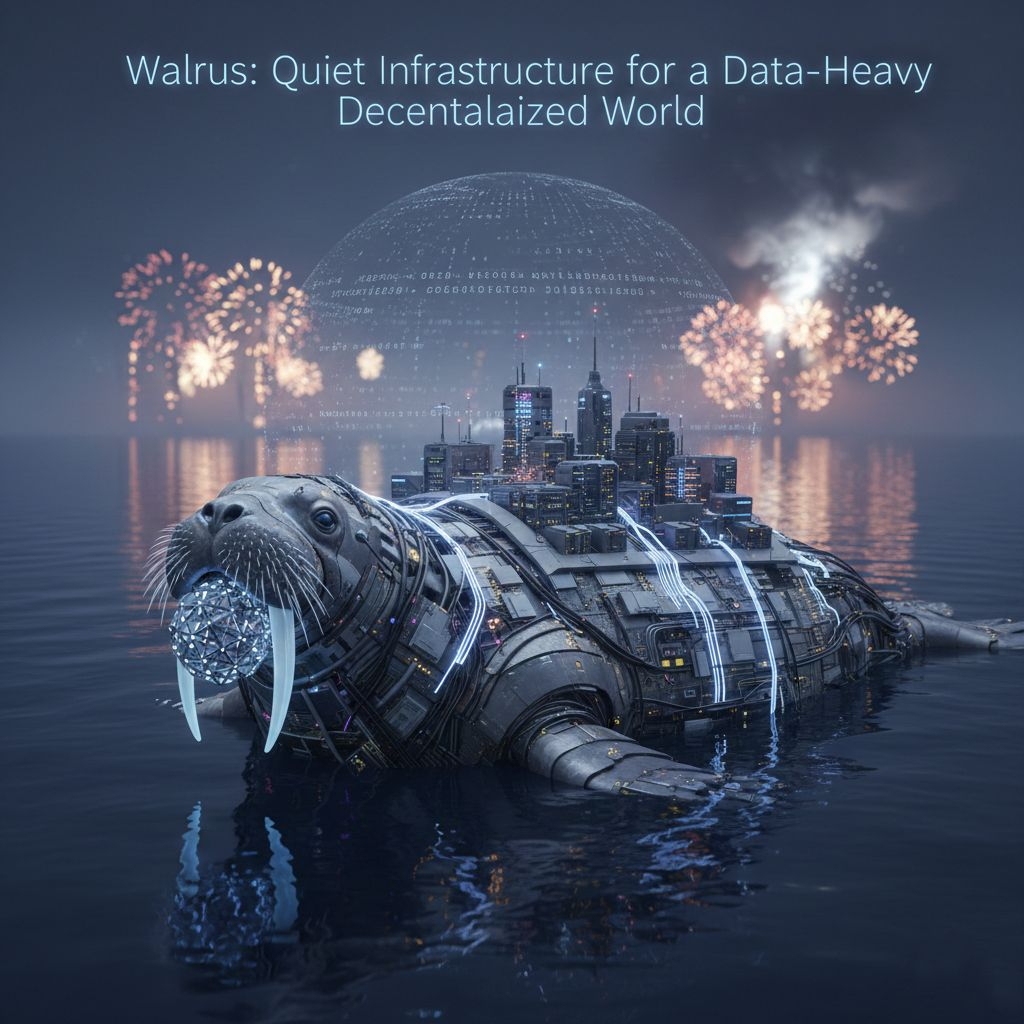
When I first started looking into Walrus, I didn’t come in optimistic. If anything, I was tired. I’ve lost count of how many times I’ve been disappointed by “fully decentralized” apps that stopped working the moment a centralized server had a hiccup. That experience has made me skeptical by default. So when Walrus described itself as storage infrastructure, not a flashy platform, my first reaction wasn’t excitement—it was caution.
That skepticism is exactly why I stayed with it longer.
Personally, what I find interesting about Walrus is that it doesn’t try to be everything at once. While most projects are racing toward speed, visibility, or complexity, Walrus is focused on something far less glamorous: data storage. The boring layer. The part no one likes to talk about, but everyone quietly depends on. And the more time you spend around real applications, the clearer it becomes that this is where things usually fall apart.
We all know blockchains are good at handling small, precise pieces of information. They track ownership well. They settle transactions cleanly. But the moment you introduce real-world data—videos, images, application files—the system starts leaning on centralized services. That’s the uncomfortable truth. So the real question isn’t whether blockchains can store everything on-chain. The real question is whether we can stop pretending they should.
Walrus seems to answer that question honestly.
Instead of forcing data onto the chain, it uses the chain for what it’s actually good at: coordination, verification, and accountability. The heavy data lives elsewhere, distributed across independent storage providers. At first, this might sound like a compromise. But the more I thought about it, the more it felt like a mature decision. Not every limitation needs to be “solved.” Some just need to be respected.
Here’s a simple reality check: can we seriously expect full video files or large datasets to live directly on a blockchain without breaking the system? Of course not. That would be slow, expensive, and fragile. Walrus doesn’t fight this reality. It designs around it.
By breaking data into fragments and spreading those pieces across the network, Walrus reduces the risk that any single failure takes everything down. No node needs to be perfect. No operator needs to be trusted blindly. Even if some parts go offline, the data remains recoverable. That kind of resilience feels less like innovation and more like common sense—something this space could use more of.
At the end of the day, decentralized storage is useless if it’s too expensive.
This is where Walrus’s economic design quietly matters. Storage providers are rewarded for reliability, not hype. Users pay for what they use, not for inflated redundancy. The system assumes people will act in their own interest and builds incentives around that assumption. That may not sound idealistic, but it’s realistic—and realism tends to age better.
Let’s talk about the WAL token. And no, not in the usual dramatic way. What stood out to me is how little drama surrounds it. It isn’t positioned as a symbol or a promise. It has a job. You pay for storage. You stake to support the network. You follow the rules, and the system stays stable. That’s it. After seeing so many tokens stretched thin trying to represent everything at once, this simplicity feels intentional.
Governance follows the same mindset. It doesn’t feel performative. It feels like maintenance. Adjusting parameters. Managing incentives. Keeping the system usable as conditions change. That suggests a team thinking in terms of years, not cycles.
But here’s the thing about infrastructure projects: they don’t feel exciting until something depends on them. Their value shows up quietly, when other systems stop breaking. Walrus seems aware of this. Recent progress around network readiness and integrations points to a project more concerned with reliability under pressure than early applause.
I also appreciate how privacy and control aren’t treated as optional features. By distributing data fragments and anchoring verification through the chain, Walrus reduces the need to trust any single party. For individuals, that means fewer hidden dependencies. For applications and organizations, it means clearer guarantees about data availability.
So, where does this leave us?
Walrus isn’t trying to sell a vision of the future. It’s addressing a present-day problem that most people already understand but rarely confront properly. Data has weight. Data has cost. And decentralized systems won’t mature if they keep outsourcing their weakest layer.
Walrus may never be the loudest project in the room. After spending time with it, I don’t think that’s an accident. It feels built to be relied on, not admired. And in infrastructure, that’s usually the difference between something that lasts and something that fades.