

For years, blockchain has faced a structural contradiction. Public blockchains were built for transparency, yet financial markets operate on confidentiality.
Regulators require oversight, auditability, and enforceable rules, while institutions demand privacy for counterparties, balances, and trading strategies. This tension has kept large financial actors at a distance from decentralized infrastructure.
Dusk was designed specifically to resolve this contradiction without compromising either side.
Most public chains expose transaction flows, wallet balances, and execution logic in full view. This radical transparency works for permissionless DeFi experiments, but it fails when applied to regulated markets. A pension fund cannot reveal its trading positions in real time. A bank cannot expose client balances publicly. At the same time, regulators cannot accept systems where compliance is optional or enforced only off-chain.
The industry has traditionally tried to solve this by moving toward permissioned or semi-private chains, but those systems sacrifice composability, neutrality, and decentralization. Dusk approaches the problem differently by embedding compliance and privacy directly into protocol architecture.
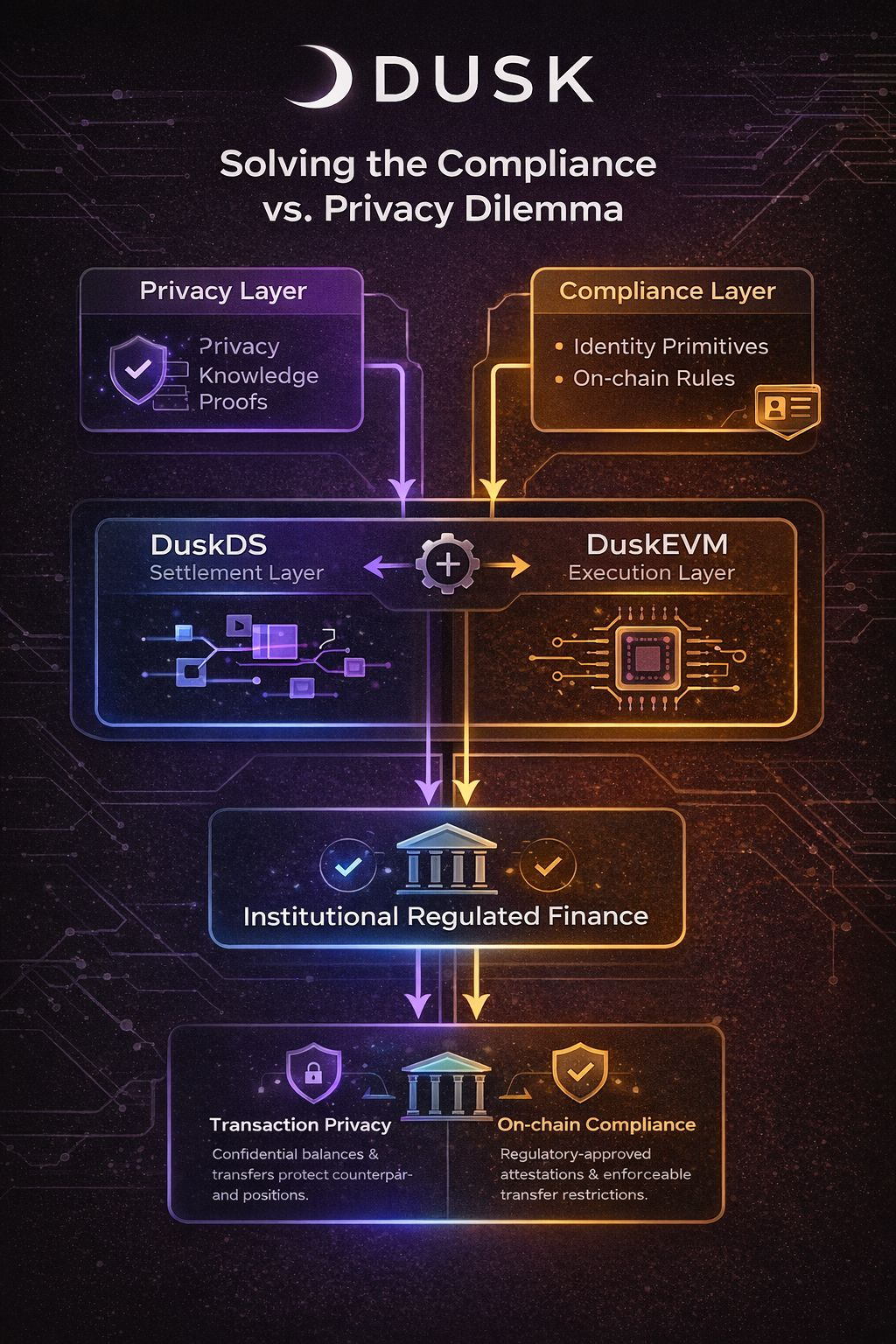
At the core of Dusk’s design is the separation between settlement and execution. DuskDS operates as the settlement and consensus layer, while DuskEVM serves as the execution environment for smart contracts. This modular structure allows privacy guarantees to exist at the foundational level rather than as optional application-layer add-ons.
Confidentiality is achieved using zero-knowledge technology, enabling transactions to be validated without revealing sensitive data. This means balances and transfers can remain confidential while still being cryptographically verified by the network.
However, privacy alone is not enough for regulated finance. What distinguishes Dusk is that compliance logic is not external; it is programmable and enforceable on-chain. Identity primitives and permissioning mechanisms allow smart contracts to embed eligibility rules directly into financial instruments.
For example, a tokenized security can enforce investor restrictions at the protocol level, ensuring that only verified participants can hold or transfer the asset. Instead of relying on centralized intermediaries to check compliance, Dusk integrates these rules into transaction validation itself.
This architectural decision fundamentally changes how regulated assets can exist on-chain. In traditional DeFi, compliance is reactive and external. On Dusk, it becomes proactive and native.
The network is capable of supporting frameworks aligned with regulatory standards such as MiCA or MiFID II because it allows disclosure requirements, transfer restrictions, and reporting logic to be encoded within smart contracts while preserving transactional confidentiality. Institutions do not need to choose between operational privacy and regulatory clarity; both coexist within the same system.
Another important element is finality and deterministic settlement. Financial markets require predictable and legally enforceable settlement guarantees. Dusk’s consensus model is optimized for fast finality, reducing counterparty risk and ensuring that once a transaction is confirmed, it cannot be reversed.
This characteristic is essential for regulated environments where transaction disputes can carry legal and financial consequences. By combining succinct attestation mechanisms with a proof-of-stake model, Dusk achieves a balance between performance and security that is suitable for institutional-grade workflows.
The compliance-versus-privacy dilemma often stems from the assumption that transparency equals trust. In retail crypto markets, visible ledgers provide assurance. In institutional markets, however, trust is derived from enforceable rules, auditability, and regulatory alignment, not from public exposure of every transaction.
Dusk recognizes this distinction. Its design ensures that regulators can obtain necessary attestations and verifiable proofs without forcing institutions to disclose sensitive data to the entire network. This selective transparency model is more aligned with how real-world financial systems operate.
Furthermore, Dusk’s support for native issuance enables compliant financial instruments to be created without relying on external wrappers or bridges. Issuers can define rule sets governing transferability, investor categories, and lifecycle events directly within the protocol environment. This approach reduces operational complexity and legal ambiguity, as compliance is cryptographically enforced rather than administratively supervised.
The result is a blockchain infrastructure specifically tailored for regulated finance rather than retrofitted for it. Many networks attempt to bolt privacy tools onto transparent architectures or add compliance layers through centralized governance.
Dusk was architected from inception around the needs of institutional markets. Its integration of zero-knowledge confidentiality, programmable compliance, modular settlement architecture, and deterministic finality forms a cohesive system rather than a collection of patches.
In practical terms, this means that asset managers, banks, and financial institutions can issue, trade, and settle instruments on-chain while maintaining both regulatory integrity and operational discretion. Investors gain privacy without sacrificing legal protections. Regulators gain oversight capabilities without undermining market confidentiality.
Developers gain access to familiar EVM tooling while building applications that inherit privacy and compliance from the underlying settlement layer.
The broader implication is significant. If blockchain infrastructure is to power the next generation of capital markets, it must reconcile transparency with regulation.
Dusk does not treat this as a marketing narrative but as an architectural requirement. By embedding both privacy and compliance at the protocol level, it creates a viable foundation for institutional adoption.
The compliance versus privacy dilemma has long been considered unsolvable within decentralized systems. Dusk demonstrates that the conflict is not inherent to blockchain technology but to how it has traditionally been implemented.
By redesigning the foundational layers of consensus, execution, and identity, Dusk provides a framework where confidentiality and regulatory assurance reinforce rather than contradict each other. In doing so, it positions itself not merely as another smart contract platform, but as infrastructure purpose-built for regulated financial markets.
