

When I think about Vanar, I don’t approach it as a flashy piece of new technology trying to change everything overnight. I see it more as an attempt to quietly fit blockchain into the kinds of systems people already understand. In the traditional world, infrastructure grows out of necessity. Banks focus on trust and settlement. Entertainment platforms focus on engagement and distribution. None of these systems succeed because they are exciting. They succeed because they work consistently over time.
Vanar seems to be built around that same kind of thinking. Instead of centering everything on technical novelty, the focus appears to be on how blockchain can support real consumer environments like gaming, digital worlds, and brand-driven experiences. That direction makes sense to me. Historically, mass adoption of any technology hasn’t happened because people were curious about the underlying system. It happened because the tools became useful in everyday life.
When I look at projects tied to gaming networks and virtual spaces, I don’t see them as futuristic ideas. I see them as familiar digital environments where people already spend their time. Platforms like Virtua Metaverse and gaming ecosystems connected to the VGN network reflect an understanding that adoption usually grows from existing behavior, not from forcing people into new patterns. If blockchain is going to matter at a large scale, it will likely show up in places where users don’t even think about it.
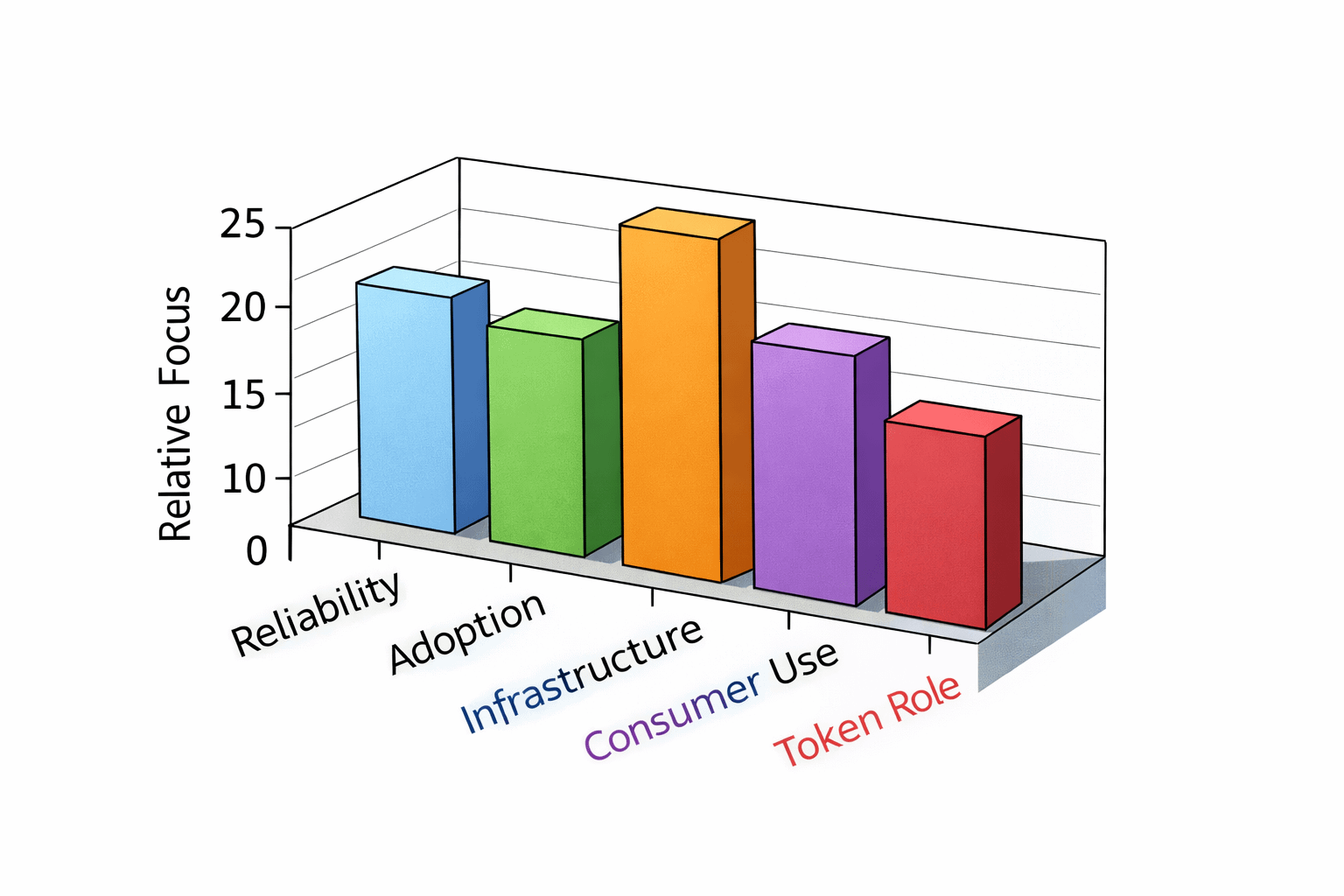
At the same time, building a Layer 1 chain for these types of experiences comes with real trade-offs. Systems that support large numbers of users need to be stable, predictable, and efficient. That means performance, cost, and reliability become more important than technical complexity. In traditional industries, the strongest infrastructure is often the least visible. The parts that keep everything running—settlement processes, record-keeping, and operational structure—don’t get attention, but they hold the entire system together.
The presence of a native token, like VANRY, also reflects a practical design choice rather than just a feature. In blockchain environments, tokens are used to coordinate activity, reward participation, and keep networks functioning. But they also introduce uncertainty. Traditional systems rely on rules, contracts, and institutions to maintain order. Blockchain systems rely more on economic incentives. Whether that works in the long run depends on how balanced and sustainable those incentives are, not just on the technology itself.
What I find most interesting is the decision to focus on areas like entertainment, AI-driven environments, and brand integrations. These are spaces where people already interact digitally in large numbers. Instead of trying to convince users to adopt something entirely new, the idea seems to be to build into what already exists. That feels more grounded to me. Real adoption usually happens quietly, through gradual integration rather than sudden shifts.
Still, there’s a deeper question behind all of this. Can a blockchain built for consumer-scale experiences remain stable as it grows? Can it offer the reliability that traditional platforms have spent decades refining? And will people actually care what technology is underneath, or will the real success come when they stop noticing it altogether? These are the kinds of questions that seem more important than any short-term narrative about growth or expansion.
