

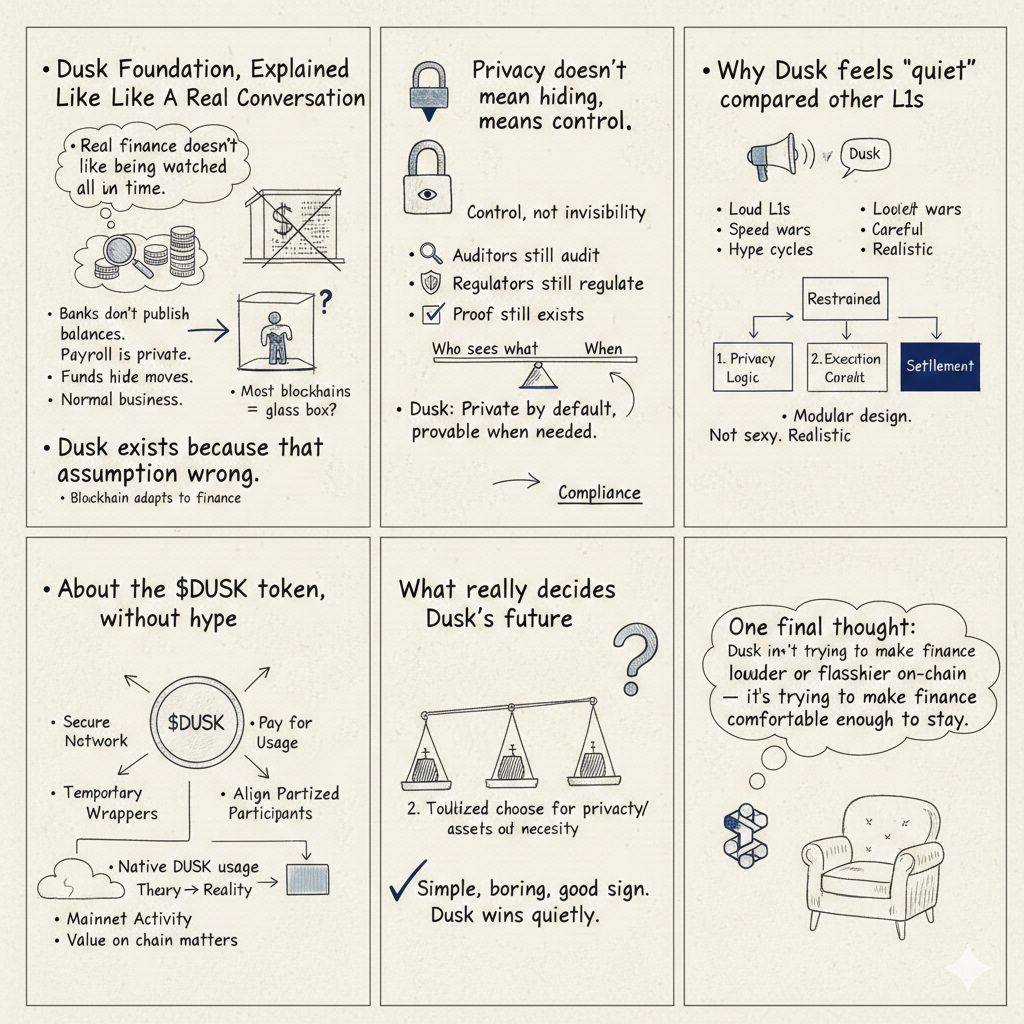
When I think about Dusk, I don’t think about block times, cryptography terms, or flashy charts. I think about an awkward truth most crypto people avoid talking about: real finance does not like being watched all the time.
Banks don’t publish their balances on billboards. Companies don’t expose payroll data in real time. Funds don’t want competitors tracking every move they make. That isn’t corruption, it’s normal business. And yet, most blockchains are built as if everyone should be okay with living inside a glass box.
Dusk exists because that assumption is wrong.
Instead of asking institutions to change how they work, Dusk quietly asks a better question: what if the blockchain adapted to finance, not the other way around?
Privacy doesn’t mean hiding, it means control
A lot of people misunderstand privacy in crypto. They imagine secrecy, shadows, or something sketchy. But in real financial systems, privacy is about control, not invisibility.
Auditors still audit. Regulators still regulate. Proof still exists.
The difference is who gets to see what, and when.
Dusk leans into that reality. It’s built so transactions and assets can remain private by default, but still be provable when needed. That’s how compliance actually works in the real world. You don’t expose everything upfront. You disclose when there is a reason.
This is why Dusk feels less like a rebel chain and more like a chain that actually understands responsibility.
Why Dusk feels “quiet” compared to other L1s
If you’re used to loud Layer 1s promising speed wars and endless hype cycles, Dusk might feel almost… restrained. That’s not an accident.
Regulated systems don’t move fast for the sake of it. They move carefully, because mistakes are expensive. Dusk’s modular design reflects that mindset. Privacy logic, execution, and settlement are treated as separate problems, not mashed together and hoped for the best.
It’s not sexy architecture.
It’s realistic architecture.
And realism is rare in crypto.
About the $DUSK token, without hype
$DUSK isn’t trying to be a meme, a flex, or a personality. It’s there to secure the network, pay for usage, and keep participants aligned with the chain actually functioning.
What matters more than price talk is the shift toward native DUSK usage. Migration away from temporary token wrappers toward mainnet activity is where theory turns into reality. If value doesn’t live on the chain, the chain doesn’t matter.
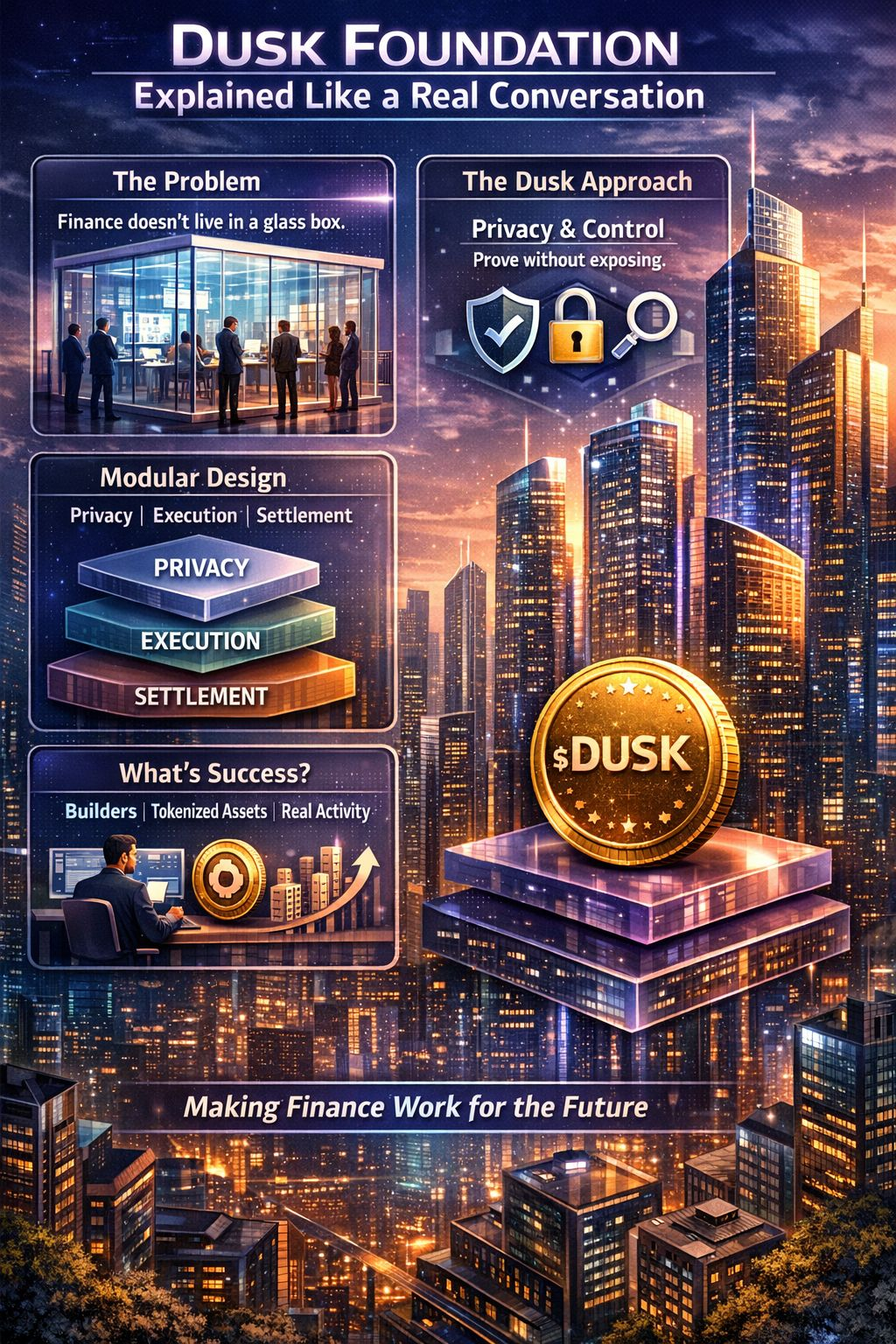
Dusk seems to understand that distinction.
What really decides Dusk’s future
Not marketing. Not slogans. Not timelines.
The real test is simple and boring, which is usually a good sign.
Do builders choose Dusk when privacy and compliance are non-negotiable?
Do tokenized assets actually settle there instead of staying off-chain?
Does activity slowly grow because it has to be there, not because it’s incentivized to show up for a week?
If those things happen, Dusk wins quietly.
One final thought: Dusk isn’t trying to make finance louder or flashier on-chain — it’s trying to make finance comfortable enough to stay.