

Whenever I think about Plasma, I don’t picture charts, TPS numbers, or whitepaper diagrams.
I picture a very ordinary moment: someone trying to send USDT and quietly hoping nothing goes wrong.
No error.
No surprise fee.
No “wait, I need another token first.”
That moment — small, boring, practical — is where Plasma starts.
Most blockchains are built by people who enjoy blockchains. Plasma feels like it was built by people who noticed that normal users don’t. They don’t want to interact with a chain. They want to settle value and move on with their day.
Stablecoins aren’t theory — they’re daily life
In a lot of places, USDT isn’t a trading pair. It’s salary, savings, remittance, and business cash flow. When something goes wrong during a transfer, it’s not an inconvenience — it’s stress.
That’s why the usual crypto assumptions fall apart:
“Just hold some gas”
“Fees change depending on network mood”
“Finality is probabilistic”
Those ideas make sense in crypto circles. They make no sense to someone who just wants certainty.
Plasma treats that certainty as the product.
Gasless USDT feels obvious once you stop defending bad habits
Requiring a volatile token just to move stable money is one of those things crypto normalized without ever justifying. Plasma doesn’t try to justify it. It removes it.
Gasless USDT transfers aren’t a gift. They’re an admission that the old model doesn’t fit how people actually use stablecoins.
When the money is stable, the experience should be too.
Stablecoin-first fees reduce mental load
One of the most exhausting parts of crypto is never knowing what something will cost until after you click confirm.
By centering fees around stablecoins, Plasma makes costs understandable before the transaction happens. That’s a small change with big consequences: users trust systems they can predict.
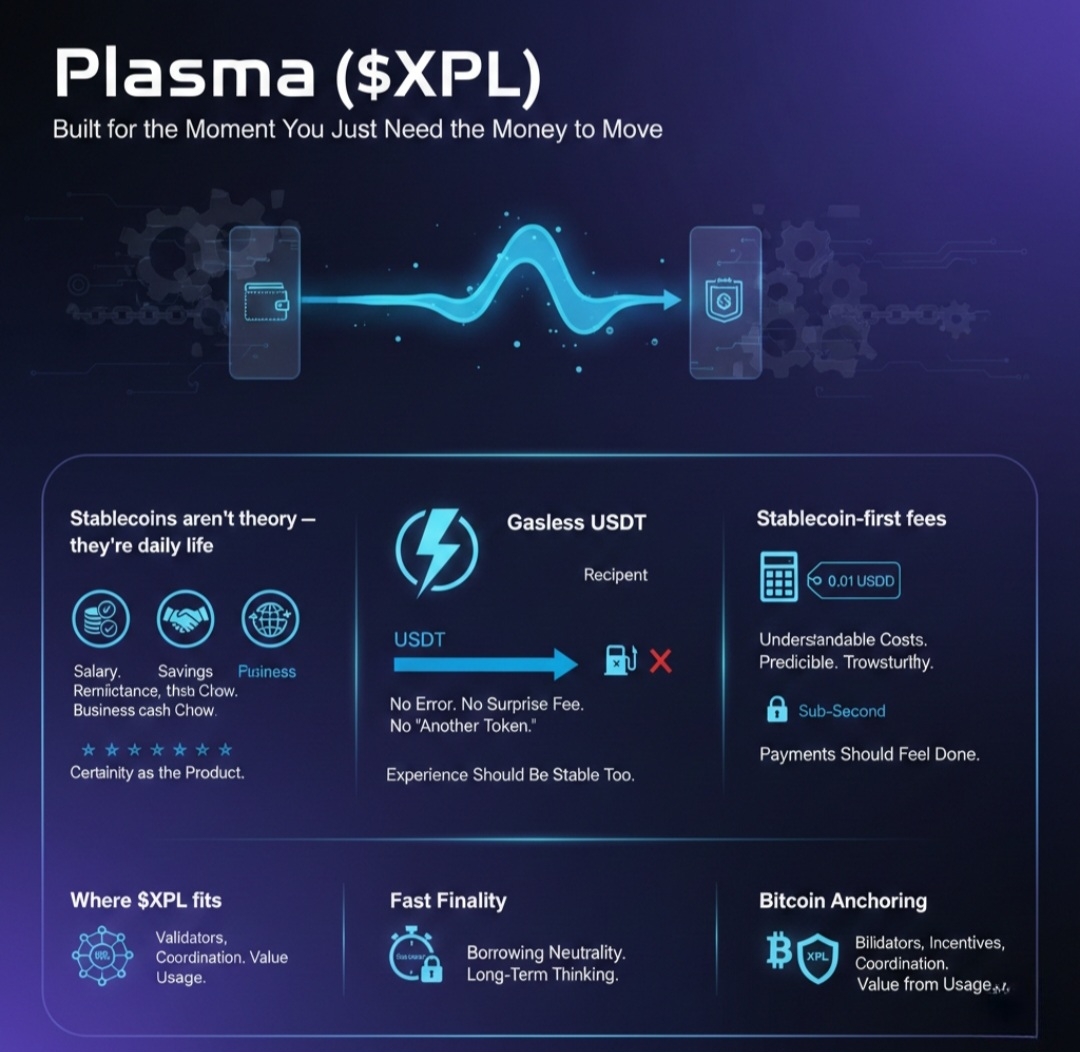
Predictability isn’t exciting — but it’s what real financial tools are made of.
Fast finality matters more than speed claims
Plasma’s consensus design focuses on finality because payments don’t tolerate uncertainty. In real-world money movement, “probably confirmed” is the same as “not confirmed.”
Sub-second finality isn’t about winning benchmarks. It’s about removing that awkward pause where everyone waits to see if the transaction actually went through.
Payments should feel done when they’re done.
Bitcoin anchoring shows restraint
Anchoring security to Bitcoin isn’t about flexing ideology. It’s about borrowing neutrality from a system that already proved it can survive pressure.
If Plasma wants to support serious payment flows — especially across borders — it needs a credibility layer that doesn’t depend on narrative cycles. This choice suggests long-term thinking rather than short-term attention.
Where $XPL fits
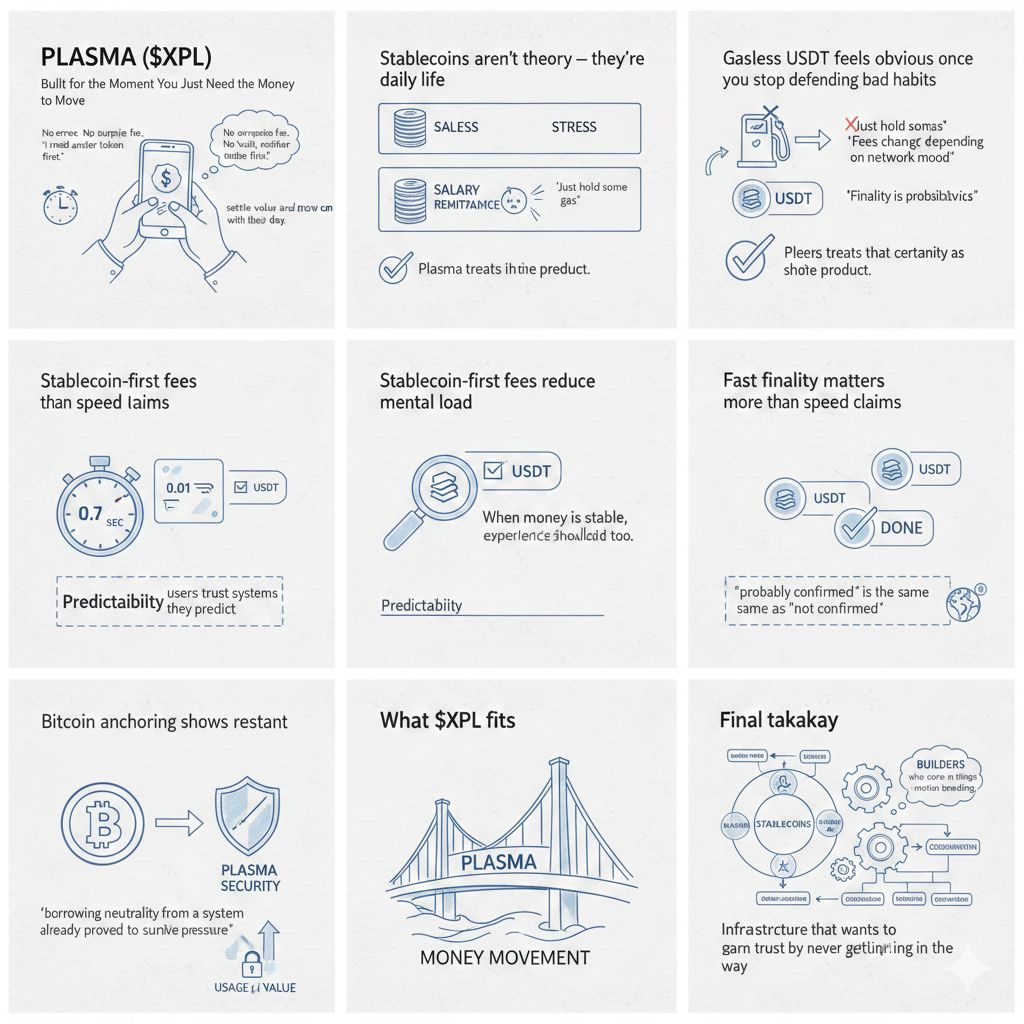
$XPL isn’t trying to replace stablecoins. It exists to hold the system together — validators, incentives, and coordination that let stablecoins move smoothly without exposing users to unnecessary complexity.
If Plasma grows, $XPL’s value comes from usage, not excitement. That’s slower — and usually healthier.
What stands out recently
What’s noticeable isn’t loud announcements. It’s steady clarification: how the chain works, how gas abstraction behaves, how consensus is structured.
That kind of progress doesn’t attract hype. It attracts builders who care about things not breaking.
Final takeaway
Plasma feels less like a blockchain trying to be impressive and more like infrastructure that wants to quietly earn trust by never getting in the way when money needs to move.