
Most blockchains talk about adoption as if it’s a marketing problem. Get more users, more wallets, more transactions, more noise. The underlying assumption is simple: if the technology is good enough, people will eventually bend their behavior to fit it. History, however, is brutally clear on this point—technology that demands behavioral change before delivering value almost always loses. What Vanar seems to understand, quietly and deliberately, is that adoption is not a numbers game. It’s a friction game.
In the early days of blockchain, friction was romanticized. Wallet setup was clunky, private keys were terrifying, fees were unpredictable, and interfaces felt like developer tools rather than consumer products. All of this was framed as the price of decentralization. The problem wasn’t that these systems were hard to use; the problem was that they confused difficulty with virtue. Vanar’s approach signals a philosophical shift away from that mindset. Instead of asking users to “learn crypto,” it asks how crypto can disappear into experiences people already understand.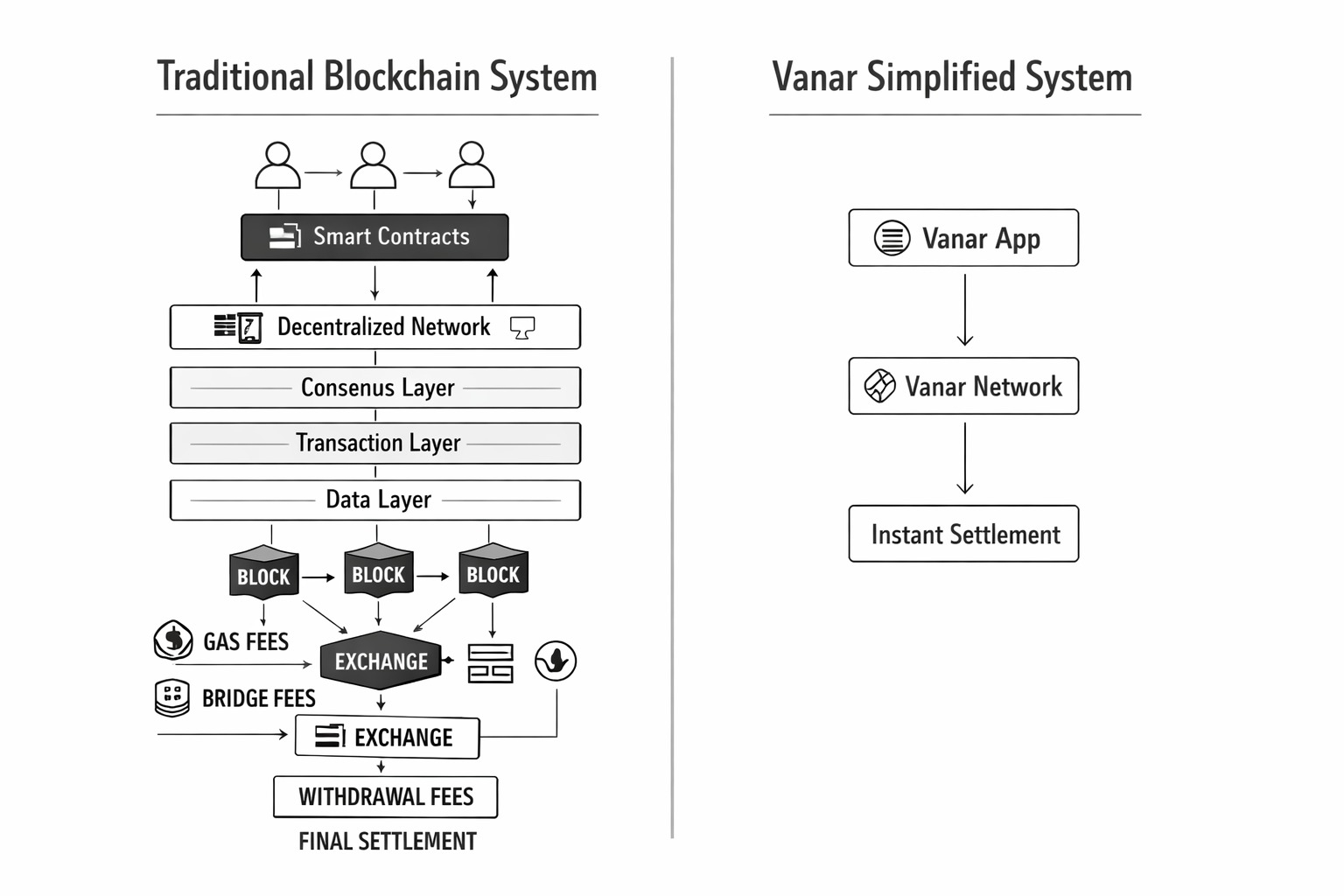
This is where most chains misread adoption. They treat users as future experts, assuming everyone will eventually care about consensus models, gas mechanics, or execution layers. Vanar treats users as they actually are: people who want things to work. Adoption, in this view, is not about educating the world on blockchain internals but about making those internals irrelevant at the point of use. The chain becomes infrastructure in the truest sense—critical, powerful, and largely invisible.
From a research perspective, this aligns closely with how successful technologies historically spread. Electricity did not gain adoption because people understood alternating current. The internet did not spread because users learned TCP/IP. These systems won because they abstracted complexity behind intuitive interfaces and reliable outcomes. Vanar appears to be building with that lesson in mind, focusing less on showcasing its architecture and more on enabling applications where the blockchain fades into the background.
Another subtle but important distinction lies in how Vanar frames value creation. Many blockchains chase adoption by incentivizing behavior—airdrops, yield, speculative rewards. This can inflate activity metrics, but it rarely builds durable usage. When incentives disappear, so do users. Vanar’s strategy suggests a deeper understanding: real adoption comes when the product itself is the incentive. When using an application feels natural, fast, and economically sensible, people return not because they’re paid to, but because it solves a real problem better than alternatives.
There is also an implicit respect for developers in this model. Instead of forcing them to design around protocol limitations, Vanar emphasizes reducing cognitive and technical overhead. Developers are not treated as evangelists who must explain why things are hard; they are treated as builders who should be free to focus on experience, storytelling, and utility. This matters because developers are the true distribution layer of any blockchain. When building feels intuitive, adoption compounds organically through the products they create.
What makes this approach especially compelling is that it does not rely on hype cycles. Vanar is not positioning adoption as a future milestone that will arrive after one more upgrade or one more narrative shift. It treats adoption as something that must be engineered from day one, embedded into design choices, tooling, and economic assumptions. This makes adoption less fragile. It’s not dependent on market sentiment or viral moments; it grows quietly, through usefulness.
In a space obsessed with being first, fastest, or most decentralized on paper, Vanar’s thinking feels almost countercultural. It recognizes that mass adoption is not a technological conquest but a human one. People do not adopt blockchains. They adopt experiences, habits, and solutions that fit seamlessly into their lives. The blockchain only succeeds if it gets out of the way.

That may be the insight most blockchains miss. Adoption is not something you announce. It’s something you earn by respecting how people actually interact with technology. Vanar’s real innovation may not be a specific feature or metric, but a shift in perspective: building systems that assume users are not wrong for wanting simplicity, and that true progress often looks quiet, invisible, and inevitable.
@Vanarchain #Vanar #vanar $VANRY
