

A few nights ago I had one of those small, irritating interruptions that shouldn’t matter, but does—because it shows you what people actually mean when they say “adoption.” Someone I know was trying a digital experience that, on paper, should have been an easy yes: it looked clean, it had a clear purpose, and it didn’t require them to care about crypto culture. They clicked around with the same calm confidence people have when a product is doing its job, when the interface is carrying them forward and their mind is focused on the experience, not the machinery. For the first minutes, it felt normal in the best way. Then the blockchain layer stepped out from behind the curtain and turned the whole moment into a checklist: a wallet install they didn’t want, a seed phrase they didn’t trust themselves to store safely, signing screens that read like legal disclaimers, the slow anxiety of waiting for something to “confirm,” and then the strangest part for a normal user—being told they need a separate token just to pay for the act of continuing. Nothing crashed, yet everything changed, because the product stopped feeling like an experience and started feeling like infrastructure management. They didn’t argue or call it stupid; they just did that polite thing people do when they’re already mentally walking away: “I’ll do it later.” They never did. And if you’ve watched it happen in real time, you know that quiet exit is the real adoption story for most blockchains—no outrage, no drama, just a gentle disappearance when the effort starts to feel heavier than the value.
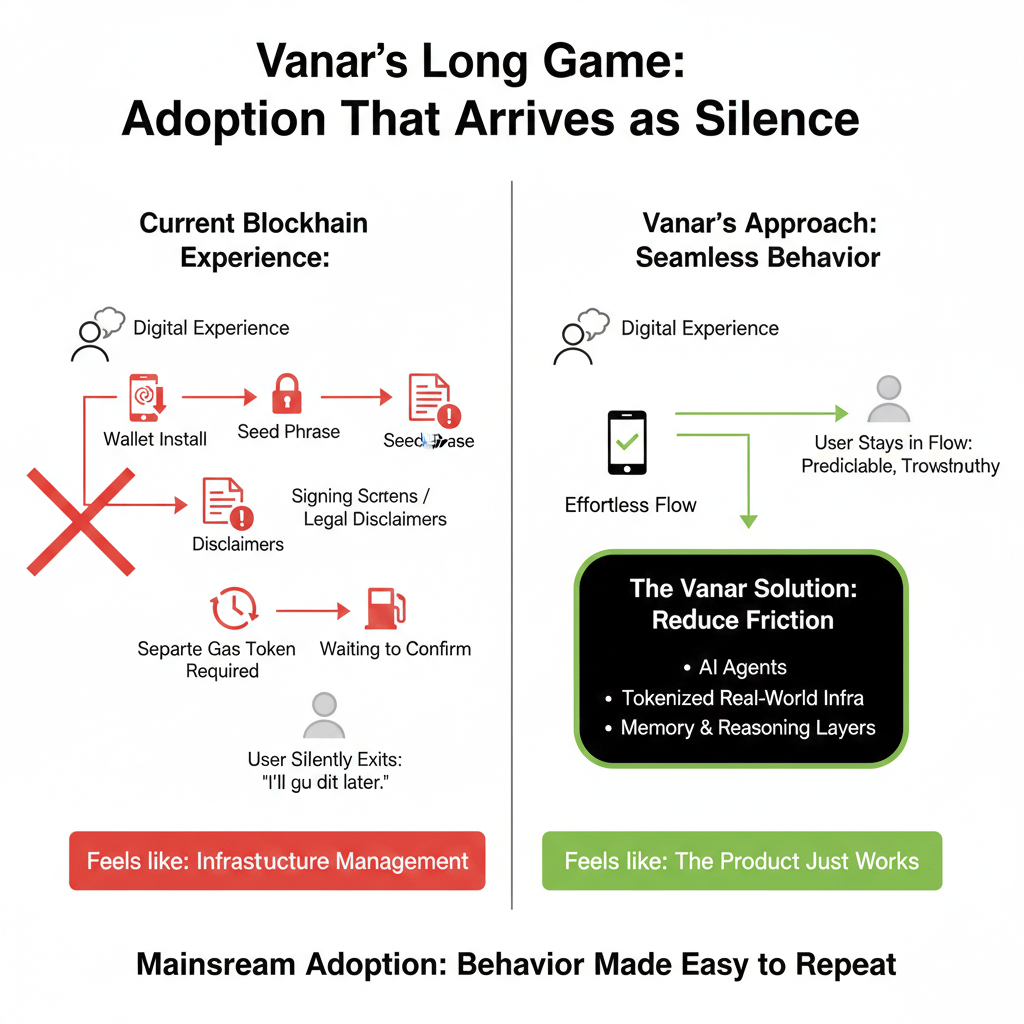
That’s the mistake a lot of chains keep repeating, even when they genuinely mean well: they talk about adoption like it’s a recruitment campaign you can win with enough features, enough partnerships, enough TPS screenshots, enough “ecosystem growth.” But mainstream adoption isn’t a belief you convince people to adopt; it’s a behavior you make easy to repeat. It lives in tiny moments of friction and trust, in whether the user can stay in flow without being forced to learn a new mental model, and in whether the system feels predictable enough that the user doesn’t start managing risk in their head. This is where Vanar becomes interesting, not as another chain trying to sound louder, but as a project that keeps pointing its identity toward consumer behavior rather than crypto culture. The way it frames itself now—AI agents, PayFi, tokenized real-world infrastructure, plus the idea of memory and reasoning as native layers—matters because it’s basically saying the product layer shouldn’t have to duct-tape intelligence and continuity on top of a chain that was never designed for it. Even if you’re skeptical about any “AI-native” narrative, the adoption instinct underneath is solid: reduce the number of separate systems a builder must stitch together, reduce the number of weird steps a user must tolerate, and reduce the number of reasons someone silently decides this isn’t for them.
The fee problem is the best example of how adoption fails in the real world, because it’s not just a technical issue—it’s an emotional one. Crypto people are trained to accept “gas” the way drivers accept fuel, but a normal user doesn’t feel like they’re driving a vehicle; they feel like they’re using an app. So when an experience asks them to buy a special token just to keep moving, it doesn’t feel innovative, it feels like being stopped at a toll booth for no good reason. It breaks rhythm. It turns small actions into decisions. And once every action becomes a decision, the experience loses its lightness. That’s why the broader industry has been pushing toward gas abstraction, sponsored transactions, and “don’t make the user think about fees” design—because consumer products can’t survive repeated moments where the user is reminded they’re operating infrastructure. Vanar’s emphasis on very low costs and “feeless-like” experiences only matters if it translates into that psychological outcome: the user stops noticing the rails. Not because the rails aren’t there, but because the rails aren’t demanding attention. In gaming and entertainment especially, that difference is everything, because those environments run on momentum; when you break momentum, you don’t get it back with another feature, you lose the user with a smile and a “maybe later.”
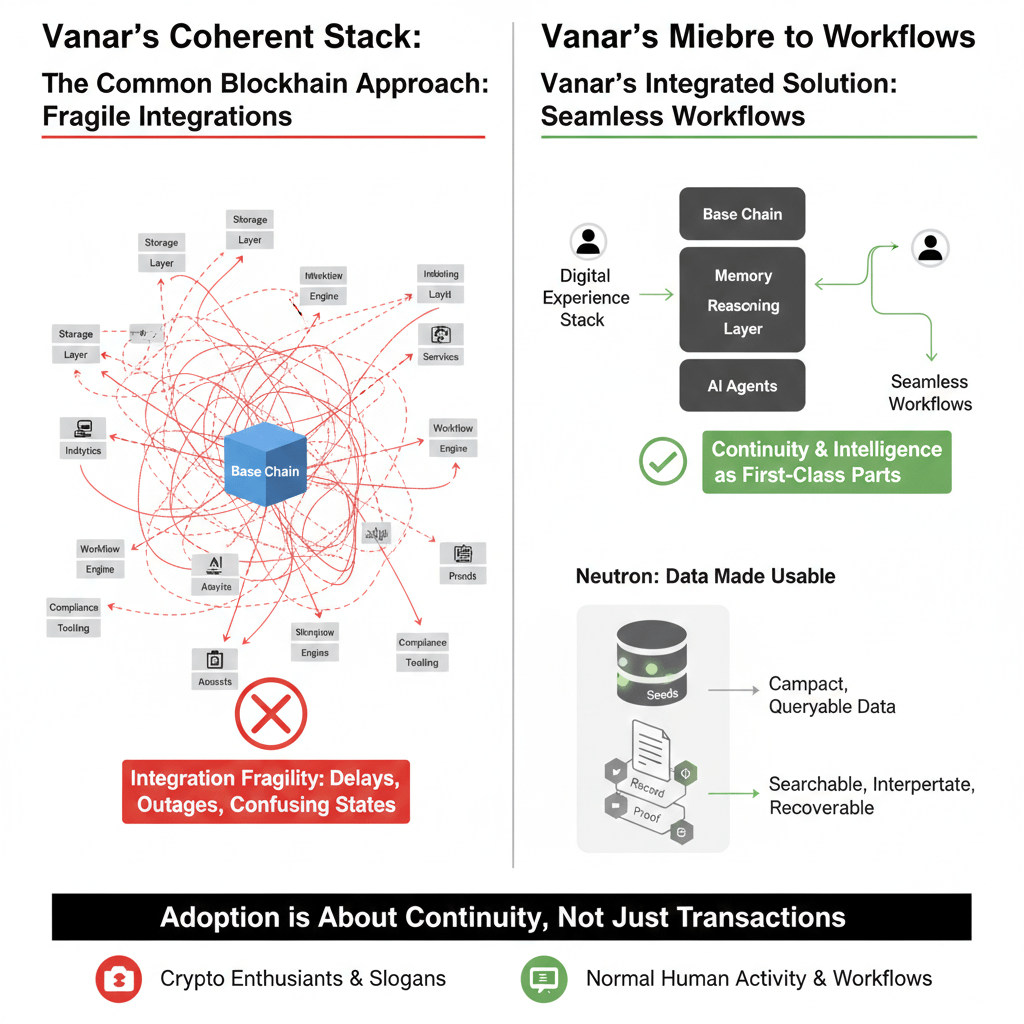
Where Vanar’s current direction feels more adoption-aware than the average chain pitch is that it isn’t only selling a base layer; it’s trying to present a coherent stack where memory and reasoning aren’t afterthoughts. Most chains still work like this: “Here’s the chain—now go find your storage layer, your indexing, your analytics, your AI, your workflow engine, your compliance tooling, and please make it all behave as if it’s one product.” That approach is fine for experiments, but consumer experiences collapse under integration fragility. A product can be brilliant, yet still feel unreliable if it depends on too many external pieces with mismatched assumptions, because the seams eventually show up as delays, outages, confusing states, or data that can’t be found when it matters. Vanar’s layering—whatever you think of its branding—tries to address that by treating continuity and intelligence as first-class parts of the system rather than as optional extras. In adoption terms, this is less about novelty and more about reducing the number of moving parts that can fail, which reduces the number of “unpredictable moments” a user experiences. And unpredictability is what makes people quietly step away, even when they liked the idea.
Neutron is the clearest example of where this becomes more than branding, because it reframes the usual “we store data” story into something closer to “we make data usable.” The way Vanar describes Neutron—data turned into compact, queryable “Seeds” that can be retrieved and reasoned over—speaks to a real-world truth: most people and most organizations do not run on tokens, they run on documents, records, proofs, and context. In day-to-day life, the pain is rarely “I can’t store something,” the pain is “I can’t find it, I can’t verify it, I can’t carry it across systems, and the moment I switch tools my context resets.” If a chain makes the data layer feel alive—searchable, interpretable, recoverable—then the chain starts to serve the part of the world that actually scales: workflows. Not just transactions. Workflows. That’s where adoption becomes less about crypto enthusiasts and more about normal human activity, because normal people value continuity more than ideology, and organizations value auditability and retrieval more than slogans.
That continuity becomes even easier to feel when you bring MyNeutron into the story, because it starts from an everyday frustration that has nothing to do with blockchain and everything to do with modern digital life: the sense that context keeps dying. Anyone who uses AI tools across multiple platforms knows the feeling—your “brain” is scattered, your notes are in one place, your chats are in another, your documents are somewhere else, and the moment you switch tools you lose the thread. MyNeutron’s promise, as Vanar frames it, is memory that can follow you: a place where your documents, pages, and interactions become a knowledge vault that persists, with the option to anchor it onchain for permanence or keep control local depending on what you value. If Vanar can make continuity feel simple—something you use naturally without becoming a wallet operator—then adoption stops being a crypto journey and becomes a habit. And habits are where real adoption lives, because habits don’t require constant motivation; they just fit.
Kayon, as the reasoning layer, is worth weaving in carefully because it can easily sound like a buzzword if it’s presented as “AI, but onchain.” The more grounded way to talk about it is to focus on why reasoning matters: mainstream use cases get blocked by the need to explain and audit what happened. It’s not enough for a system to execute; it has to produce outcomes that people can interpret, verify, and report. That’s the gap between “cool tech demo” and “something a serious team can operationalize.” Vanar’s idea of a reasoning engine that can query memory and data in natural language, generate insights, and support compliance-friendly workflows is, at its best, an attempt to make blockchain systems legible to humans and institutions. That legibility is an adoption unlock, because the world outside crypto runs on accountability. If you can’t explain the why, you don’t get to scale beyond enthusiasts. If you can’t retrieve the evidence, you don’t get to integrate into real systems. If you can’t audit the trail, you don’t get trust. Reasoning and memory are not decorations; they’re bridges between execution and reality.
When I step back, what Vanar seems to understand—at least in direction—is that adoption is not about making people care about chains. It’s about making chains behave like infrastructure: fast enough that waiting doesn’t become doubt, cheap enough that actions don’t become decisions, coherent enough that builders don’t spend their energy stitching fragile parts together, and quiet enough that users can stay focused on what they came to do. The strongest consumer technologies in history did not win by demanding admiration; they won by disappearing into normal life. People do not need to understand networking to send messages. They do not need to understand power grids to turn on lights. They do not need to understand settlement rails to tap and pay. The system becomes invisible until it matters—and even when it matters, recovery is part of the design rather than a punishment the user must learn.
I keep returning to that person who almost adopted a Web3 product because it reminds me how little patience the real world has for ceremony, and how rarely people announce that they’ve left. They don’t write long critiques. They don’t start arguments. They just move on to the next app that respects their time. If Vanar’s newer direction—memory as a primitive, reasoning layered on top of memory, PayFi and real-world infrastructure framing, and an obsession with making the experience feel light—continues to mature into something builders can actually ship and users can actually trust, then its adoption story won’t arrive as a loud headline. It’ll arrive the way the most important changes always arrive: quietly, through repetition, through normal behavior, through people coming back the next day without needing a reason to “believe.” And one day, someone will use something powered by Vanar and the only thing they’ll notice is that it worked—no lecture, no rituals, no pause to ask what chain they’re on—just a smooth experience that let them stay human while the infrastructure did its job underneath.