
The most uncomfortable part of using stablecoins isn’t sending them. It’s explaining them afterward.
At some point, someone always asks a simple question: “How did this money move?” Not in a philosophical way, but in a practical one. Which transactions settled when? Why did two identical transfers have different fees? Why does the explorer show temporary states that later disappear? Why is “final” a word that comes with footnotes?
That moment exposes a gap between crypto-native logic and financial reality. Plasma feels like it was designed by someone who noticed that gap and decided it shouldn’t exist.
Financial Systems Are Judged After the Transaction, Not During It
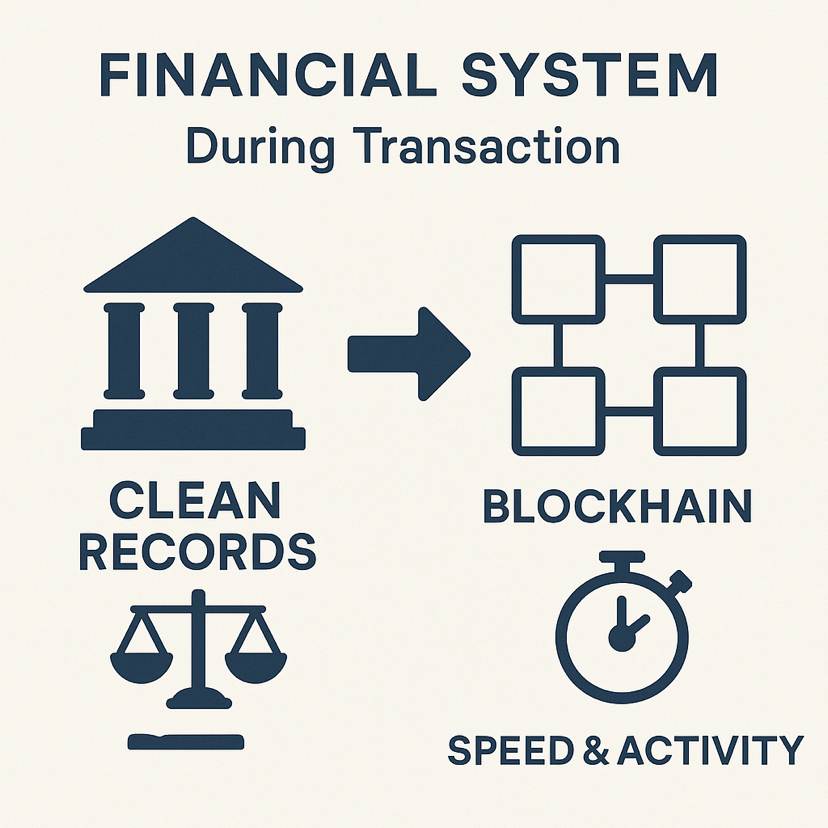
Most blockchains optimize the moment of execution. They care about speed, throughput, and activity. Finance teams care about what remains after execution: clean records, consistent settlement, and histories that don’t require interpretation.
Plasma appears to prioritize that aftermath. Instead of treating transactions as events to be celebrated, it treats them as facts that must be easy to account for. Once a payment settles, it stays settled. Once a balance updates, it doesn’t wobble. There’s no need to explain probabilistic outcomes to people whose job depends on certainty.
That design choice doesn’t make Plasma exciting. It makes it explainable.
Finality That Doesn’t Need Translation
Probabilistic finality is intellectually interesting, but practically awkward. When you have to explain to a non-technical stakeholder that a transaction is “effectively final unless something unusual happens,” you’ve already lost trust. Finance doesn’t run on edge cases.
Plasma’s deterministic finality removes that conversation entirely. A transaction is either done or not done. There is no waiting period where meaning is ambiguous. That clarity reduces the need for monitoring, manual checks, and contingency explanations.
It’s a small shift, but it changes how confidently money can be discussed.
Fees That Don’t Complicate the Story
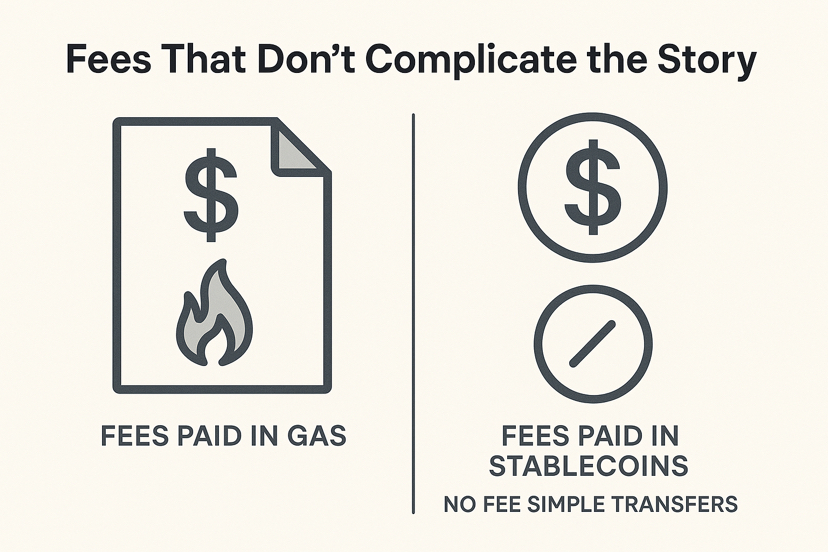
Another source of explanation debt in stablecoin systems is gas. Variable fees paid in volatile assets create accounting noise that spreads far beyond the transaction itself. Suddenly, every transfer comes with a side calculation and a justification.
Plasma’s choice to allow fees in stablecoins — and to eliminate them entirely for simple transfers — reduces that noise. When the unit of cost matches the unit of value, the story becomes simpler. No conversions. No side balances. No footnotes.
This isn’t about saving pennies. It’s about reducing the number of questions a ledger raises.
Familiar Execution Lowers Institutional Friction
Plasma’s EVM compatibility quietly supports this explainability goal. Familiar execution environments mean familiar assumptions. Auditors, developers, and operators don’t have to reinterpret behavior or learn new mental models just to understand what happened.
In payments infrastructure, novelty often increases the burden of explanation. Plasma avoids that trap by inheriting what already works and limiting what needs to be justified.
XPL as an Internal Mechanism, Not a Talking Point
The role of $XPL fits into this same pattern. It secures the network and aligns validators, but it doesn’t insert itself into user-facing narratives. Most stablecoin users won’t need to explain why a separate asset was involved in a payment flow — because it isn’t.
That restraint matters. Systems that force users to explain their internal mechanics usually signal unfinished design.
Adoption That Shows Up in Confidence, Not Buzz
Plasma doesn’t feel built for storytelling. It feels built for repetition. The kind of repetition where payments happen daily, records accumulate quietly, and confidence grows because nothing surprising occurs.
This kind of adoption rarely produces excitement. It produces relief. And relief is what financial teams look for when choosing infrastructure.
The Quiet Advantage Plasma Is Building
Plasma’s advantage isn’t speed or cost in isolation. It’s the absence of explanation. When money moves and nobody has to justify how or why, the system fades into the background where infrastructure belongs.
If Plasma succeeds, it won’t be because people talk about it more.
It’ll be because they stop having to explain it at all.