
Dusk didn’t show up trying to impress anyone. When it launched in 2018, the blockchain world was loud, idealistic, and often proud of ignoring the rules of traditional finance. Transparency was treated like a moral absolute, and regulation was something to outrun, not engage with. But in the background, a quieter question was forming: if blockchain ever wanted to carry real money, real securities, and real institutions, how could it do that without exposing everything to the public eye?
Dusk started from that exact tension.
Instead of framing privacy as secrecy or regulation as a necessary evil, Dusk treated both as unavoidable realities of how finance actually works. In the real world, financial systems are not transparent billboards. They are private by default, accountable when required, and built around trust, law, and audit. Dusk’s founders didn’t try to reinvent that logic. They tried to translate it into code.
That decision shaped the network from day one. Privacy on Dusk isn’t about disappearing; it’s about control. Transactions can remain confidential, balances don’t have to be publicly exposed, and sensitive data stays shielded. At the same time, the system can still prove that rules were followed. Zero-knowledge proofs make this possible, allowing the network to confirm that something is valid without revealing the underlying information. It’s the blockchain equivalent of saying, “Yes, this is compliant,” without laying every document on the table.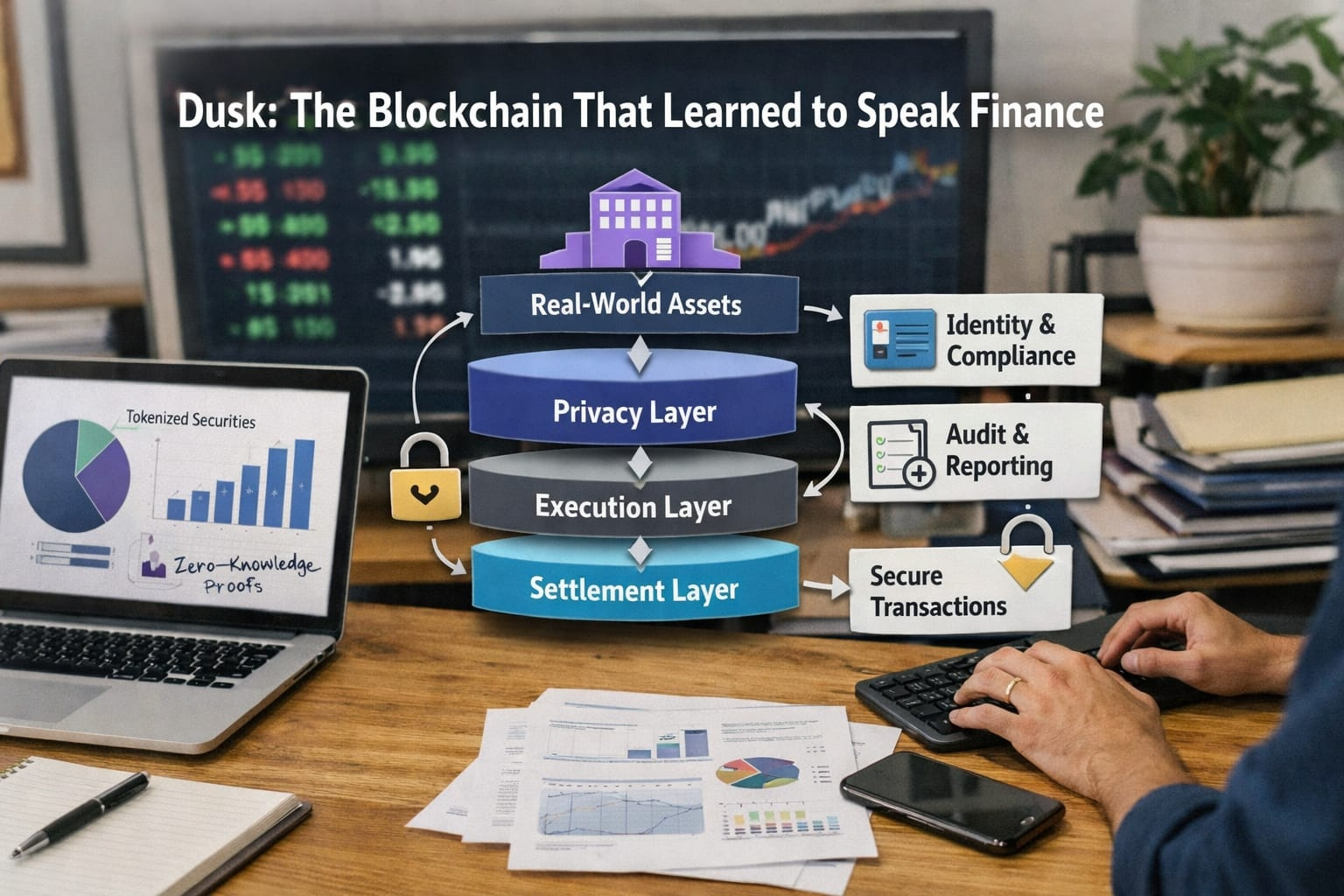
This approach feels almost obvious once you see it, but it’s rare in practice. Many blockchains were built for openness first and are now struggling to retrofit compliance. Dusk did the opposite. It assumed that regulation wasn’t coming someday — it was inevitable. So instead of adding compliance layers later, Dusk embedded them into the protocol itself. Identity checks, eligibility rules, transfer restrictions, and reporting logic aren’t awkward add-ons. They’re native behaviors.
Under the hood, the network reflects this same realism. Dusk is modular, separating settlement, execution, and privacy into distinct layers. This isn’t about technical elegance for its own sake; it’s about stability. Financial systems don’t like all-in-one experiments. They prefer clear boundaries, predictable behavior, and components that can evolve without breaking everything else. By structuring the network this way, Dusk creates room for innovation without sacrificing control.
Where all of this comes together is in Dusk’s focus on real-world assets. While much of the blockchain space talks about tokenization as a future milestone, Dusk treats it as a present responsibility. The network is designed to issue and manage tokenized securities that behave like their traditional counterparts. Ownership rules matter. Jurisdiction matters. Compliance isn’t optional. Smart contracts don’t just move value — they enforce the legal reality surrounding that value.
This changes what blockchain can be used for. Settlement no longer needs to take days. Corporate actions don’t have to involve endless reconciliation. Audits become cryptographic rather than procedural. Most importantly, institutions don’t have to choose between decentralization and control. They can have both, if the infrastructure is built with their constraints in mind.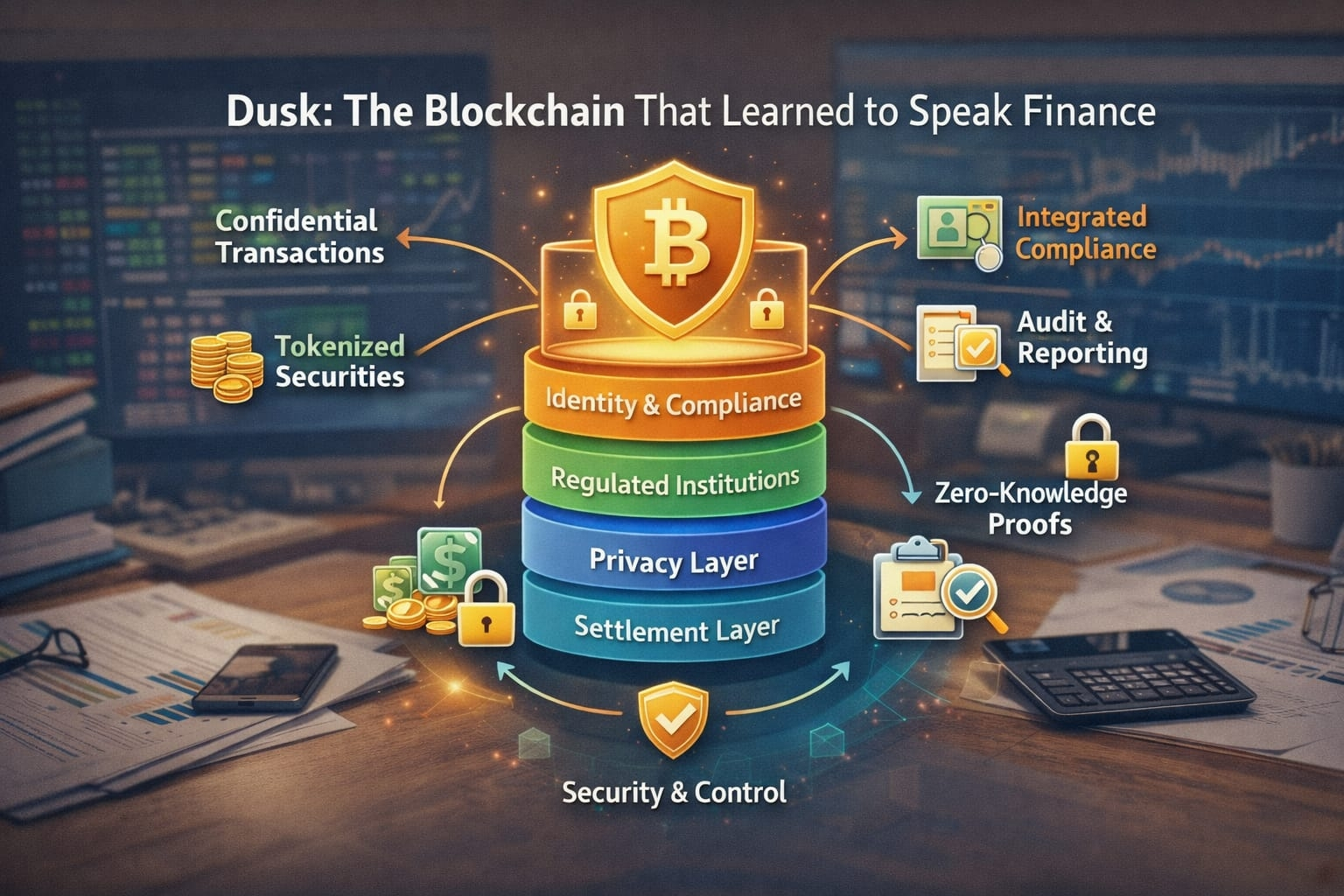
Dusk’s partnerships with regulated exchanges, compliant digital currency initiatives, and data providers hint at where this is going. The goal isn’t to replace financial institutions or shock the system. It’s to give the system better tools. Tools that reduce friction, lower costs, and still respect the frameworks that keep markets functioning.
The irony is that if Dusk succeeds, most people may never notice it. Infrastructure rarely gets applause. It just works in the background, quietly supporting everything above it. But history shows that the platforms shaping the future of finance aren’t always the loudest ones. They’re the ones that understand how money actually moves — and build accordingly.
Dusk feels like one of those projects. Less interested in hype, more interested in longevity. Not trying to escape the rules, but to encode them. And in a world where blockchain is slowly being asked to grow up, that mindset may turn out to be its greatest advantage.
