 Vanar Chain is solving a problem that almost everyone in Web3 talks about, but very few teams truly understand. People say adoption is broken. They say users don’t stay. They say consumer apps don’t scale. But the real issue is much simpler. Web3 has never been designed around how ordinary people actually behave. Fees change every minute. Latency feels unpredictable. Apps ask users to manage things they don’t care about. Chains force developers to fight painful tradeoffs between performance, privacy, cost, and compliance. The system never felt built for real human use. Vanar Chain is quietly fixing exactly this problem, and the effect is becoming obvious across the entire ecosystem in 2026.
What makes Vanar different is that the chain isn’t trying to copy the old playbook. Vanar does not position itself as a generic L1 fighting for the same narratives as everyone else. It’s a consumer-first, AI-native chain focused on reliability, predictability, safety, and the comfort level of real people. The early 2020s pushed Web3 into a strange cycle: exciting technology but terrible user experience. Vanar’s design turns that equation upside down by asking a question nobody else prioritized. What would Web3 look like if it behaved normally, like the apps people already trust.
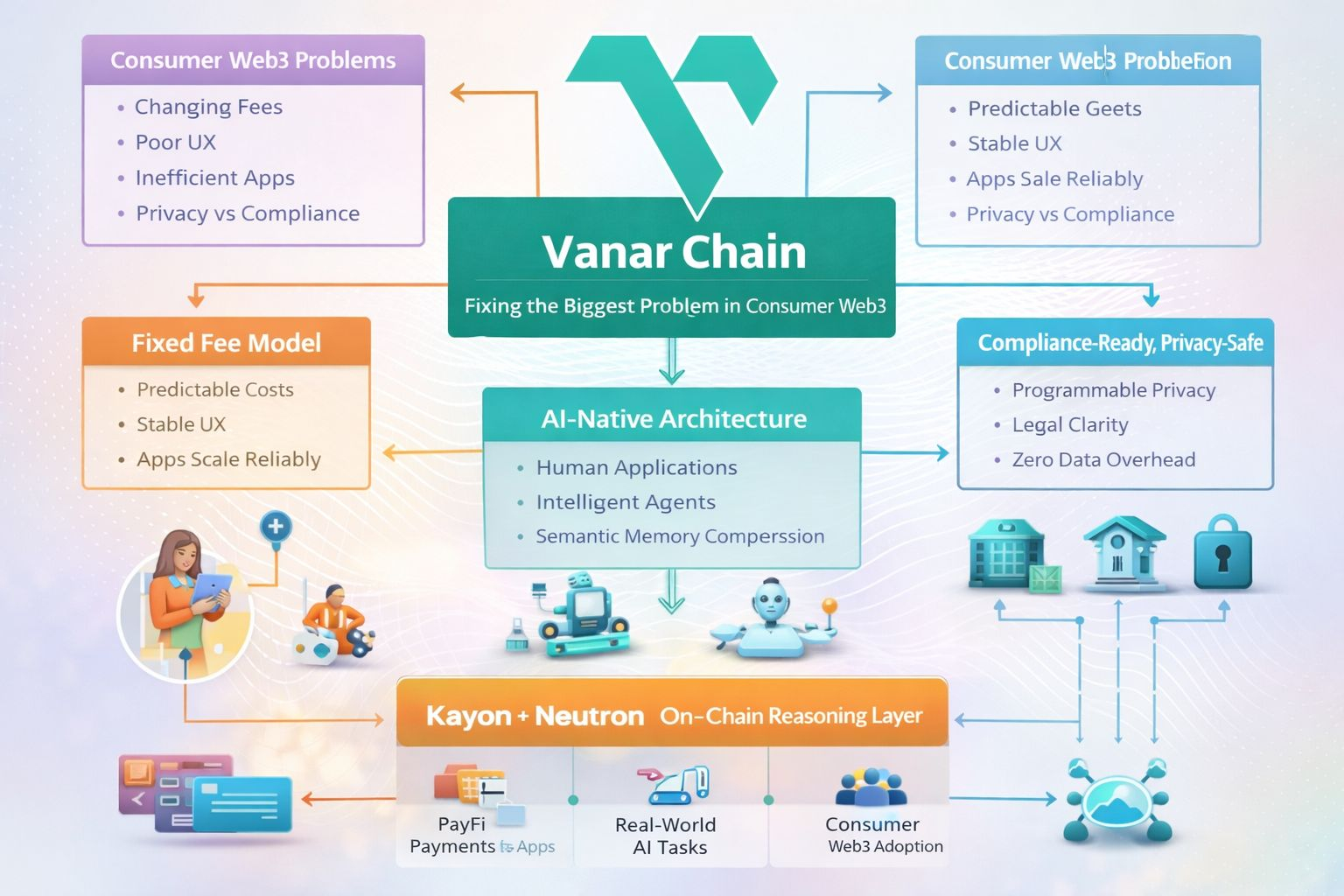
The answer begins with the fixed-fee model, one of the most underrated strengths in the entire ecosystem. Markets are chaotic. Volatility affects everything. But humans crave stability. Vanar gives that stability to both developers and users. Fees remain predictable. Transactions feel consistent. Apps don’t break during network spikes. For most blockchains, user experience breaks exactly when demand increases. For Vanar, the experience stays the same. This alone solves one of the biggest pain points that has limited the growth of consumer Web3 for years.
The next breakthrough lies in the architecture. Vanar was not designed as a simple transactional chain. It was built as an AI-native execution layer for human applications, digital environments, and intelligent agents. The ecosystem is shifting toward agent-first design, where users rely on AI to navigate, transact, filter information, and automate tasks. Most L1s were never built with this future in mind. Vanar’s stack—especially Neutron and Kayon—unlocks exactly the type of infrastructure AI systems require to run safely, efficiently, and at scale.
Neutron handles semantic memory compression, which is an entirely different approach to data understanding compared to standard blockchains. Instead of storing information in raw form, Neutron can compress meaning, patterns, and relationships in a way that reduces cost and increases intelligence. Kayon, the on-chain reasoning layer, allows AI agents to act on-chain with safety, guardrails, and verifiable logic. Together, these two components form the backbone of a chain built for the next era of digital behavior.
A huge portion of future consumer activity will be driven by autonomous agents—not just people tapping buttons on screens. Agents will shop, manage subscriptions, handle payments, organize digital collectibles, buy tickets, authenticate assets, and interact with virtual environments. These agents need a chain that is fast, inexpensive, compliant, and safe enough to execute tasks without breaking user trust. Vanar is one of the only chains in the world that has been engineered with this reality at the center.
But there’s another layer to the story: compliance and privacy. Most blockchains fall apart when these two requirements appear together. Strong privacy usually means weaker compliance. Strong compliance usually means weaker privacy. Vanar flips the framework by designing an infrastructure where privacy is contextual, programmable, and aligned with regulatory expectations instead of being in conflict with them. Developers get a system where sensitive data is minimized, not harvested. Users get control without losing the ability to access mainstream markets. Institutions get a chain where legal clarity is not sacrificed for innovation.
This balance is exactly why the entertainment, gaming, AI, and consumer sectors are beginning to choose Vanar. These industries cannot survive on chains that expose user identities or require unpredictable costs. They need reliability, safety, interoperability, and a predictable environment where digital commerce can happen at scale. Vanar delivers all of those components at once—without forcing developers to compromise the experience of their users.
Then there’s PayFi, an engine that takes payments from a technical feature to a consumer-ready experience. In most blockchains, payments are mechanical, abstract, and intimidating for people who just want things to work. Vanar’s PayFi ecosystem turns stable payments, microtransactions, digital services, and everyday interactions into something fluid and familiar. Fees remain stable. Execution is fast. Settlement feels instant. Apps can design payment flows without worrying about gas modeling or infrastructure overhead. It is the opposite of the clunky systems people expect from Web3.
The V23 upgrade magnifies all of this even more. It strengthens throughput, refines security, enhances developer tools, and prepares the network for the next generation of AI-native applications. V23 is not just a technical patch. It is a directional shift toward a fully autonomous, highly scalable, and human-centered L1. It sets the stage for thousands of real applications to emerge—apps that don’t need to explain the blockchain underneath because the experience simply works.
Vanar’s real achievement is subtle but powerful. It has redesigned the foundation of Web3 around human expectations instead of crypto assumptions. People don’t want to think about wallets, gas, or validators. They want apps that load fast, actions that feel smooth, and systems that behave the same every time. For years, this gap between expectation and experience is what kept Web3 stuck at the margins. Vanar is removing that barrier. Slowly, quietly, and methodically.
It’s easy to measure performance in transactions per second, but far more difficult to measure satisfaction, trust, and consistency. Vanar delivers those intangibles at scale, and that is why 2026 is shaping into the year the chain becomes a true consumer platform. With AI agents rising, global digital activity accelerating, and mainstream brands exploring Web3 once again, Vanar is positioned exactly where the market needs stability, intelligence, and user-friendly design the most.
The shift is already visible. Builders are testing deeper integrations. AI companies are exploring the reasoning layer. Developers are discovering the strength of the fixed-fee model. Consumer projects are experimenting with Vanar because it gives them something they haven’t found anywhere else: an environment where normal people can use blockchain technology without needing to understand blockchain at all.
The next phase of Web3 will not be defined by hype cycles or speculative waves. It will be defined by chains that deliver predictable, safe, and intelligent user experiences at global scale. Vanar Chain is quietly making that future possible, solving the one problem that has held consumer Web3 back for a decade. And because it solves that problem so naturally, so structurally, and so effectively, it is becoming one of the most important platforms of 2026—without needing to shout for attention.