

February 9, 2026 — If someone asked you what succinct attestation means in blockchain, the instinct might be to brace for math, diagrams, and complicated proofs. But in the case of Dusk Network, the idea is surprisingly grounded: it’s about getting consensus agreement on the next block in a way that’s fast, efficient, and resilient, all while staying decentralized and ready for real financial use cases.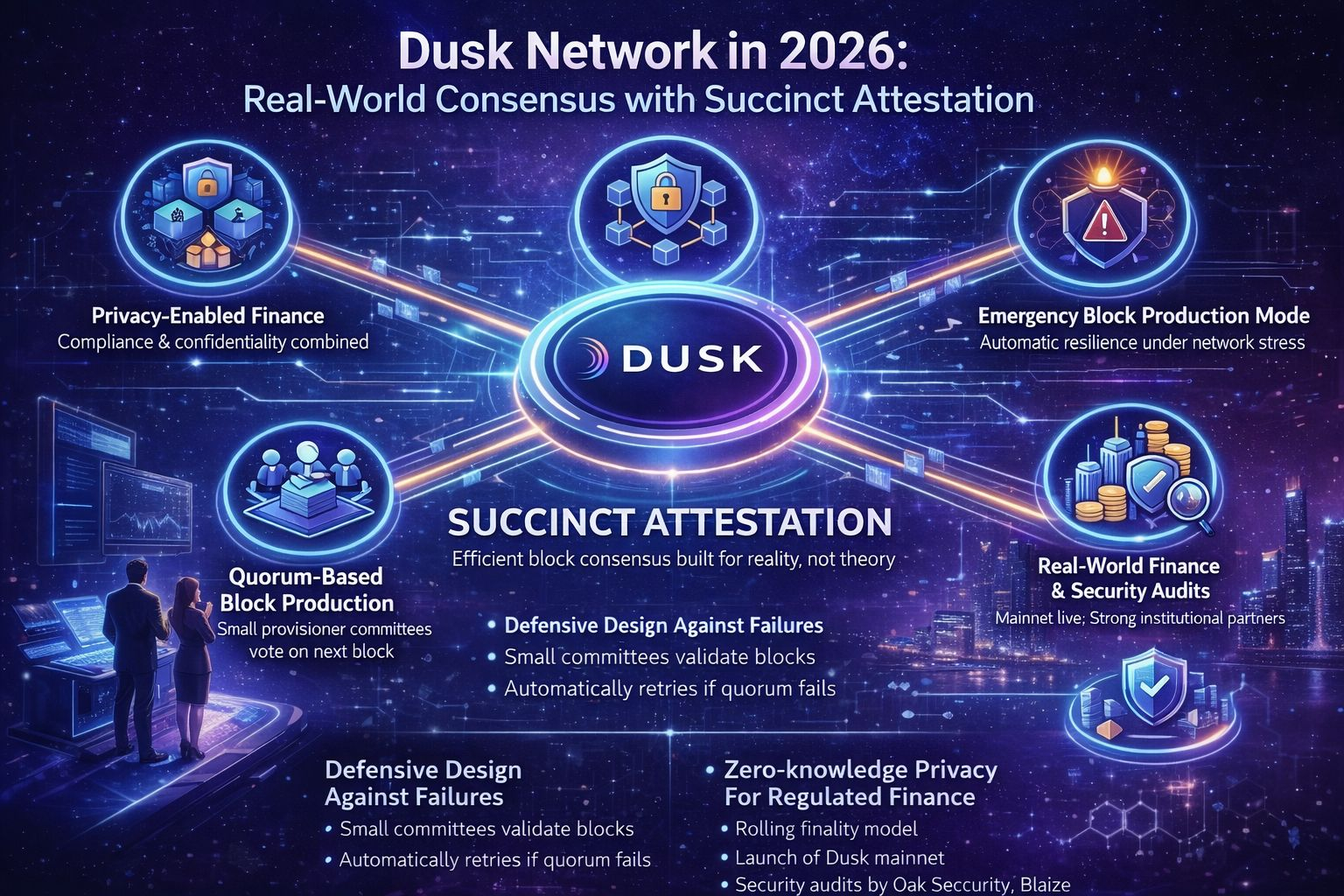
At its heart, Dusk is not just another blockchain. It’s a privacy-enabled, regulated finance-ready Layer 1. That means the chain is built with real-world institutions in mind: firms that need confidentiality, compliance with rules like MiCA or GDPR, and settlement guarantees that courts and custodians can actually rely on. The team has fused zero-knowledge cryptography and flexible transaction models so that some transactions can be completely private, while others remain transparent for audit and reporting when required.
Succinct Attestation (SA), Dusk’s consensus protocol, is a committee-based Proof-of-Stake design built for these goals. Instead of having all validators vote on everything all the time, the system selects small groups of validators called provisioners pseudo-randomly each round using deterministic sortition. These provisioners propose, validate, and ratify blocks. This keeps the network efficient while still letting a broad set of participants take part.
What makes this especially compelling is how the protocol deals with failure. If a committee doesn’t reach quorum, or a block doesn’t come in time, Dusk doesn’t freeze it simply starts another iteration. If conditions get really rough, the protocol enters Emergency Mode, relaxing some rules to maximize the chance of producing a block rather than stalling entirely. This isn’t academic it’s practical behavior designed for real network turbulence.
Finality on Dusk follows a rolling model. Blocks don’t become “permanently etched in stone” instantly, but they grow more secure as new blocks build on them and attestations accumulate. For traders and institutions, that mirrors how settlement risk is understood: a transaction becomes less and less likely to be undone the deeper it sits in the chain.
Beyond consensus mechanics, recent developments show that the project is moving fast. After years of testing, the Dusk mainnet launched on January 7, 2026, transitioning the network from development to a live layer 1 blockchain that supports confidential smart contracts and privacy-preserving finance applications.
The protocol’s security has also been audited by respected firms like Oak Security and Blaize, with critical issues resolved and robustness affirmed a key milestone for any chain aiming at institutional trust.
Meanwhile, underlying engineering continues to evolve. Recent updates to the Rusk execution layer and improvements in how rolling finality is calculated reflect active development toward even smoother operation.
At the community level, initiatives like regulated trading platforms (e.g., Dusk Trade with licensed partners) are starting to take shape, showing how this technology could bridge traditional finance and decentralized infrastructure in real ways.
Succinct attestation isn’t here to dazzle you with theoretical proofs it’s built around the real flaws of real networks: delays, drops, and occasional outages. Dusk’s answer isn’t perfection; it’s practical continuation, something that matters especially when markets move fast and downtime is costly. That pragmatic approach might be what sets Dusk apart from consensus concepts that live purely in textbooks.
In a space full of bold promises, Dusk’s evolution in 2026 feels like a reminder that real consensus is about working reliably under pressure not just looking elegant on paper.
