
It was close to midnight, the kind where the room is quiet enough that you can hear the power supply whine. I was recompiling a node after changing a single configuration flag, watching the build crawl while the laptop thermally throttled. The logs weren’t angry, no red errors, no crashes. Just slow, deliberate progress. When the node finally came up, it refused to participate in consensus because a proof parameter was a hair off. Nothing broke. The system simply said no.
That’s the part of Dusk Network that feels too real for crypto.
Most of the industry trains us to expect softness. Fast iterations, forgiving tooling, abstractions that hide consequences. You deploy, tweak, redeploy. If it fails, you patch it later. Dusk doesn’t work like that. It’s strict in the way regulated systems are strict, correctness first, convenience second, forgiveness rarely. As a builder, you feel it immediately, in compile times, in hardware requirements, in proofs that won’t generate if you cut corners.
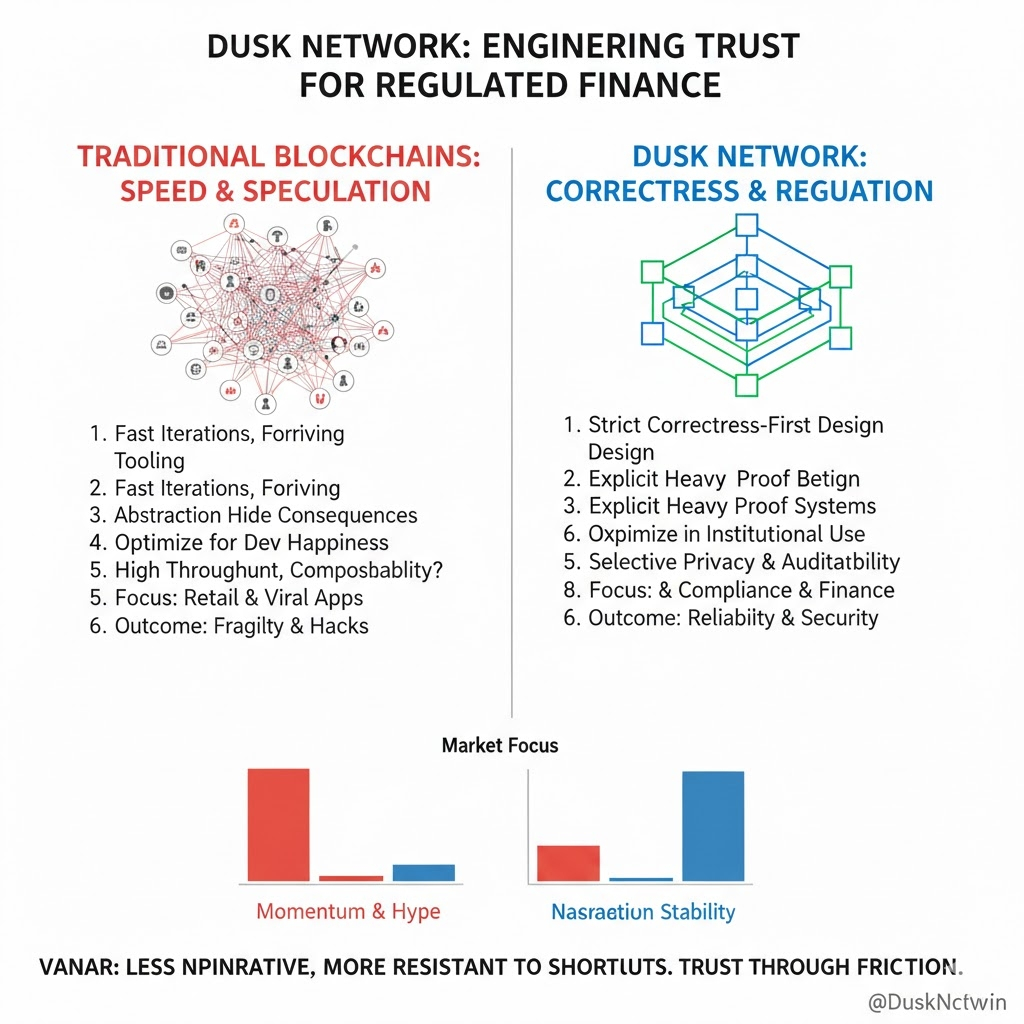
At first, that friction feels hostile. Then it starts to read like a design brief.
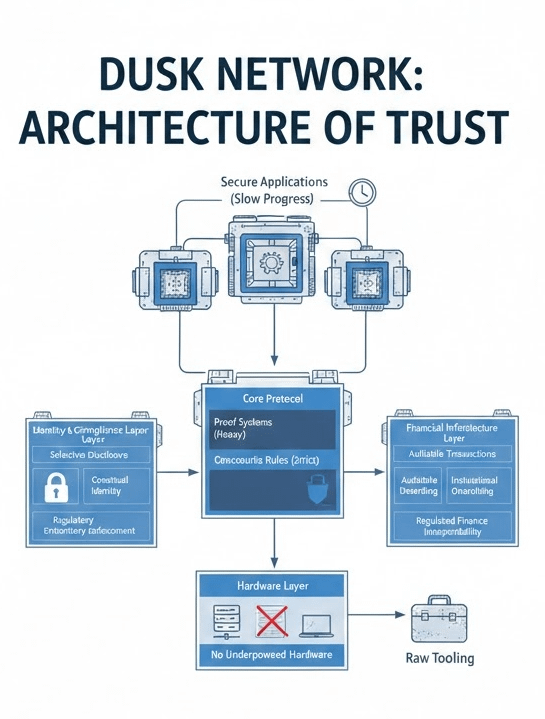
Privacy combined with identity and regulated finance isn’t a narrative problem; it’s an engineering one. Selective disclosure, auditability on demand, deterministic execution, those properties don’t come cheap. Proof systems get heavier. Consensus rules get less flexible. The margin for probably fine disappears.
A lot of crypto platforms optimize for developer happiness and user velocity. Dusk optimizes for institutional correctness. That choice leaks into everything. You can’t just spin up a node on underpowered hardware and expect it to coast. You can’t hand-wave identity constraints or compliance flows. The system enforces them because, in the environments it’s meant for, failure isn’t a bad UX, it’s a legal or financial risk.
That’s why the tooling still feels raw. It’s why the ecosystem looks sparse compared to retail first chains. And it’s why progress feels slower than the timelines promised in threads and roadmaps. The friction isn’t accidental; it’s the tax you pay for building something that could survive contact with regulators and institutions that don’t tolerate beta.
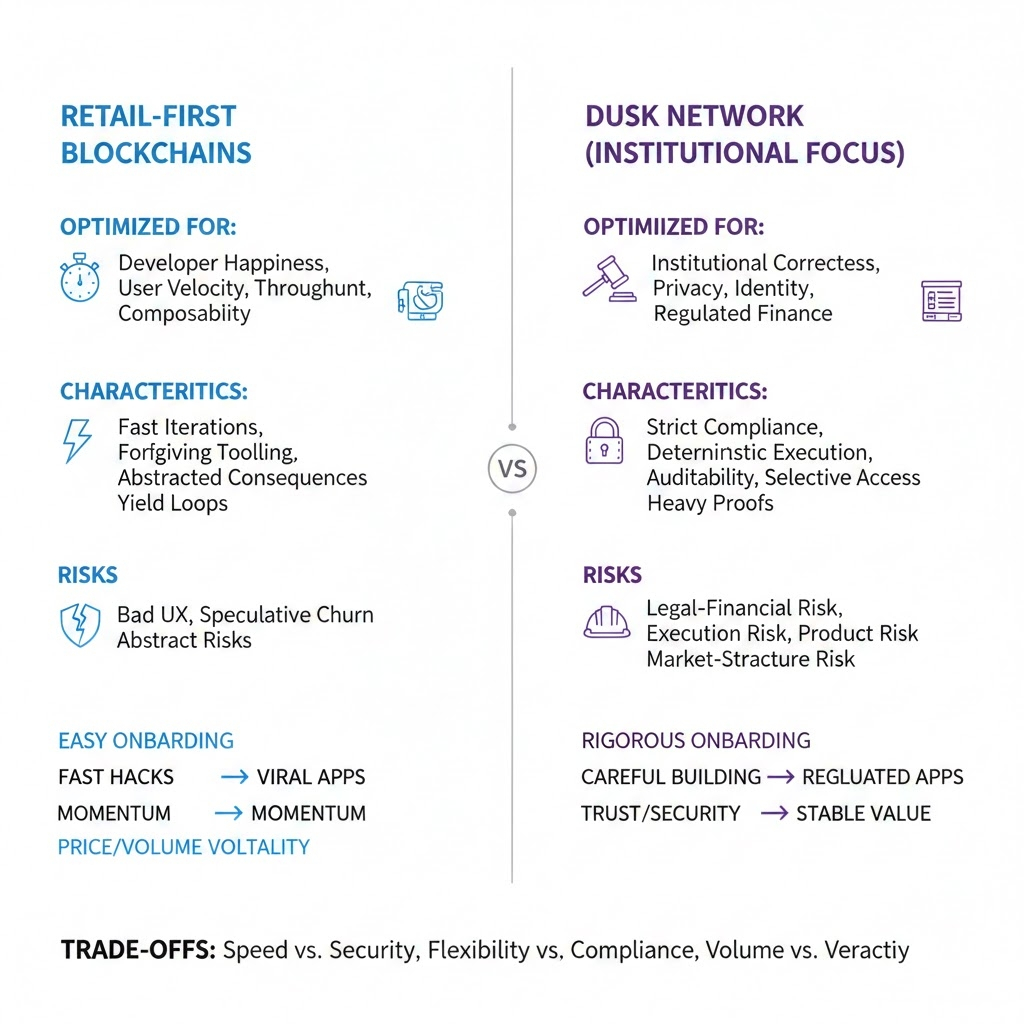
I’ve worked with chains that prioritize throughput, chains that prioritize composability, chains that prioritize developer ergonomics above all else. None of those are wrong. They’re just optimized for different truths.
Dusk’s philosophy is closer to traditional financial infrastructure than to DeFi playgrounds. Privacy isn’t a default aesthetic; it’s conditional. Identity isn’t optional; it’s contextual. Transparency isn’t maximal; it’s deliberate. That puts it at odds with ecosystems where permission is the primary value. Here, the value is selective access with guarantees.
There’s no winner in that comparison, only trade offs. If you want fast hacks and viral apps, this isn’t the place. If you want systems that can be audited without being exposed, that can enforce rules without leaking data, you accept the weight.
As of early 2026, DUSK trades roughly in the $0.20–$0.30 range, with daily volume often under $10–15M, a circulating supply just over 400M, and a market cap hovering around $100M. Those numbers aren’t impressive by hype standards. They are consistent with a protocol that hasn’t unlocked a broad retail funnel and isn’t optimized for speculative churn.
Price and volume lag because usage lags, and usage lags because onboarding is hard. Identity aware flows are heavier. Compliance aware applications take longer to ship. Retention depends on repeated, legitimate on chain actions, not yield loops or incentives.
The risks here aren’t abstract. Execution risk is real, cryptography is unforgiving, and delays compound. Product risk is real, if tooling doesn’t mature, builders won’t stick around. Market structure risk is real, regulated finance moves slowly, and adoption cycles are measured in years, not quarters.
There’s also a distribution risk. Without a clear user funnel, from institution to application to repeated usage, the network can remain technically sound but economically quiet. No amount of narrative fixes that.
What keeps me engaged isn’t excitement. It’s the sense that this is unfinished machinery being assembled carefully, piece by piece. The discomfort I feel while compiling, configuring, and debugging isn’t wasted effort, it’s alignment with the problem space.
Systems meant to last don’t feel good early. They feel heavy, opinionated, and resistant to shortcuts. For all its rough edges, this system behaves like it expects to be used where mistakes are expensive.
In a market addicted to momentum, that patience reads as weakness. From the inside, it reads as intent. And sometimes the most honest signal a system can send is that it refuses to move faster than reality allows.
