

Dusk feels like a project that started with one honest question that most chains avoid asking out loud, how do you build on chain finance that can actually live in the real world without forcing every balance, every transfer, and every investor position into permanent public visibility, because the moment you accept regulated markets as the destination, you also accept that confidentiality and rule enforcement are not optional features, they are the foundation that everything else must stand on.
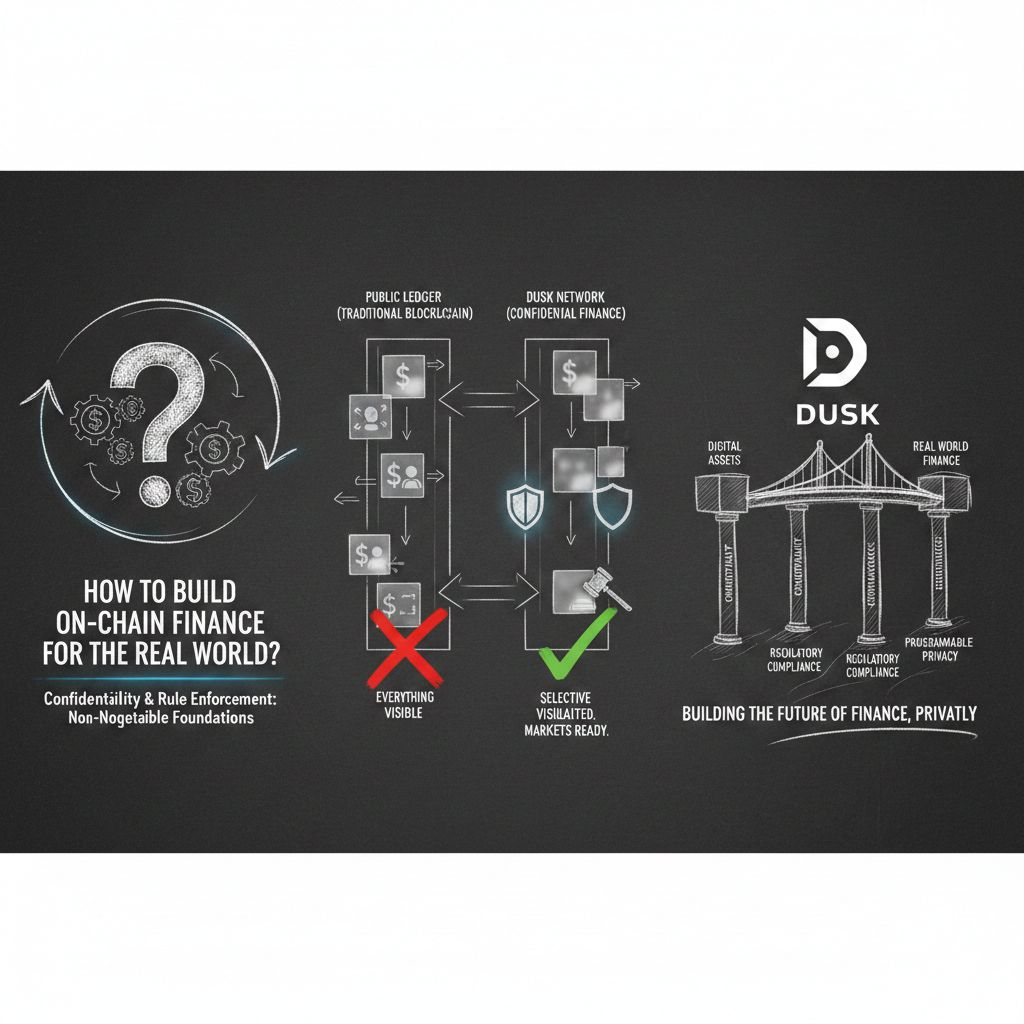
What keeps Dusk interesting is that it is not trying to win by being everything for everyone, since it is deliberately shaped around financial applications where privacy must be native and settlement must be dependable, and when you read through the way they describe the network, you can tell the architecture was designed for institutions and issuers who care about compliance boundaries, reporting requirements, and controlled disclosure, while still wanting the speed, programmability, and automation that public infrastructure makes possible.
The core idea becomes clearer when you look at how Dusk treats privacy, because it is not positioned as a hiding mechanism that breaks accountability, it is positioned as confidentiality with the ability to reveal what needs to be verified at the right time to the right parties, and that is exactly the mindset regulated finance needs, since markets do not function properly if everything is exposed, but they also cannot exist if nothing can be proven when it matters.
A big part of the behind the scenes work is the way Dusk approaches transactions, because instead of forcing one transaction style for every user and every asset, the network is built to support different modes where privacy can be strong and default for sensitive flows, while still allowing more transparent movements when transparency is the correct choice, and that dual approach matters because real financial systems do not operate in a single visibility setting, they operate across layers of confidentiality depending on product type, jurisdiction, and participant role.
When Dusk talks about Phoenix, it is basically describing the idea that transactions can be validated as correct without broadcasting private details to everyone watching the chain, and this is where the project tries to turn advanced cryptography into normal infrastructure, so users and applications can get confidentiality without needing to bolt on external privacy systems that often break composability and introduce trust risks, and when that is paired with selective disclosure mechanisms, it creates a path where privacy and auditability can coexist without either side becoming a compromise.
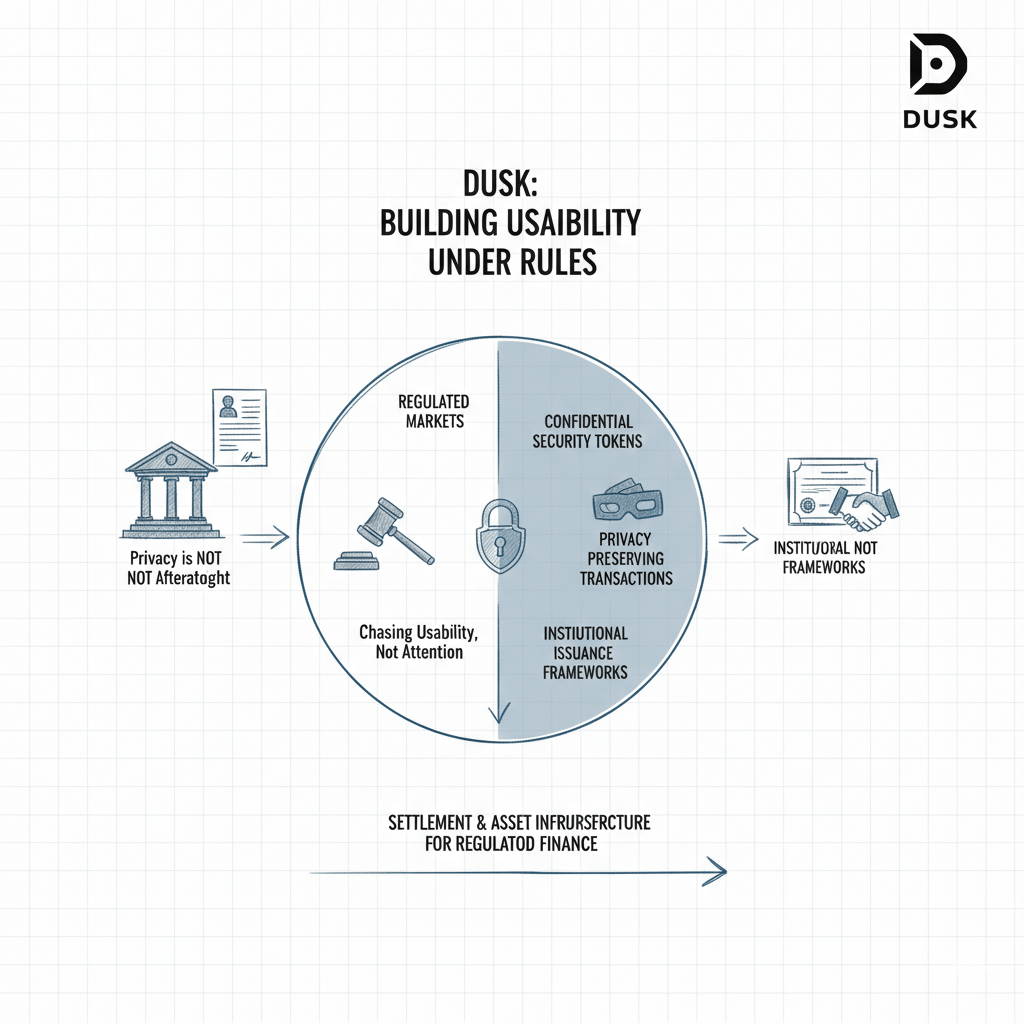
Where the project sharpens its identity is in how it talks about regulated assets and tokenized securities, because Dusk is not just aiming to move coins around, it is aiming to support financial instruments that come with rules, restrictions, and lifecycle events, and that is why their standards and frameworks around confidential security tokens exist, since a security token is not only a transferable unit, it is a programmable representation of rights and obligations that must be enforced across issuance, trading, custody, and settlement.
This is also why concepts like Zedger are meaningful in Dusk land, because the project is trying to provide a model where privacy preserving transfers and compliance controls can be baked into the same asset logic, so issuers can define what is allowed, participants can prove they meet requirements, and markets can still operate with discretion, and the reason that matters is simple, regulated markets cannot scale on fully transparent rails, and they also cannot scale on rails that ignore enforceable constraints.
The token story fits into this in a practical way, because DUSK exists today in a form you can track on chain through the ERC20 contract you shared, which shows the public footprint of the token on Ethereum along with holder activity and transfers, and at the same time the deeper role of the token is tied to how the network secures itself and coordinates participation, since in a proof of stake system the token is not just an asset people trade, it is part of how the chain stays live, consistent, and resistant to attacks.
What makes the token relevant to the project is that it is designed to support network usage and security through fees and staking, and the long term emission approach described in Dusk materials is meant to keep incentives alive over many years, which matters more than people realize, because infrastructure chains that want to host serious finance cannot depend on a short season of attention to remain secure, they need an incentive model that keeps validators and builders committed well beyond the early cycle.
When you ask what is next, the real answer is that Dusk needs to keep proving the full stack works under real conditions, meaning that privacy enabled value movement must feel smooth, compliance oriented asset behavior must be reliable, developer tooling must be approachable enough that teams can ship products without fighting the chain, and the network itself must keep tightening stability and finality so that it can honestly claim it is ready for settlement grade workloads, because in regulated finance there is no tolerance for fragile systems that work only in ideal conditions.
If Dusk executes well, the payoff is not just another layer 1 narrative, since the bigger outcome is that issuers and financial builders could create assets that behave like real instruments while still benefiting from programmable settlement, faster reconciliation, and reduced dependence on intermediaries, and that is the kind of progress that tends to grow quietly at first and then suddenly matters when the market realizes that confidentiality plus enforceable rules is the missing bridge between public chains and the financial world they want to absorb.
My takeaway is that Dusk is best understood as a disciplined attempt to build a settlement and asset infrastructure for regulated markets where privacy is not a slogan and compliance is not an afterthought, and if they keep pushing adoption around confidential security tokens, privacy preserving transactions, and issuance frameworks that real institutions can tolerate, the project has a clearer destination than most chains, because it is not chasing attention, it is chasing usability under rules.
For your last 24 hours angle, the cleanest thing you can say without guessing is what the chain data shows on the ERC20 side through the Etherscan view, since it reflects ongoing token movement and holder activity, and if you want a true project level last 24 hours section with accuracy, the best source is the most recent official Dusk announcement or changelog item, so if you paste any fresh update text you saw from their official news or a recent release note, I will reshape it into a polished last 24 hours paragraph that matches this same style and stays strictly correct.
