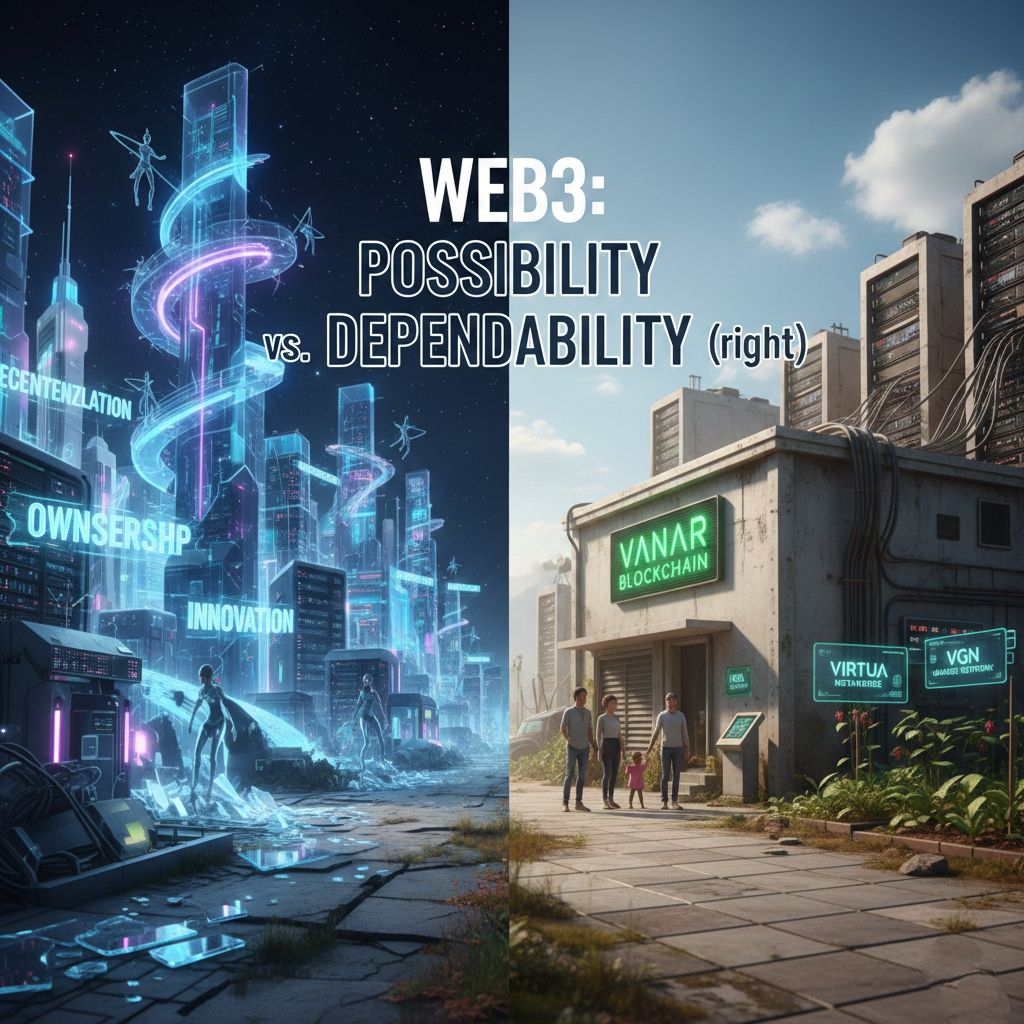
There’s a truth many of us feel but don’t always articulate. Web3 is excellent at imagining what’s possible. It’s far less consistent at delivering things people can depend on.
We’ve built an industry fluent in big language. Decentralization. Ownership. Innovation. These ideas matter. They’re why many of us stayed through cycles that were confusing, exhausting, and often disappointing. But somewhere along the way, the conversation became detached from day-to-day reality.
Because when you step away from the whitepapers and conference talks, Web3 still struggles with something basic: working reliably for real people, over time.
We don’t usually notice this all at once. It shows up gradually. A product that once felt solid starts to glitch. A platform stops updating. A community tool breaks and never quite gets fixed. A game loses momentum because simple interactions become frustrating. An NFT points to an experience that no longer exists.
There’s rarely a clear ending. Just quiet failure.
The industry tends to explain this away as a side effect of being early. But after years of repeating the same patterns, that explanation wears thin. Early doesn’t mean unstable by default. It just means priorities are still being set.
And right now, many of those priorities feel misaligned.
A lot of Web3 infrastructure is built to demonstrate concepts, not to support ongoing use. We optimize for scale as an idea rather than reliability as a lived experience. We design systems that assume constant attention, technical competence, and goodwill from everyone involved.
Real users don’t behave that way. They forget passwords. They lose interest. They expect things to work without needing to understand how. When systems fail to account for that, adoption stalls quietly, without drama.
The consequences accumulate. Builders spend energy maintaining fragile stacks instead of improving products. Communities shrink not because of disagreement, but because friction becomes exhausting. DAOs become symbolic rather than functional. Games struggle to retain players once novelty fades. NFTs lose context when the platforms around them decay.
When these issues surface, the responses often feel superficial. Another layer is added. Another abstraction is proposed. Another framework promises coordination will improve later. Many of these fixes rely heavily on trust. Trust that maintainers will stay engaged. Trust that incentives will align eventually. Trust that nothing critical will break at the wrong moment.
It’s a strange outcome for an industry that prides itself on reducing trust. In practice, a lot of Web3 systems depend on it more than they admit.
What’s missing is a serious focus on responsibility. Who is accountable when things stop working? What incentives exist to maintain systems long after launch? What consequences are there for neglect?
These questions aren’t exciting. They don’t generate attention. But they determine whether ecosystems survive.
This is where Vanar enters the picture, not as a bold promise, but as a grounded response to these gaps.
Vanar is an L1 blockchain designed from the ground up to make sense for real-world adoption. That framing matters because of the team’s background. They’ve worked in games, entertainment, and brand environments where reliability isn’t optional. Where users don’t wait patiently for fixes. Where broken experiences are simply abandoned.
That perspective shows up in the focus. Vanar isn’t trying to reinvent everything at once. It’s building infrastructure intended to support practical use across familiar areas like gaming, digital environments, and brand-driven experiences. Products such as the Virtua Metaverse and the VGN games network reflect a commitment to continuity. Staying usable. Evolving without constant breakage. Respecting the user’s time.
This kind of work rarely gets attention. It’s maintenance-heavy. It’s iterative. It’s often invisible when done well. But it’s what separates experiments from systems people rely on.
The VANRY token exists within this structure as part of how participation and incentives are aligned. Not as a promise, but as a mechanism that encourages long-term involvement rather than short-term engagement. Tokens alone don’t fix culture. But they can reinforce responsibility when they’re designed around real use, not speculation.
Vanar’s approach feels quietly important because it acknowledges something Web3 often avoids: infrastructure isn’t just philosophy. It’s service. It has to earn trust repeatedly, not just once.
This matters deeply for NFTs, DAOs, and games.
NFTs don’t exist in isolation. Their meaning depends on the environments around them. If those environments feel temporary, ownership feels abstract. DAOs don’t fail because decentralized governance is flawed. They fail because execution relies on informal coordination and unpaid effort. Games don’t struggle because they’re on-chain. They struggle when infrastructure makes everyday interaction unreliable.
Long-term Web3 use requires layers that assume imperfect behavior. People come and go. Teams evolve. Interest fluctuates. Infrastructure has to handle that reality without demanding constant attention or forgiveness.
Vanar doesn’t position itself as a revolution. That restraint is deliberate, and it matters. It frames itself as a serious attempt to close the gap between promise and practice. By focusing on usability, accountability, and incentives that reward upkeep, it treats Web3 as something meant to be lived in, not just talked about.
If Web3 is going to grow up, it won’t be because of louder narratives or sharper positioning. It will be because we finally value the unglamorous work. Reliability. Maintenance. Consequences.
Growing up doesn’t mean abandoning ideals. It means grounding them in systems that last longer than attention cycles. Systems that work quietly, consistently, and without demanding constant belief.
Web3 doesn’t need more possibility. It needs more dependability.