
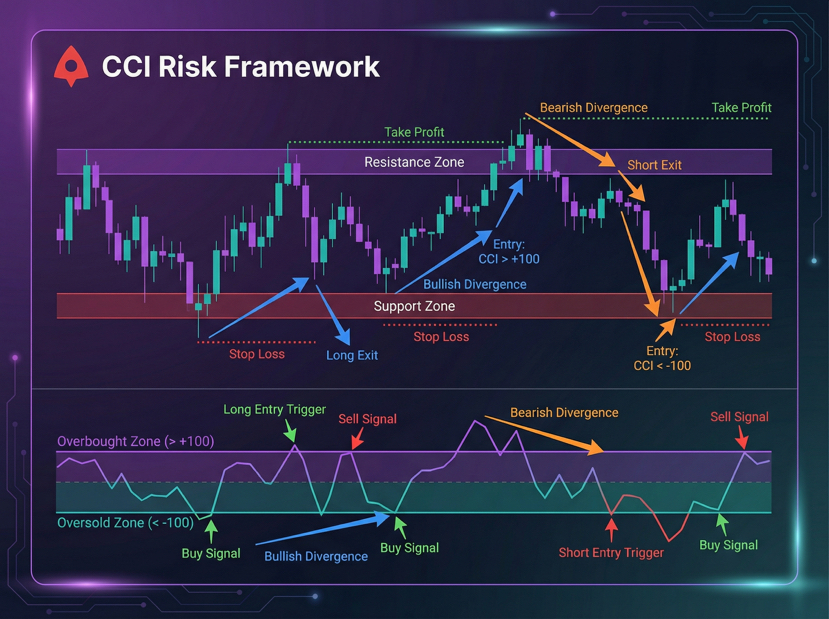
Combining the Commodity Channel Index (CCI) with disciplined risk management is essential for protecting capital while maximizing momentum-based trading opportunities. The CCI measures the current price level relative to an average price range over a given period, identifying overbought or oversold conditions. When price diverges significantly from its statistical average, the CCI becomes a powerful tool to identify potential reversal zones. However, raw signal strength alone does not guarantee safety in volatile crypto markets.
Effective risk management begins with setting appropriate position sizes. Since the CCI provides momentum-based entry signals, traders can integrate fixed fractional position sizing or percentage-based risk models. For instance, risking only 1-2% of total capital per trade ensures that even consecutive losing trades won't significantly erode account balance. Aligning trade size with measured volatility helps create room for the strategy's natural drawdown periods.
Stop-loss placement should incorporate both price action and CCI levels. A protective stop-loss can be positioned below recent swing lows for long trades or above swing highs for short setups. Alternatively, traders can trail stops using dynamic support/resistance zones. When used in tandem with CCI divergence or extreme level crossovers (such as +100 or -100), stop-losses can be adjusted based on confirmation strength. This dual approach filters out false signals while maintaining responsiveness to significant moves.
Profit targets are equally critical in managing exposure. As a momentum oscillator, the CCI signals trend exhaustion during extreme readings. Traders can scale out portions of their positions near key CCI levels such as zero-line crosses or when price reaches previous resistance zones. Using partial profit-taking allows locking in gains while giving the remainder room to run.
Crypto markets often exhibit sharp moves that can quickly trigger stops if not calibrated carefully. Buffering stop-losses slightly beyond typical volatility ranges reduces premature exits caused by noise. Combining trailing mechanisms with volatility-based indicators like Average True Range (ATR) further refines exit timing.
By embedding CCI-generated signals within a structured risk framework, traders preserve capital during adverse conditions while allowing profitable momentum plays to develop. This methodology supports longer-term sustainability and consistent performance across various market environments.