
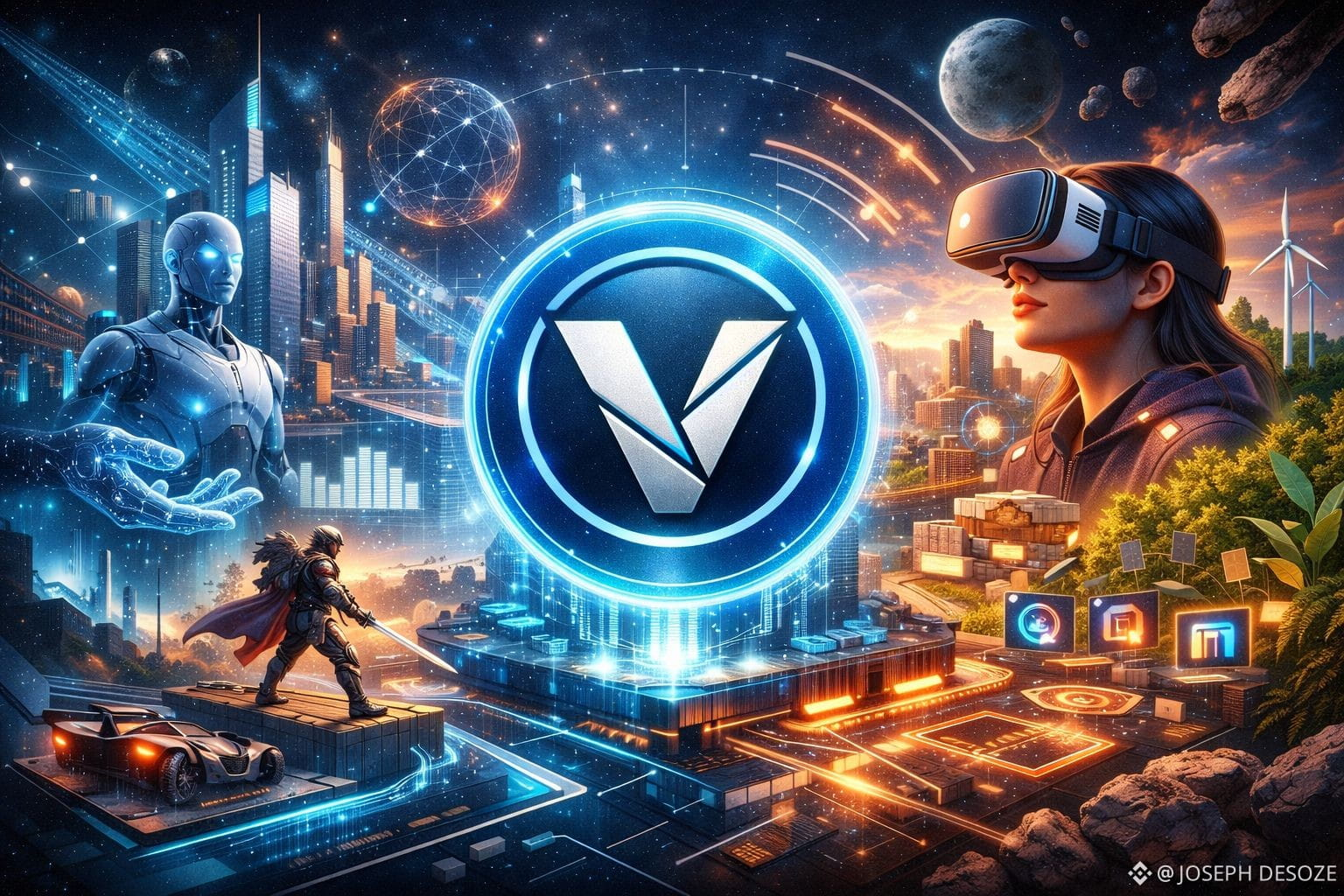
When I sit and think about Vanar Chain, I’m not just picturing a new coin bouncing up and down on a price chart, I’m picturing a team that came from games, entertainment and brand work, looking at the current state of Web3 and quietly saying this is never going to reach real people if everything stays this complicated. They’re not building only for traders or hardcore blockchain fans, they’re building for the next wave of everyday users who open games on their phone, join online communities, explore virtual worlds and interact with brands without ever wanting to learn what a consensus mechanism is. Vanar Chain is a Layer 1 blockchain that has been built from the ground up with that mindset, focused on real world adoption, especially in gaming, metaverse experiences, AI powered applications, eco projects and branded digital solutions, with its ecosystem already including things like the Virtua Metaverse and the VGN games network, all of it tied together by the VANRY token that acts as the core fuel of this universe. When you look at it from that angle, the chain stops feeling like a distant technical experiment and starts feeling like infrastructure that wants to disappear into the background of normal digital life.
To understand what Vanar Chain actually is, it helps to strip away the technical noise and say it in simple terms. Vanar is its own base blockchain, a public Layer 1 network that does not depend on someone else’s chain to function, and it is built to be friendly to developers through full EVM compatibility while also being deeply connected to AI and richer data structures. Underneath everything, the chain is essentially a customized fork of the same core software that powers Ethereum, so smart contracts are executed in a familiar environment and developers can use Solidity, common toolchains and widely used wallets with minimal friction. This choice is not an accident, it is a very deliberate “best fit” decision, because the team knows that if It becomes too exotic, most builders will simply not have the time or energy to learn yet another strange stack. By choosing to align with what people already know, they remove one of the biggest emotional and practical barriers for studios, startups and independent developers who want to build games, metaverse spaces or AI applications on a faster, cheaper chain without throwing away their existing knowledge.
On top of this familiar execution core, Vanar adds something more ambitious. The architecture is laid out as a layered system where the base chain handles transactions and structured state, while additional layers are designed to handle things like semantic memory, intelligent reasoning and automated workflows. At the simplest level, every transfer, in game purchase, marketplace trade and metaverse land sale is just a transaction that gets bundled into blocks and confirmed by validators, with VANRY used to pay the gas fee. But above that, there is a layer that focuses on storing compressed, meaningful representations of complex information, such as documents, agreements, rules and behaviors in a way that AI can work with directly on chain instead of constantly going off chain for interpretation. Then there is an AI logic layer that lets smart contracts and agents perform context aware checks, compliance rules and decision making, turning the chain from a passive ledger into something more like a living system that can actively participate in processes. Higher up, there are components designed to orchestrate flows between agents and applications, so tasks can move from one module to another automatically, whether that is a payment being routed, a subscription being adjusted or an in game reward being calculated and delivered. We’re seeing a design that tries to make intelligence and structure native to the chain instead of bolted on later.
None of this can work if the network itself is not secure and consistent, so the way Vanar reaches consensus is a key part of the story. The chain uses a model based on proof of authority guided by proof of reputation, which means that instead of letting any anonymous participant become a validator just by providing hardware or tokens, Vanar relies on a set of known, reputable validators that are responsible for creating and confirming blocks. In the early stages, these validators are run and controlled by the Vanar Foundation, which gives the project strong coordination and fast response times when upgrades or fixes are needed, and it allows the network to keep confirmation times low, which is crucial for gaming and consumer apps where people expect actions to feel instant. Over time, the idea is that more validators will be added based on reputation, performance and alignment with the ecosystem, so the circle of trust widens and the network moves closer to a distributed, multi party model instead of a foundation centric one. This path gives Vanar speed and predictability, but it also introduces a real centralization risk at the beginning, because any system where a small group controls validation is more exposed to governance mistakes, outside pressure or simply slow decentralization. That trade off is part of the project’s reality and anyone paying attention should hold it in mind while also recognizing why the team chose this route for performance and adoption reasons.
The choice to stay EVM compatible matters a lot more than it might seem at first glance. From a developer’s perspective, EVM compatibility means that contracts written for Ethereum and other similar chains can be ported to Vanar with minimal changes, that existing standards like fungible and non fungible tokens behave in familiar ways, and that standard wallets and developer tools work almost out of the box. It also means that security practices, audits and patterns that the community has built up over years remain valid here. This is important because developers do not want to gamble their entire project on an execution environment that has not been tested in the wild, and they do not want to risk subtle bugs in unfamiliar virtual machines. Vanar’s team is basically saying, we are changing the infrastructure around the engine, improving fees, performance and adding AI aware features, but we are not asking you to trust a completely new engine. For a gaming studio or a brand that wants to test Web3 features in a campaign, that sort of reassurance lowers the emotional cost of experimentation.
At the center of all this structure is the VANRY token, which is what actually flows through the system. VANRY is the native token used to pay for gas on the chain, so every transaction, contract call and state update costs a small amount of VANRY that goes to validators and helps secure the network. Beyond this basic role, VANRY also appears as the key currency and reward unit in core ecosystem products. In a metaverse like Virtua, people use VANRY to buy digital land, items and experiences, and those purchases are recorded permanently on the chain so that ownership is clear and tradable. In the VGN games network, VANRY can be used to pay for in game features, reward players or settle trades between users. In brand oriented experiences, VANRY can be tied to loyalty programs, gated access or participation in community decisions. On top of that, a portion of the total token supply is reserved for validator rewards and ecosystem incentives, which means the protocol can encourage long term security and growth by continuously rewarding those who run infrastructure or build valuable applications. Public information shows that VANRY has a fixed maximum supply and a large portion already circulating in the market, with its price and market capitalization changing over time as people form opinions about the chain’s prospects. The token is listed on major exchanges, including Binance, which helps with liquidity and accessibility, but it also exposes it to all the usual market forces, from speculation to broader macro shifts.
Talking about architecture and tokenomics is useful, but Vanar’s ambitions only become real if there is concrete usage to justify them. This is where the focus on gaming, metaverse, AI and brands comes in. The team has deep roots in entertainment and gaming, so it makes sense that some of the earliest and most visible use cases land there. In a game backed by Vanar, assets like characters, skins, items or land parcels can exist as real digital property that a player can trade, sell or carry into other experiences, not just as entries in a centralized database. In a metaverse built on the chain, the economy of land, buildings, events and rewards can be powered by VANRY and secured by the consensus layer, with AI characters and agents adding life and complexity to the world. On the brand side, imagine a loyalty campaign where attending events, watching content, making purchases and engaging on social media all contribute to a persistent on chain profile, with rewards and collectibles that can be redeemed or traded across multiple experiences. AI fits into this picture by making these experiences smarter, more adaptive and easier to manage, for example by powering NPC behavior, customizing content for each user or coordinating complex reward flows without a giant manual backend.
For people who want to keep an eye on Vanar and judge whether it is actually moving forward, there are some important metrics and signals to watch, and they all tie back to the health of the network and ecosystem. One of the most direct signals is network activity, such as the number of daily transactions and active addresses, because that shows whether the chain is being used in a meaningful way. If we see spikes of activity during major game events, metaverse launches or brand campaigns and then a steady baseline that rises over time, that would suggest real traction. Another important signal is the growth and diversity of the validator set, because moving from a foundation controlled group toward a more open and reputable multi party group is essential for long term resilience. The size and liveliness of the ecosystem matters as well, including how many projects are live, how often they are updated, how many users they attract and whether there is a steady stream of new builders entering. The behavior of the VANRY market, including price, liquidity and trading volume, can also reflect sentiment, although it is always noisy and influenced by broader conditions. Finally, progress on the roadmap for AI related features, workflows and cross chain capabilities gives a sense of whether the team is executing or just repeating promises.
At the same time, anyone looking seriously at Vanar has to be honest about the risks that surround it. The centralization risk of its early proof of authority model is genuine, because while it gives good performance, it also concentrates power, and the transition toward a more distributed validator set requires strong governance, clear rules and transparency. Competition is intense, with many chains trying to become the main home for gaming, metaverse and AI driven applications, which means Vanar has to fight for mindshare and developer attention, and good technology alone is not enough. Regulatory uncertainty may affect its ambitions around payments and tokenized real world assets, as different jurisdictions work out how they want to treat on chain value flows, and changes in those rules could force the project to adjust its design or partnerships. Ecosystem risk is always present, since games can lose players, brands can shift budgets, and AI trends can move on, leaving infrastructure looking underused if it does not keep reinventing itself. On top of all that, the market risk of VANRY itself remains, because token prices can move for many reasons that have little to do with fundamental progress, and that can shape how confident or nervous the community feels at any given moment.
Even with all of those risks laid out, there is something quietly encouraging about the direction Vanar is trying to take. We’re seeing an attempt to make Web3 feel less like a playground for a small technical crowd and more like a hidden layer that supports things ordinary people already enjoy, such as games, digital communities, creative worlds and interactive brand experiences. Instead of asking users to become experts in wallets, gas fees and consensus, the project is trying to bury that complexity deep under an architecture that remains developer friendly and AI aware. If It becomes normal one day for someone to move from a mobile game into a metaverse space, join a live event, receive a reward, trade an item and let an AI assistant handle the boring parts of payments and logistics, without once needing to ask which chain is behind it, then infrastructure like Vanar will have done its job.
In the end, you might choose to build on this chain, to hold some VANRY, or simply to watch how the story unfolds from a distance, and every one of those is a valid choice. What matters more than any single decision is the larger movement that projects like Vanar are part of, a movement that keeps asking how we can make advanced technology feel more human, more useful and more quietly supportive of everyday life instead of louder and more confusing. If Vanar manages to keep walking that path, learning from its mistakes, growing its ecosystem and steadily pushing its AI native, game friendly infrastructure toward real world value, then all the effort going into it today will have helped shape a digital future that feels a little more open, a little more creative and a little more welcoming for everyone. And for me, that is a future worth hoping for and keeping an eye on, even in the middle of all the noise.