
In recent years, discussions around the potential for quantum computers to break Bitcoin ( $BTC ) cryptographic security have gained attention across tech and finance circles. Some observers paint quantum computing as an imminent danger that could dismantle Bitcoin security model, while others argue the threat is distant and manageable. Understanding what’s real and what’s exaggerated helps separate constructive debate from unfounded alarm.
Why People Are Talking About Quantum Danger
Bitcoin relies on cryptographic algorithms like the Elliptic Curve Digital Signature Algorithm (ECDSA) and SHA-256 hashing to secure wallets and validate transactions. These cryptographic functions depend on mathematical problems that classical computers cannot efficiently solve. A sufficiently advanced quantum computer one with enough fault-tolerant qubits running algorithms like Shor’s could theoretically derive a private key from a public key, granting control over a Bitcoin address. This is the core of the “quantum threat” concept.
Current Quantum Realities: Far from Practical Threats
Despite impressive progress in quantum research, practical devices capable of cracking Bitcoin cryptography remain out of reach. Modern quantum systems are noisy and limited in scale, lacking the error-corrected qubits necessary for powerful cryptographic attacks.
For perspective, recent analyses estimate that reversing a single Bitcoin public key in a short timeframe (such as one day) would require millions of physical qubits, orders of magnitude beyond today’s capabilities. The largest quantum computers today operate at around 100-150 qubits, and even with optimistic development roadmaps, systems of the required scale are likely many years, if not decades, away.
How Much Bitcoin Would Actually Be Vulnerable?
Another important nuance is that not all BTC addresses are equally at risk. Bitcoin has evolved its address formats over time:
Legacy addresses (Pay-to-Public-Key or P2PK) reveal the public key on-chain, theoretically exposing them to quantum attacks. These represent a minority of the total Bitcoin supply roughly 8 %, or about 1.7 million BTC.
Even among these, only a relatively small amount around 10,200 BTC sits in large outputs that would matter meaningfully in market terms if compromised. Most legacy outputs are spread over many smaller transactions that would take extremely long to break, even with optimistic quantum performance assumptions.
Modern formats like P2PKH and P2SH hide public keys until funds are spent, limiting quantum exposure further until users actually transact.
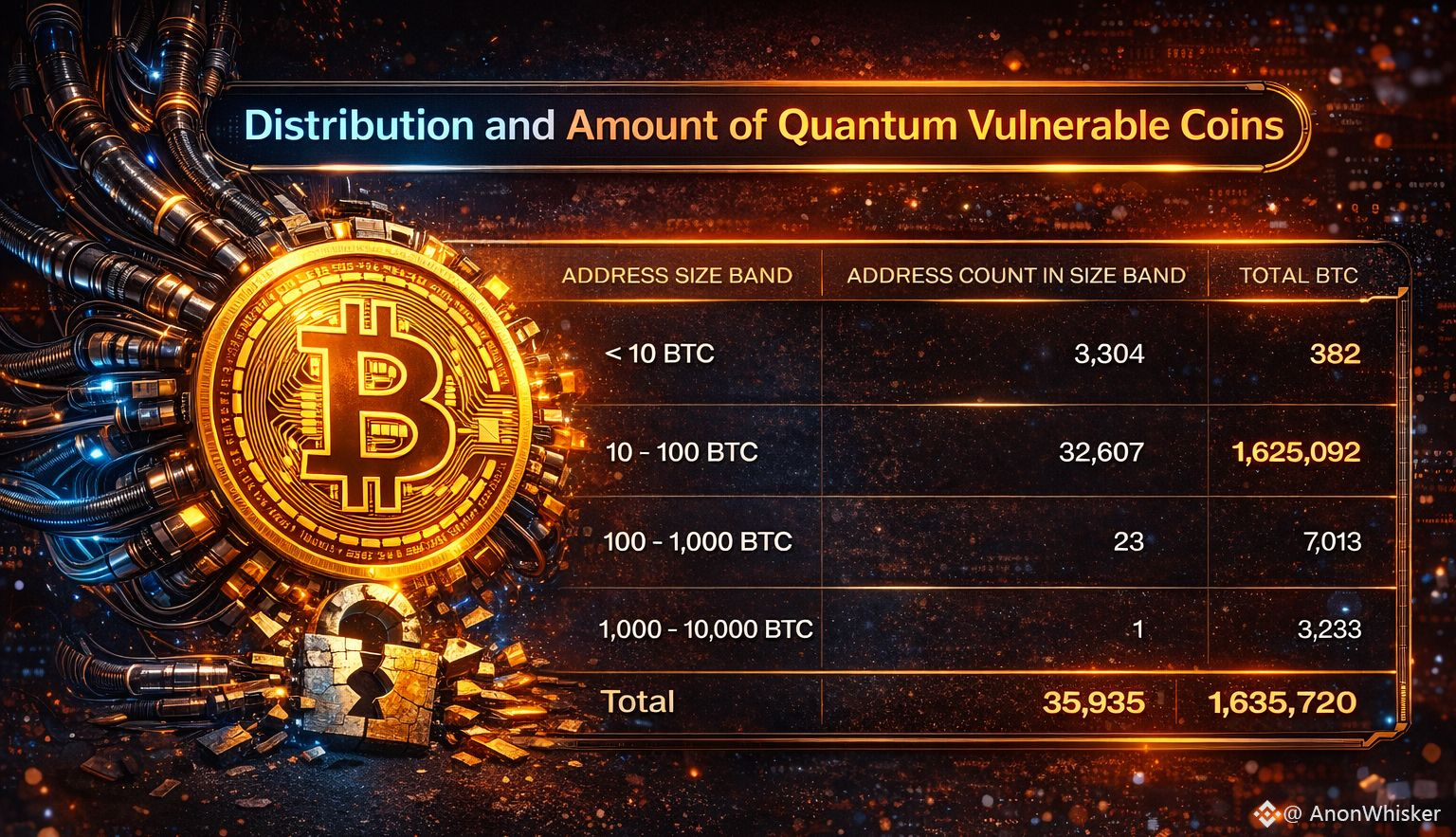
This layered vulnerability means that while theoretically susceptible coins exist, the portion that could be exploited quickly enough to disrupt markets or Bitcoin security today is very limited, according to data from Glassnode and CoinShares Research as of early February 2026.
Group Perspectives: Careful, Not Panic
Experts differ on how urgent the issue is:
Some technical voices in the Bitcoin community emphasize that quantum computing poses one of the “most serious long-term risks” to Bitcoin security model and encourage proactive planning and cryptographic hygiene.
Others, like analysts at CoinShares, stress that fears of an imminent quantum “attack” on Bitcoin are overblown. They argue the threat remains a long-term engineering challenge rather than an immediate crisis.
Institutional warnings, such as those from major asset managers, highlight the risk in regulatory filings as a material factor to consider in long-term investment strategies, albeit without concrete timelines.
Across the board, even concerned parties acknowledge that quantum threats are not around the corner in the sense of something that will instantly break Bitcoin in 2026 or 2027.
Can Bitcoin Adapt Before Quantum Becomes Dangerous?
Importantly, Bitcoin (BTC) open-source and upgradeable nature gives the community and developers tools to prepare well ahead of time. Several approaches can improve Bitcoin quantum resilience:
Migration to Quantum-Resistant Signatures: Cryptographers have developed post-quantum signature schemes including lattice-based or hash-based methods that would be much harder for quantum machines to break.
Best Practices in Wallet Management: Avoiding address reuse and moving funds from older formats to modern types shortly after transactions reduces exposure.
These moves can be phased in gradually, given the long runway before quantum systems reach the necessary power to threaten Bitcoin security.
A Risk to Watch, Not Panic About
Is quantum computing a real threat to Bitcoin? The short answer: yes, in theory but not in practice today or in the immediate future. Current quantum technology is far from capable of breaching Bitcoin cryptographic defenses at scale. And even when more powerful quantum machines do arrive, Bitcoin has time likely decades to evolve its protocols, adopt post-quantum cryptography, and implement changes gradually without undermining its decentralized philosophy.
So while quantum computing deserves careful monitoring and thoughtful preparation, it doesn’t signal an impending collapse of Bitcoin security. Instead, it highlights the importance of forward-looking research and proactive upgrades in the world’s leading cryptocurrency.
#bitcoin #quantumcomputing #CryptoSecurity #BitcoinWarnings