

How @Plasma Solves Crypto's Biggest UX Problem: The Hidden Magic Behind Zero-Fee Transfers
The Problem Every Crypto User Faces (But Nobody Talks About)
Imagine you want to send $50 USDT to a friend. Simple, right?
Not on most blockchains.
On Ethereum, you first need ETH for gas. On Binance Smart Chain, you need BNB. On Polygon, you need MATIC.
So before you can send your $50, you need to:
Buy the native token
Figure out how much gas you'll need
Hope you bought enough (but not too much)
Finally send your stablecoin
This is like needing to buy special stamps every time you want to send money through a different bank. It's confusing, expensive, and kills adoption.
#Plasma solved this with two interconnected innovations that work together like a perfectly synchronized machine.
The Two-Part Solution: Paymaster + Gas Abstraction
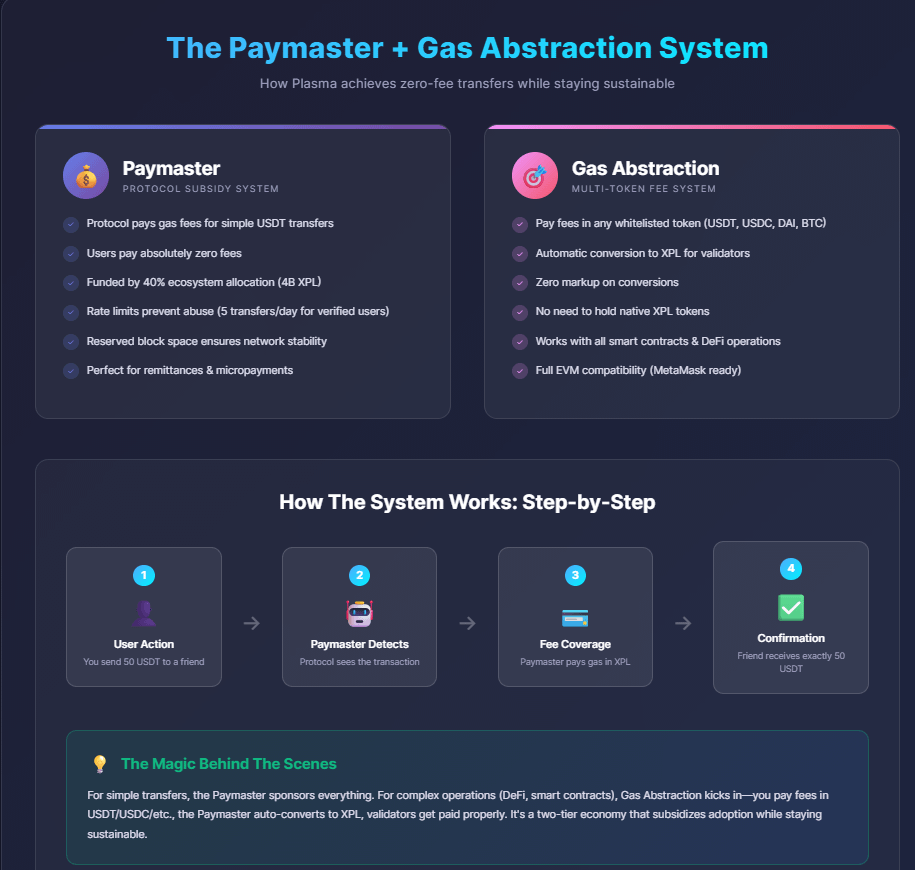
Part 1: The Paymaster System (The Protocol's Wallet)
Think of the Paymaster as a generous friend who pays your bills for you.
Here's how it works in simple terms:
When you send USDT on Plasma:
You just hit "send" – that's it
The Paymaster (a protocol-managed smart contract) automatically covers your gas fee in XPL
Your transaction goes through
You pay zero fees
The Flow:
You → Send 50 USDT → Paymaster sees it
Paymaster → Pays gas in XPL → Transaction confirmed
Your friend → Receives exactly 50 USDT
No native tokens. No gas calculations. No friction.
Part 2: Gas Abstraction (Pay Your Way)
But what about more complex transactions? Smart contract interactions? DeFi operations?
This is where Gas Abstraction comes in.
Plasma lets you pay fees in the tokens you already have:
USDT ✅
USDC ✅
DAI ✅
BTC (via pBTC) ✅
Even native dApp tokens ✅
Behind the scenes:
You want to interact with a smart contract
You pay the fee in USDT (for example)
The Paymaster automatically converts USDT to XPL
The network receives its fee in XPL
Validators get paid properly
No markup. No extra fees. Automatic.
How These Two Work Together: Real-World Examples
Example 1: Simple USDT Transfer (Basic Paymaster)
Maria (Philippines) → Sends $100 USDT → Brother (UAE)
Cost: $0
Requires: Just USDT in wallet
Speed: ~2 seconds
The Paymaster sponsors the entire fee. Maria's brother receives exactly $100.
Example 2: Smart Contract Interaction (Gas Abstraction)
Merchant → Accepts payment via smart contract → Customer pays
Customer pays: Fee in USDT (already in wallet)
Paymaster converts: USDT → XPL automatically
Validator receives: XPL for securing transaction
The customer never even knows XPL exists. They just see "pay 0.02 USDT in fees."
Example 3: DeFi Operations
User → Deposits USDC in lending protocol
Pays gas in: USDC
Paymaster handles: Conversion to XPL
Network gets: Proper validator compensation
The Economics: How Does Plasma Pay for This Without Going Bankrupt?
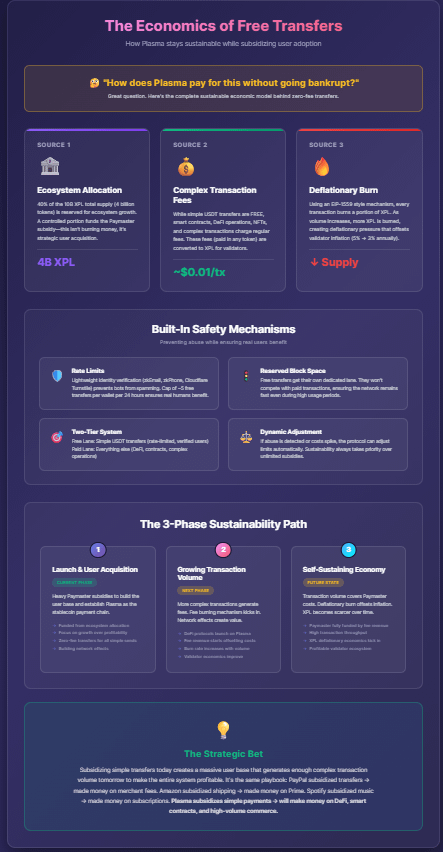
Great question. Free things usually don't last. Here's Plasma's sustainable model:
Funding the Paymaster
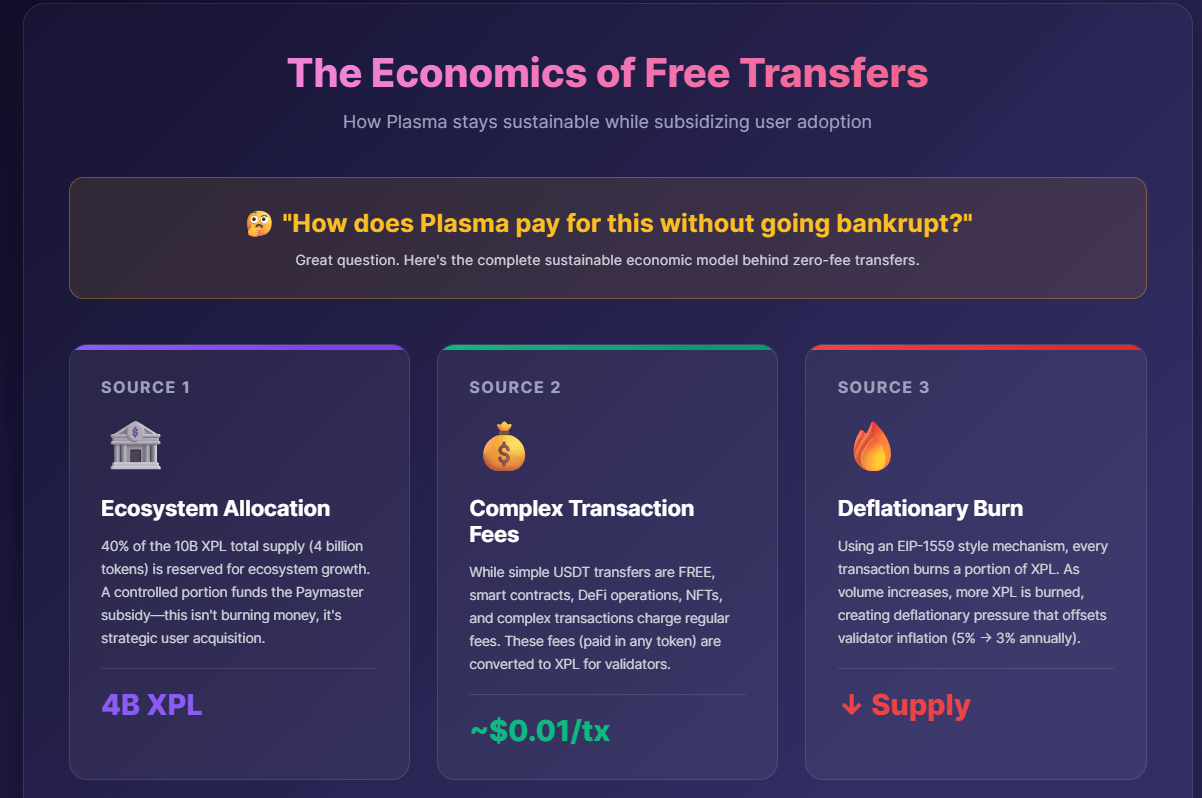
1. Ecosystem Allocation (40% of 10B XPL)
4 billion XPL tokens reserved for ecosystem growth
A controlled portion funds the Paymaster subsidy
This isn't a "burn money" model – it's strategic user acquisition
2. Revenue from Complex Transactions
Simple USDT transfers: FREE ✅
Smart contracts, DeFi, NFTs, complex operations: Regular fees 💰
These fees (paid in any token) are converted to XPL for validators
3. The Deflationary Mechanism (EIP-1559 Style)
Every transaction burns a portion of XPL
As transaction volume increases → more XPL burned
This creates deflationary pressure
Helps offset the inflation from validator rewards (5% → 3% annually)
The Built-In Safety Systems
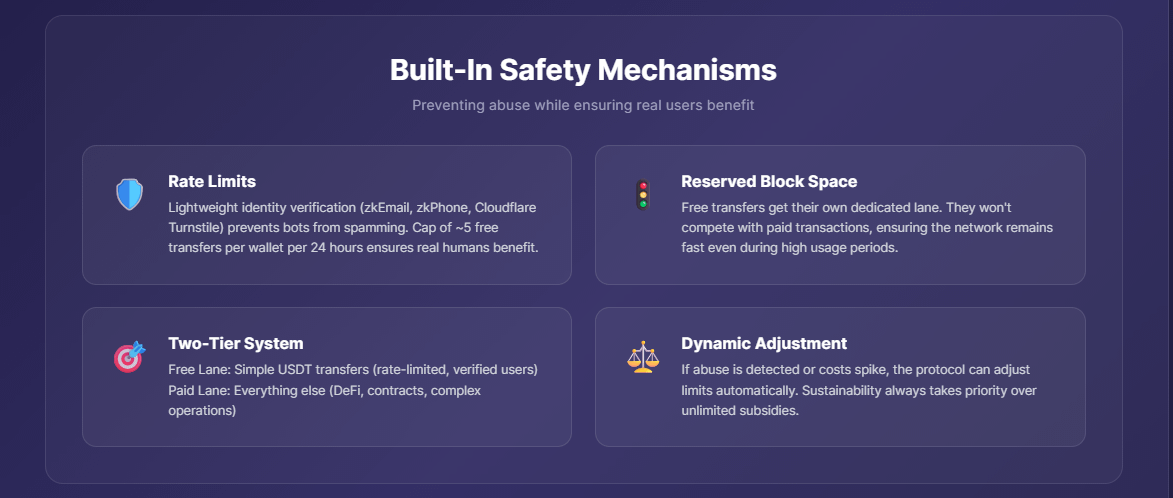
Rate Limits:
Lightweight identity verification (zkEmail, zkPhone, Cloudflare Turnstile)
Prevents bots from spamming free transactions
Example: Cap of ~5 free transfers per wallet per 24 hours
Ensures real humans benefit, not spam bots
Reserved Block Space:
Free transfers get their own dedicated lane
Won't compete with paid transactions
Network remains fast even during high usage
Two-Tier System:
Free Lane: Simple USDT transfers (rate-limited, verified users)
Paid Lane: Everything else (DeFi, contracts, complex operations)
This ensures the network stays economically sustainable while offering the best UX in crypto.
Why This Matters: The Real-World Impact
1. Remittances ($50 USDT from Dubai → Philippines)
Traditional Banks:
Fee: $15-25
Time: 3-5 days
Total received: $35
Ethereum:
Fee: $5-20 (depending on congestion)
Time: 2-15 minutes
Needs: ETH first
Plasma:
Fee: $0
Time: ~2 seconds
Needs: Just USDT
Total received: $50
2. Micropayments (Content Creators)
Scenario: Tipping a content creator $1
Other chains: Gas fee might be $2-5 → Makes no sense
Plasma: $0 fee → The full $1 goes to the creator
This unlocks entirely new use cases that were economically impossible before.
3. Merchant Adoption
The Old Way:
"Accept crypto payments!"
Merchant: "Okay... but customers need ETH first? And gas fees are unpredictable? Pass."
The Plasma Way:
"Accept USDT payments – customers pay in USDT, no gas tokens needed, fees are negligible."
Merchant: "That's actually usable. Let's do it."
Compared to Ethereum's Gas UX Nightmare
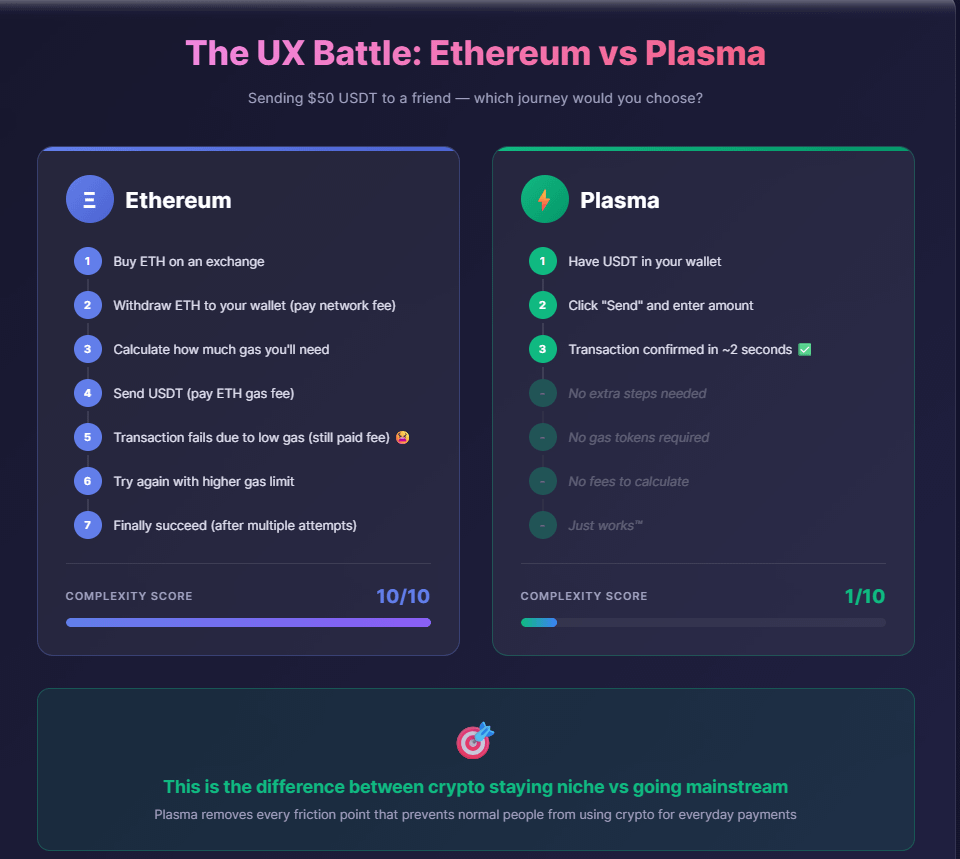
Ethereum User Journey:
Buy ETH on exchange
Withdraw to wallet (pay network fee)
Now you can use USDT (pay ETH gas)
Gas price spikes during congestion
Transaction fails (still paid gas)
Try again with higher gas
Finally succeed
Complexity Score: 10/10 😫
Plasma User Journey:
Have USDT in wallet
Send USDT
Complexity Score: 1/10 ✅
This is the difference between crypto staying niche vs going mainstream.
Technical Deep Dive: How It Actually Works
The Paymaster Contract Architecture
Protocol-Managed (Not Third-Party)
Maintained by Plasma Foundation
Audited for security
No external dependencies
No markup or hidden fees
Whitelisted Tokens
USDT (Tether)
USDC (Circle)
DAI (MakerDAO)
pBTC (Bitcoin via Plasma's trust-minimized bridge)
Additional tokens added based on usage and liquidity
Automatic Conversion Logic
User pays → Token X
Paymaster receives → Token X
Paymaster swaps → XPL (at fair market rate, no markup)
Validator receives → XPL
Full EVM Compatibility
Works with MetaMask ✅
Works with any EVM wallet ✅
No custom integration needed ✅
Developers don't need to change anything ✅
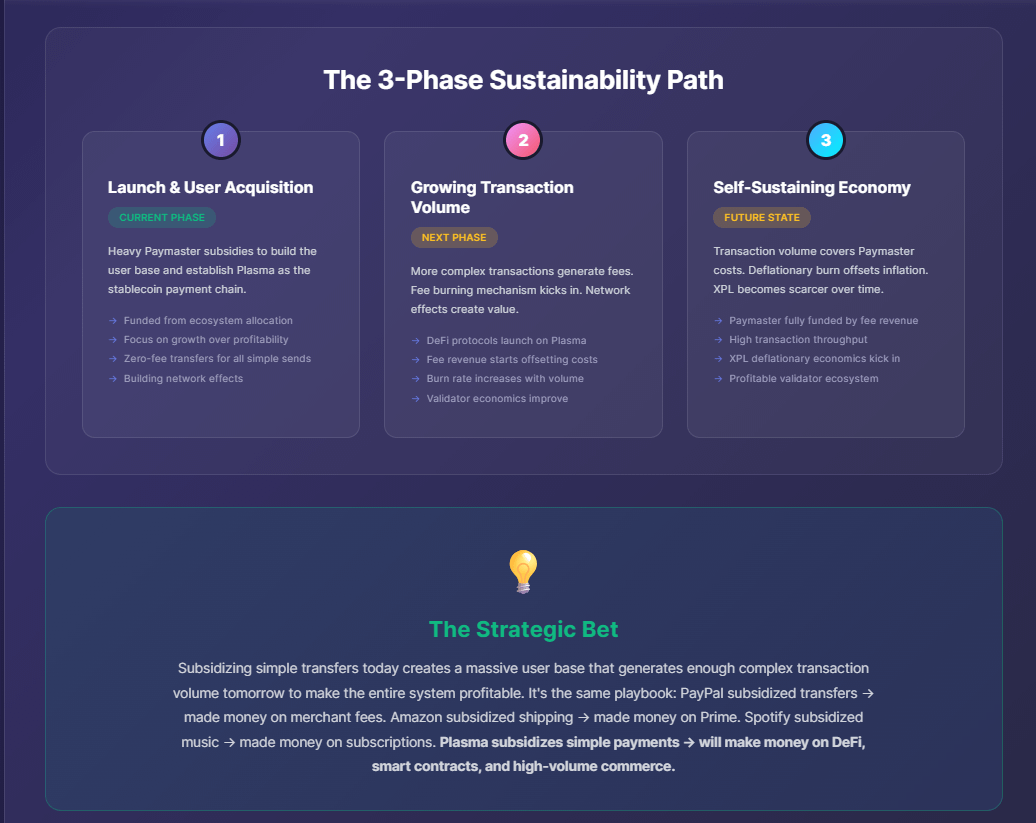
The Long-Term Sustainability Model
Phase 1: Launch & User Acquisition (Current)
Heavy Paymaster subsidies
Build user base
Establish Plasma as the stablecoin payment chain
Cost: Funded from 40% ecosystem allocation
Phase 2: Growing Transaction Volume
More complex transactions generate fees
Fee burning mechanism kicks in
Network effects: more users = more value
Phase 3: Self-Sustaining Economy
Transaction volume covers Paymaster costs
Deflationary burn offsets validator inflation
XPL becomes scarcer over time
Validators earn from high transaction volume
The Bet: Subsidizing simple transfers today creates a massive user base that generates enough complex transaction volume tomorrow to make the entire system profitable.
Similar Playbook:
PayPal subsidized transfers → made money on merchant fees
Amazon subsidized shipping → made money on Prime memberships
Spotify subsidized music → made money on subscriptions
Critical Questions Answered
Q: Won't spam kill the free transfers?
A: Rate limits + identity verification prevent abuse. Only verified humans get unlimited free simple transfers within reasonable limits.
Q: What happens if gas costs spike?
A: Paymaster absorbs the cost for basic transfers. Complex operations still pay fees, which adapt to market conditions.
Q: Can the Paymaster run out of funds?
A: Funded by 4 billion XPL ecosystem allocation + fees from complex transactions. If volume grows as expected, it becomes self-sustaining.
Q: Why would anyone hold XPL if they can pay in USDT?
A: XPL is needed for:
Validator staking (earn rewards)
Governance votes
Complex DeFi operations
Some dApps may accept it for specific utilities
The Bigger Picture: Why This Innovation Matters
Crypto has spent 15 years solving technical problems:
Scalability ✅ (Solved with L2s)
Speed ✅ (Solved with new consensus)
Security ✅ (Solved with better cryptography)
But we never solved the UX problem.
The Paymaster + Gas Abstraction combo is the first serious attempt to make crypto feel like using Venmo or PayPal.
No more:
"Wait, I need ETH first?"
"How much gas should I use?"
"Why did my transaction fail?"
"Where did my $20 in gas fees go?"
Just:
Open wallet
Send money
Done
Final Thoughts: The Real Genius
The genius of Plasma isn't just technical – it's strategic:
Target the right use case (stablecoins = $250B+ market)
Remove all friction (Paymaster + Gas Abstraction)
Make it sustainable (Two-tier economy)
Focus on real utility (remittances, payments, commerce)
This isn't innovation for innovation's sake.
This is solving the #1 reason crypto hasn't gone mainstream: It's too complicated and expensive for normal people.
If Plasma succeeds, we'll look back at "buying ETH to pay gas on USDT transfers" the same way we now look at dial-up internet – a necessary but absurd temporary state of technology.
Key Takeaways
✅ Paymaster = Protocol pays your gas for simple USDT transfers (zero fees)
✅ Gas Abstraction = Pay fees in any token you already have (USDT, BTC, etc.)
✅ Economic Model = Subsidize simple transfers, monetize complex ones, burn fees to stay sustainable
✅ Real Impact = Makes crypto payments actually usable for remittances, micropayments, and merchants
✅ The Future = If adoption grows, transaction volume makes the system self-sustaining
Plasma isn't trying to be the next Ethereum killer.
It's trying to be the first blockchain your non-crypto friends would actually use.
And with the Paymaster + Gas Abstraction working together, they might actually have a shot.

