

The first thing I remember wasn’t a breakthrough. It was fatigue.
I had been staring at documentation that didn’t try to sell me anything. No polished onboarding flow. No deploy in five minutes promise. Just dense explanations, unfamiliar abstractions, and tooling that refused to behave like the environments I’d grown comfortable with. Commands failed silently. Errors were precise but unforgiving. I kept reaching for mental models from Ethereum and general purpose virtual machines, and they kept failing me.
At first, it felt like hostility. Why make this harder than it needs to be?
Only later did I understand that the discomfort wasn’t accidental. It was the point.
Working with Vanar Network forced me to confront something most blockchain systems try to hide: operational reality is messy, regulated, and intolerant of ambiguity. The system wasn’t designed to feel welcoming. It was designed to behave predictably under pressure.
Most blockchain narratives are optimized for approachability. General-purpose virtual machines, flexible scripting, and permissive state transitions create a sense of freedom. You can build almost anything. That freedom, however, comes at a cost: indistinct execution boundaries, probabilistic finality assumptions, and tooling that prioritizes iteration speed over correctness.
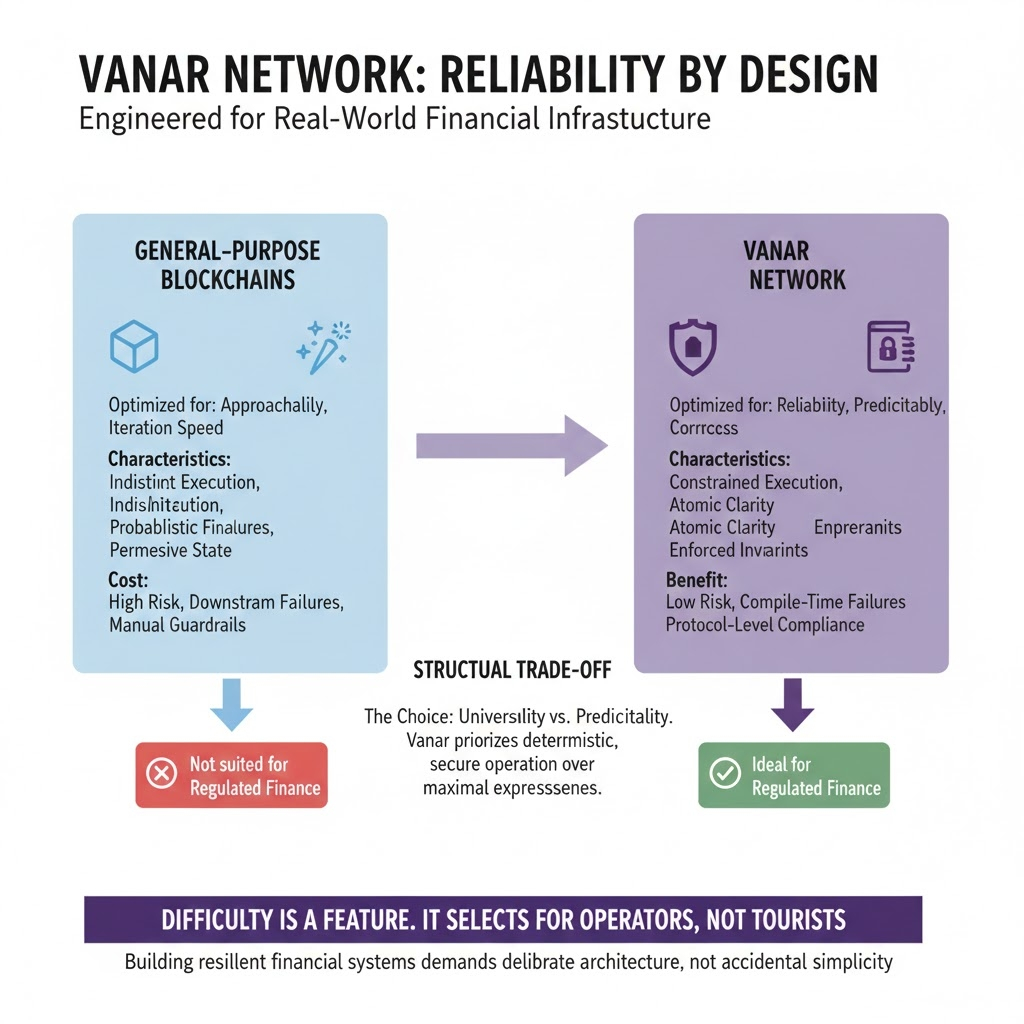
Vanar takes the opposite stance. It starts from the assumption that execution errors are not edge cases but the norm in real financial systems. If you’re integrating stablecoins, asset registries, or compliance constrained flows, you don’t get to patch later. You either enforce invariants at the protocol level, or you absorb the failure downstream usually with legal or financial consequences.
That assumption shapes everything.
The first place this shows up is in the execution environment. Vanar’s virtual machine does not attempt to be maximally expressive. It is intentionally constrained. Memory access patterns are explicit. State transitions are narrow. You feel this immediately when testing contracts that would be trivial elsewhere but require deliberate structure here.
This is not a limitation born of immaturity. It’s a defensive architecture.
By restricting how memory and state can be manipulated, Vanar reduces entire classes of ambiguity: re-entry edge cases, nondeterministic execution paths, and silent state corruption. In my own testing, this became clear when simulating partial transaction failures. Where a general purpose VM might allow intermediate state to persist until explicitly reverted, Vanar’s execution model forces atomic clarity. Either the state transition satisfies all constraints, or it doesn’t exist.
The trade off is obvious: developer velocity slows down. You write less “clever” code. You test more upfront. But the payoff is that failure modes become visible at compile time or execution time not weeks later during reconciliation.
Another friction point is Vanar’s approach to proofs and verification. Rather than treating cryptographic proofs as optional optimizations, the system treats them as first-class execution artifacts. This changes how you think about performance.
In one benchmark scenario, I compared batch settlement of tokenized assets with and without proof enforcement. Vanar was slower in raw throughput than a loosely constrained environment. But the latency variance was dramatically lower. Execution time didn’t spike unpredictably under load. That matters when you’re integrating stablecoins that need deterministic settlement windows.
The system accepts reduced peak performance in exchange for bounded behavior. That’s a choice most narrative driven chains avoid because it looks worse on dashboards. Operationally, it’s the difference between a system you can insure and one you can only hope behaves.
Stablecoin integration is where Vanar’s philosophy becomes impossible to ignore. There is no pretense that money is neutral. Compliance logic is not bolted on at the application layer; it is embedded into how state transitions are validated.
When I tested controlled minting and redemption flows, the friction was immediate. You cannot accidentally bypass constraints. Jurisdictional rules, supply ceilings, and permission checks are enforced as execution conditions, not post-hoc audits.
This is where many developers recoil. It feels restrictive. It feels ideological.
But in regulated financial contexts, neutrality is a myth. Someone always enforces the rules. Vanar simply makes that enforcement explicit and machine-verifiable. The system trades ideological purity for operational honesty.
Comparing Vanar to adjacent systems misses the point if you frame it as competition. General purpose blockchains optimize for optionality. Vanar optimizes for reliability under constraint.
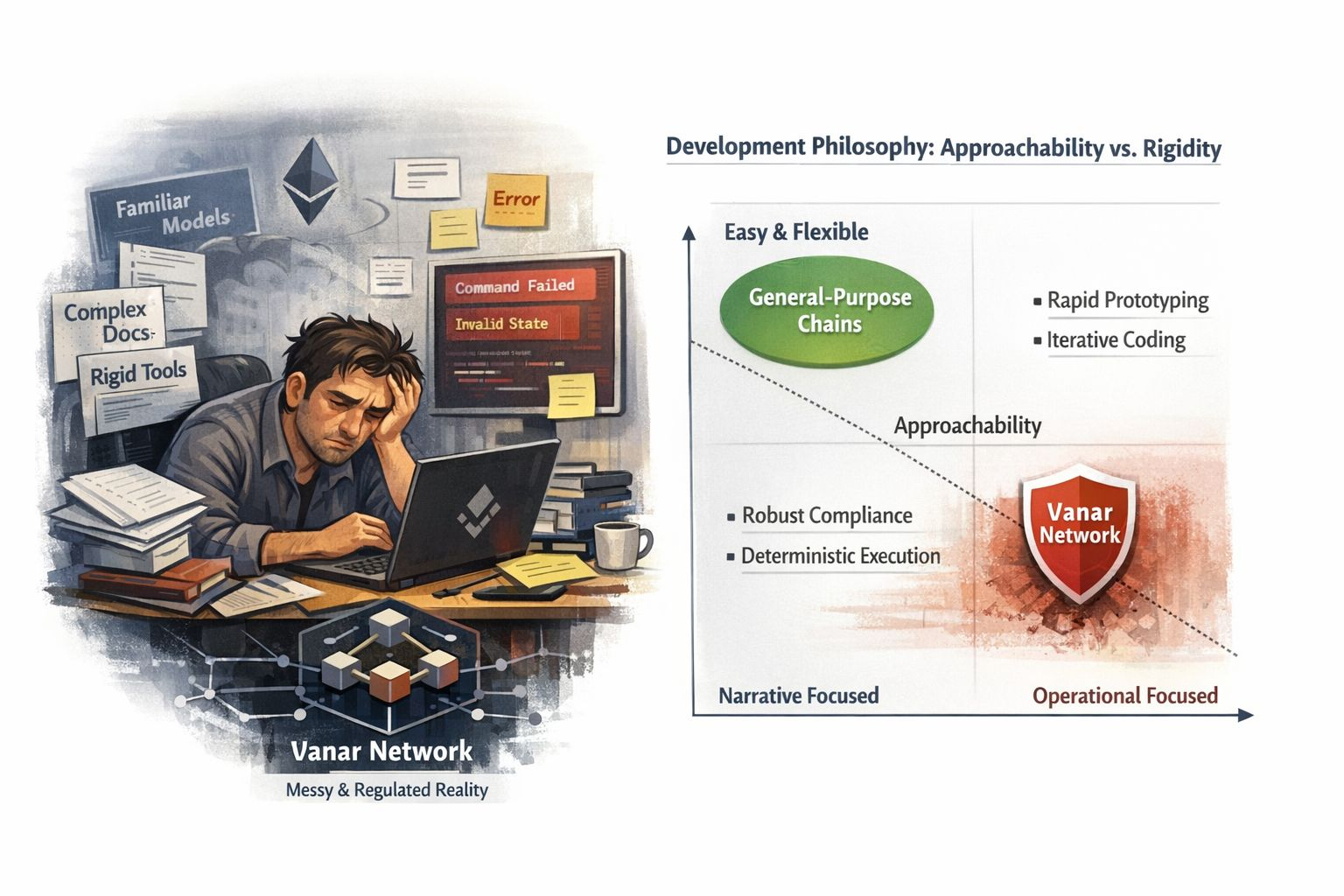
I’ve deployed the same conceptual logic across different environments. On general-purpose chains, I spent more time building guardrails in application code manual checks, off chain reconciliation, alerting systems to catch what the protocol wouldn’t prevent. On Vanar, that work moved downward into the protocol assumptions themselves.
You give up universality. You gain predictability.
That trade off makes sense only if you believe that financial infrastructure should behave more like a clearing system than a sandbox.
None of this excuses the ecosystem’s weaknesses. Tooling is rough. Documentation assumes prior context. There is an undeniable tone of elitisman implicit expectation that if you don’t get it, the system isn’t for you.
That is not good for growth. It is, however, coherent.
Vanar does not seem interested in mass onboarding. Difficulty functions as a filter. The system selects for operators, not tourists. For teams willing to endure friction because the cost of failure elsewhere is higher.
That posture would be a disaster for a social network or NFT marketplace. For regulated infrastructure, it may be the only honest stance.
After weeks of working through the friction,failed builds, misunderstood assumptions, slow progress,I stopped resenting the system. I started trusting it.
Not because it was elegant or pleasant, but because it refused to lie to me. Every constraint was visible. Every limitation was deliberate. Nothing pretended to be easier than it was.
Vanar doesn’t promise inevitability. It doesn’t sell a future where everything just works. It assumes the opposite: that systems fail, regulations tighten, and narratives collapse under real world pressure.
In that context, difficulty is not a barrier. It’s a signal.
Long term value does not emerge from popularity or abstraction. It emerges from solving hard, unglamorous problems, state integrity, compliance enforcement, deterministic execution, long before anyone is watching.
Working with Vanar reminded me that resilience is not something you add later. It has to be designed in, even if it hurts.
