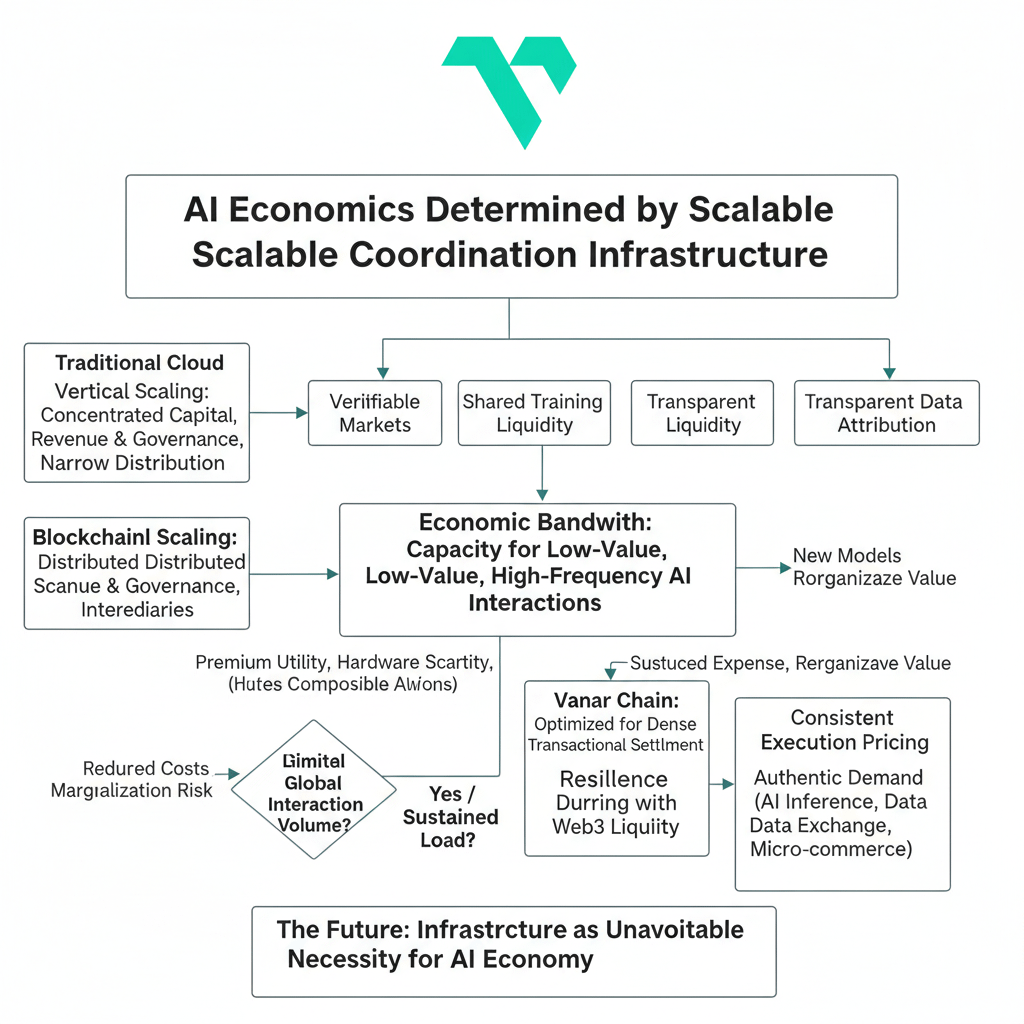
Artificial intelligence is frequently framed as a breakthrough in algorithms,yet its binding constraint is economic infrastructure.Training cycles,inference requests,and persistent data storage all rely on systems capable of handling enormous computational demand at predictable and declining marginal cost. When scale changes,the governing economics of AI change with it.This structural shift is why the convergence of scalable blockchain coordination and machine intelligence is emerging as a defining theme in the digital asset landscape.
At limited scale,AI resembles a premium utility.Compute access is concentrated, pricing reflects hardware scarcity,and participation is filtered through centralized intermediaries.Under those conditions, innovation progresses,but distribution remains narrow.Once infrastructure achieves genuine network level throughput,the equation reverses.Marginal costs compress, coordination friction declines,and previously impractical models continuous micro payments for inference,decentralized data contribution markets,and programmable ownership of model outputs become economically feasible.Scale therefore does more than reduce expense;it reorganizes value creation itself.
Historical precedent from the evolution of internet bandwidth clarifies this transition. Early connectivity costs restricted experimentation.As transmission capacity expanded,entirely new industries streaming media,cloud software,and real time digital collaboration materialized.AI appears to be approaching an analogous threshold.The decisive question is no longer whether intelligence scales,but which infrastructure layer will coordinate that expansion and internalize the economic upside.
Conventional cloud architecture scales vertically through concentrated capital deployment.Blockchain native systems pursue horizontal scaling through distributed coordination.This divergence carries long term implications.Vertical expansion centralizes revenue capture and governance authority,whereas horizontal coordination enables open participation and composable economic layers.Within an AI context,this could translate into verifiable inference markets,shared training liquidity,and transparent data attribution functions difficult to guarantee inside closed computational silos.
Seen through this framework,Vanar Chain becomes relevant not as speculative infrastructure but as an execution environment designed for sustained digital throughput.The meaningful conceptual evolution here is the transition from measuring performance in transactions per second to evaluating economic bandwidth the capacity to settle vast numbers of low value,high frequency AI interactions reliably and affordably.If AI adoption continues toward ambient,always on usage,only infrastructures optimized for dense transactional settlement will remain competitive.
Current on chain sector growth reinforces this interpretation.Capital and developer attention are concentrating around restaking frameworks,data availability layers,and decentralized compute coordination each indirectly responding to anticipated AI demand.Market behavior suggests that scalable coordination is becoming more valuable than simple token transfer functionality.Networks unable to sustain low cost execution under persistent load risk marginalization regardless of technical sophistication.
Yet scale introduces symmetrical risk. Reduced execution cost can amplify spam, adversarial automation,and fragile token driven incentive loops.Economic architecture therefore becomes inseparable from technical design.Throughput without disciplined incentive engineering may accelerate instability rather than adoption. Sustainable fee logic and predictable settlement guarantees matter more than theoretical peak performance.
From my professional perspective,Vanar Chain’s opportunity lies in emphasizing measurable utility density instead of narrative positioning.AI linked economies will demand consistent execution pricing,resilience during demand spikes,and interoperability with broader liquidity layers across Web3.My practical suggestion is that Vanar should prioritize verifiable real world workload integration AI inference settlement,data exchange finality,or machine driven micro commerce over symbolic ecosystem expansion.Durable relevance will emerge from observable transaction purpose,not promotional visibility.
The structural conclusion is straightforward:
AI economics will be determined by scalable coordination infrastructure rather than model sophistication alone.
Whichever network enables trustworthy,low friction settlement at global interaction volume will shape the foundation of the next digital economy.
For analysts,builders,and investors,the actionable insight is to evaluate infrastructure through evidence of sustained economic activity stable fee behavior,execution reliability,and authentic demand generation. True scale is not headline growth;it is the point at which technology transitions from impressive capability to unavoidable necessity.