
When people say “this L1 is built for real-world adoption,” I usually brace myself for the usual: a paragraph about TPS, a paragraph about “community,” and a paragraph about how everything will be solved by “mass adoption” in the future tense.
Vanar feels different to me for a simpler reason: it doesn’t read like it was designed to impress crypto people. It reads like it was designed to survive contact with game studios, entertainment teams, and brands — the kind of people who will happily use blockchain only if it stops acting like blockchain.
In consumer products, the chain can’t be a personality. It has to be plumbing. If a player ever has to think, “Wait, which network am I on?” or “Why did this transaction cost more than the item?” you’ve already lost them. Vanar’s whole vibe points at that problem: make the fees small enough that nobody feels them, keep the experience predictable, and make it easy for builders to ship without rewriting their entire stack.
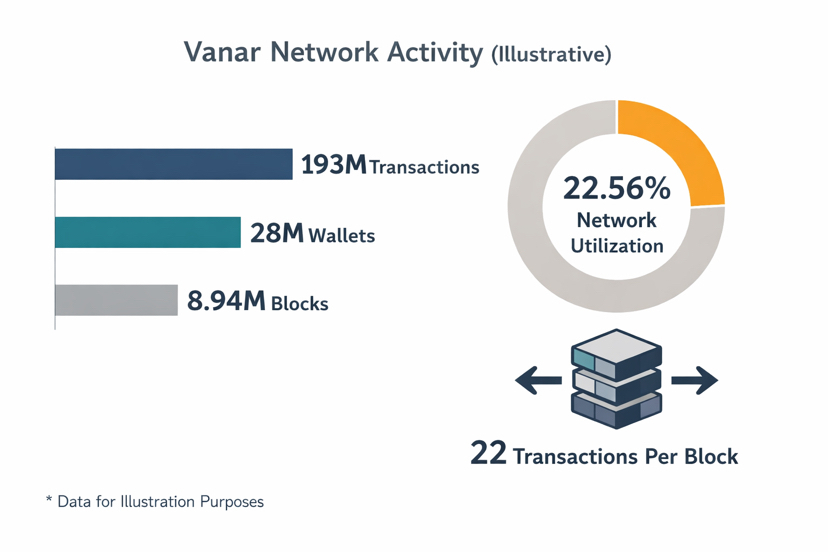
One of the quickest ways to see whether that’s more than talk is to look at what the chain is actually doing. When I last looked at Vanar’s mainnet explorer, it was showing activity in the “consumer scale” direction — not a few big DeFi transactions, but lots of small movements: roughly 193M transactions, around 28M wallet addresses, and millions of blocks. That doesn’t automatically mean “real users,” because crypto can inflate addresses and automate activity. But it does match the kind of background noise you’d expect from marketplaces, quests, in-game actions, and constant micro-events that come with entertainment ecosystems. If your chain is aiming at games, it should look more like a busy city intersection than a quiet bank vault.
And then there’s the unsexy detail that matters more than most roadmaps: fees. The explorer was showing tiny transaction fees (on the order of a few thousandths of a VANRY for simple transfers). In a consumer world, that’s not just “nice.” That’s the difference between a flow people repeat ten times a day and a flow they abandon after the first try. Games train users to expect instant feedback; they don’t train users to tolerate friction.
That’s also why VANRY’s “utility” matters in a very practical way. Yes, it’s the gas token. Yes, it’s tied into staking and governance in the documentation. But the real question for a chain like this isn’t “does the token have utility?” It’s “does the token make the product feel stable?” If the whole ecosystem relies on frequent, low-value actions — buying an item, upgrading an asset, minting a badge, proving access — then predictable costs are basically the product.
Where Vanar becomes a little more polarizing (and honestly more interesting) is its attitude toward validators and governance. A lot of consumer-facing partners don’t want anonymous infrastructure with unclear accountability. They want predictable uptime, known operators, and a sense that somebody can be called when something breaks. Vanar’s documentation leans into that reality with a reputation-led approach: foundation involvement early on, validators brought in through a reputation lens, and a staking setup where the community can delegate but the validator set isn’t framed as a totally open free-for-all.
That’s a very “mainstream-friendly” posture — and it’s also the part that needs the most trust-building over time. Because the trade-off is obvious: the more curated the validator set is, the more important transparency becomes. People will want to know what the rules are, how those rules change, and what the path looks like from “we run key parts of this” to “this is meaningfully independent.”
The token’s design on Ethereum also hints at the same practical mindset. The contract pattern shown publicly includes the kind of controls you often see in ecosystems that expect to work with bigger partners: capped supply mechanics, role-based permissions, even pausing capabilities in the familiar OpenZeppelin style. I’m not saying that as a scare tactic — plenty of serious projects use these patterns. I’m saying it because it tells you the team is optimizing for operational control and safety rails, not just ideology. If you’re building a consumer ecosystem, those rails can be helpful. If you’re judging decentralization purity, you’ll naturally ask harder questions.
The part of the Vanar ecosystem that makes this feel less theoretical is Virtua. A lot of L1s talk about “gaming” and then you discover they mean one NFT mint page and a Discord server. Virtua is an actual product orbit — and the marketplace angle is a real stress test. Marketplaces are brutally honest: if transactions are slow, if fees feel random, if wallets are confusing, the user doesn’t write a think-piece about it — they just leave. So having a marketplace story close to the chain is, in practice, a commitment to being judged on UX instead of slogans.
And then there’s the piece I personally find the most “Vanar-ish”: the focus on on-chain memory through Neutron. Most chains treat storage and media like someone else’s problem — “Here’s the token, here’s the transaction, good luck hosting the actual content.” Vanar is trying to tackle the part consumers actually care about: “Will my stuff still work later?”
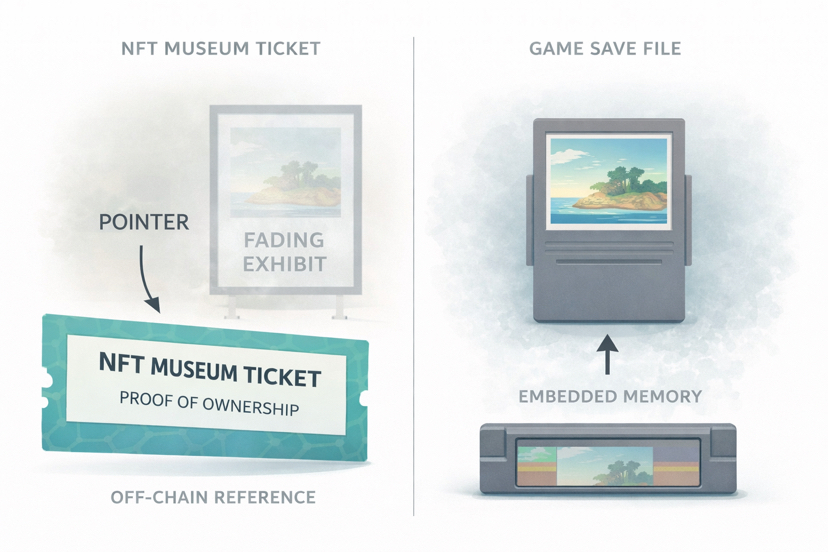
The way I explain this to non-crypto friends is: a lot of NFTs today are like owning a museum ticket that proves you paid — but the museum itself is rented, and the exhibit can disappear. You “own” something, but what you own is a pointer. Vanar’s Neutron idea is basically trying to make the asset more like a game save file that can travel with you — not just proof you owned something once, but a durable, reconstructable form of meaning and state. Even if you’re skeptical of the bold demo claims, the underlying problem they’re aiming at is real, and it’s one of the reasons consumer trust breaks so easily in Web3.
The other thing I appreciate, purely on a practical level, is that Vanar didn’t choose “developer novelty.” It chose EVM compatibility. That’s like choosing to build a restaurant in a busy neighborhood instead of inventing a new city. It’s not romantic, but it’s how you get people in the door. Games and entertainment teams already have enough complexity without adopting an exotic dev environment just to experiment with digital ownership.
So when I step back, I don’t think Vanar’s main story is “we’re a better chain.” I think the real story is “we’re trying to be a chain that consumer products can tolerate.” That’s a narrower goal than most L1s claim — and weirdly, it might be the smarter one.
If you’re watching Vanar with a clear head, the best questions aren’t hype questions. They’re boring questions — the kind of questions real adoption answers for you over time. Does the activity you see on-chain start lining up with actual product usage rather than address churn? Do fees stay reliably tiny as the ecosystem grows? Does the validator model become more transparent and more plural over time? Does the “memory” idea turn into tools developers actually use, not just impressive demos?
If those things go right, Vanar ends up in a rare spot: the chain becomes the thing nobody talks about because it simply works. And in consumer tech, that’s the highest compliment you can get.
#vanar $VANRY @Vanarchain
VANR
0.006202
-1.54%