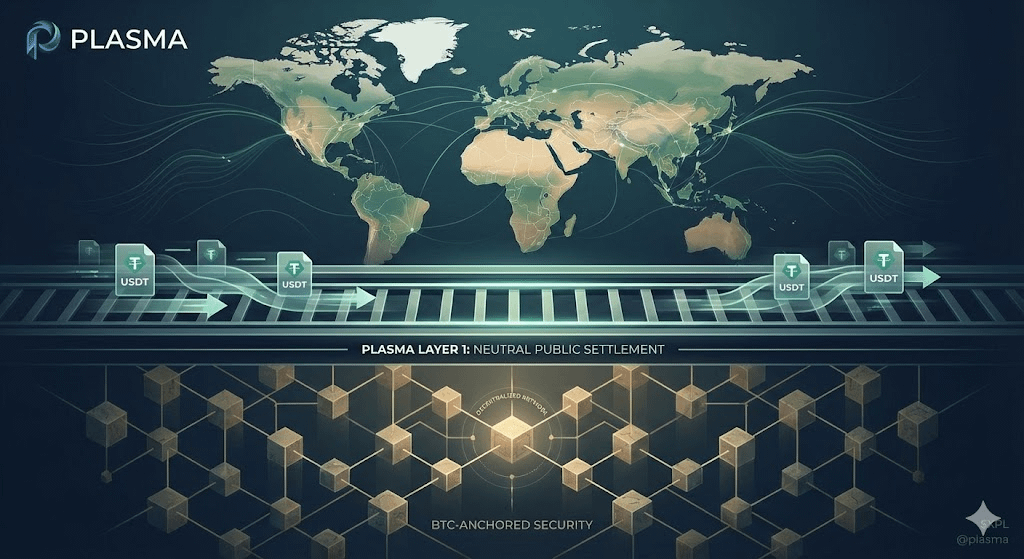
To the majority of the population, the ideal infrastructure is the one that one does not need to worry about. Not many users care about the manner in which payment systems pass transactions, how banks balance the books, or how the world networks remain online 24 hours. They just want the money to be transferred as soon as they press a button. This is expected to be transferred to blockchain systems as stablecoins are used as the money on a daily basis. Plasma was constructed on that concept, where stablecoin settlement is considered an invisible infrastructure that bears complexity to allow users to concentrate on results, but not the mechanics.
User experience has remained one of the greatest obstacles to mainstream blockchain adoption. Decentralized systems have a strong technology behind them, but operating them can be challenging unless a person has a technical approach to it. The users are required to handle wallets, gas tokens, network parameters, and to wait until confirmed. These frictions may be acceptable to the early adopters but it becomes a barrier when the stablecoins are used to pay salaries, remittances or even business payments. @Plasma addresses this by coming up with a Layer1 blockchain that hides complexity rather than unveiling it.
The fundamental principle of plasma is first the stablecoin. The settlement layer has been designed with the daily utilization of stablecoins, as opposed to being viewed as a mere asset. It enhances the user experience: in the case of the stablecoins as the primary unit of value, the network gets the chance to concentrate on clarity, predictability, and simplicity. The users do not have to know the underlying mechanics of the chain to be assured that a payment will complete fast and successfully.
A very obvious one is the way of dealing with transaction fees by Plasma. Most blockchains have users pay gas using a separate native token, which can be confusing to new users and creates some friction to users who just want to transfer stablecoins. Plasma takes the form of gasless USDT transfers and gasless intuitive coin first, which allows fees to be paid in stablecoins or abstracted away in some instances. To a user, this can be compared to the conventional payment systems, where the fees are tacit and not proactively managed.
Perceived simplicity is also a consideration of speed. With PlasmaBFT, Plasma can have finality in sub seconds, that is, transactions are verified and inelastic almost immediately. Fast finality eliminates the ambiguity associated with the process of awaiting confirmations, and users do not have to scroll parts of screens or even question whether a payment will be declined. It just transacts, and is over. This urgency is essential to any financial transaction of daily life, in which any delays disrupt the process and destroy the confidence.
The secret of such smooth experience in the background is complete EVM compatibility with Reth. Although the smart contract code might never be viewed by the end users, it allows developers to have a familiar environment. Plasma-based apps can leverage existing Ethereum tooling and a settlement layer that is optimized towards stablecoins. This allows the developers to work on the user-friendly interface and payment processes rather than making up the limitations of the network. Plasma is indirectly useful in improving user experiences because it makes protocol level development easier.
Invisible infrastructure requires security and trust. Complexity will not be overlooked by the users unless they are convinced that the system is trustworthy. Plasma goes to solve this using Bitcoin-linked security that increases neutrality and resistance to censorship. Although the majority of users do not explicitly consider Bitcoin anchoring, its existence contributes to the long-term trust to the network. An application can also be used to facilitate a more seamless user experience by a settlement layer that can resist interference to enable applications to work reliably.
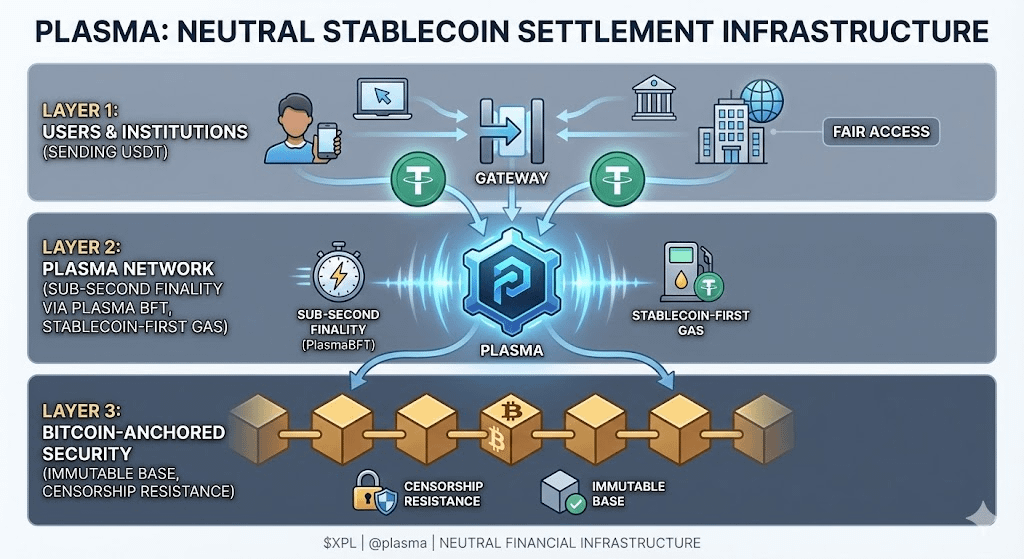
The significance of this design is evident in areas where the stable coins are very high. Stablecoins have already become normal elements of the lives of people in many regions of the world. They are used by people to store value and send money to family and conduct cross-border business. These users are not trying some new technology, they are solving real world problems. Plasma also concurs with this fact and focus on the invisible infrastructure by reducing the number of steps and decisions one has to make to transfer money.
These issues are of concern to institutions in large scale. Reliability and integration are of great concern to the payment processors and financial platforms. They require settlement systems which act uniformly and can be abstracted into back-end processes. The high finality and predictable fee model of plasma, combined with its compatibility with EVMs, makes implementing stablecoin settlement by institutions simpler, avoiding exposing their users to the complexity of a blockchain. In this regard Plasma will be a base that can be quietly built upon by other systems.
The purpose of the $XPL token can be explained in the framework of this philosophy. It is not the central focus of the user experience; it assists in the coordination of networks and operations in the background. The design of Plasma does not obtrude on the user to interface with the token unless it is crucial, which supports the concept of infrastructure being application and user-friendly, and not requiring users to pay attention.
An additional trend of blockchain development is the focus of plasma on invisibility. The handicraft of the early networks demanded users to adjust to technology; as the number of users rises the role played by the network is to adapt to the user. The concept of abstraction, simplification, and predictability is gaining equal importance as the concepts of decentralization and security. The architecture of plasma indicates that these objectives are not exclusive of each other.
Treating stablecoin settlement like a background service rather than a front facing product, Plasma shows a way to a wider adoption. Once blockchain systems are no longer the focus of attention, they will be able to assist in the actual economic activity without the need to explain it all the time. This is particularly relevant to stablecoins that are supposed to act like money but not technology experiments.
Plasma provides a convenient view of the next stage of blockchain development to readers who want to gain an insight into it. It demonstrates that improvements are not always made by adding features; it can also be achieved by simplifying and simplifying systems to become natural. Plasma is a network that is built to enable daily financial life through the infrastructure that goes unnoticed and remains unchanged by the user.
Stay up to date on the latest developments of the project, follow the updates of the project team and community on the twitter account plasma, and discuss the topic of user friendly settlement infrastructure development on the platform called plasma to find out how it is being created. According to the approach of Plasma, the future of blockchain can be characterized not by what users see.