
I heard people say Plasma $XPL “balances speed, security, and decentralization,” I rolled my eyes. Because that line gets tossed around like it’s a magic spell. Say it, and the chain is now fast and safe and open to everyone. Cool story.
Then I dug in. Not to fall in love. Just to see where the trade-offs are hiding. And yeah… there are trade-offs. But Plasma’s approach feels less like “we solved the trilemma” and more like “we built the bike with the right gears.” Speed isn’t free. Security isn’t vibes. Decentralization isn’t a logo. You pick, you pay, you manage the bill. Plasma’s job is to keep that bill from blowing up.

The Speed Part: Quick, But Not Reckless
Speed is the easiest thing to fake. You can make a chain “fast” the way you can make a restaurant “fast.” Just cook fewer dishes. Or stop checking if the chicken is raw. Boom. Short wait times. In blockchains, the “raw chicken” is weak checks. Loose rules. Small validator sets. Or systems where a few machines do most of the work while everyone else claps.
Plasma’s speed pitch makes more sense when you treat it like traffic flow, not a drag race. You don’t want one car going 200 mph. You want the road to move people without crashes. So Plasma aims at fast finality. Quick point of “this is done.” Not “it looks done, maybe.” Finality is like the bouncer stamping your hand at the door. Once you have the stamp, you’re not arguing again.
That’s different from basic “confirmation,” where you’re kind of squinting at the chain like… “is this safe yet?” That wait is the pain traders and apps feel. The “12 blocks” habit didn’t come from nowhere. It’s humans learning to fear re-orgs. Plasma tries to reduce that fear by making the “done” point arrive sooner, and in a cleaner way.
But speed needs discipline. It needs limits. It needs a network that can keep up without turning into a private club. If Plasma pushes fast blocks but only a few nodes can run them, you didn’t get speed. You got central control wearing a sports jacket. So the real question isn’t “how fast is it.” It’s “how fast can it be without shrinking the set of people who can verify what happened.” That’s the difference between a fast checkout line and a fast pickpocket.
The Security Part: Trust, But Built on Math
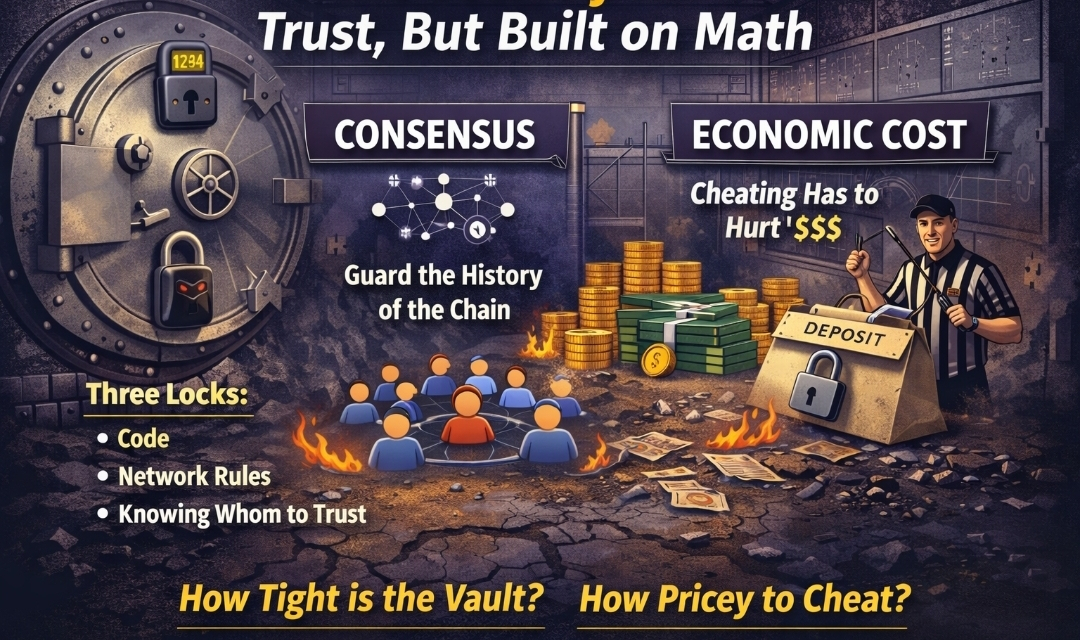
Security is where people get weird. They talk like it’s one big thing. “Is it secure?” Yes or no. Like you’re asking if a door is locked. But chain security is more like a bank vault with three locks. One lock is the code. One lock is the network rules. One lock is the people who run it. If any lock is weak, the vault isn’t “kind of safe.” It’s just a target. Plasma’s security story, at least how I frame it, is about making attacks expensive and obvious. Two words matter here: consensus and economic cost. Consensus is just how a network agrees on the same history. Think of it like a group chat deciding what happened last night. If 7 people say one thing and 3 people say another, you need a rule for which story becomes “official.” That rule is consensus.
If that rule is too loose, attackers can rewrite parts of the story. If it’s too strict, the chat slows down and nobody talks. Plasma’s aim is to keep the rule tight enough to stop rewriting, while keeping the pace high enough for real use. Then there’s economic cost. Not “trust us,” but “hurt your wallet if you cheat.” That’s the grown-up version of security. When bad behavior has a clear price tag. Staking systems do this by putting value at risk. It’s like a referee holding your deposit. You can play rough, sure, but you might lose the deposit on camera.
Now, I’m not going to pretend any system is perfect. Code can have bugs. Bridges can be messy. Governance can drift. But a chain that designs security as a constant pressure not a one-time feature usually survives longer. Security is also about clean failure modes. If something goes wrong, does it fail loudly and stop? Or does it fail quietly and keep producing blocks like nothing happened? Quiet failure is the nightmare. Loud failure at least gives you a chance to react.
The Decentralization Part: Who Gets a Seat at the Table
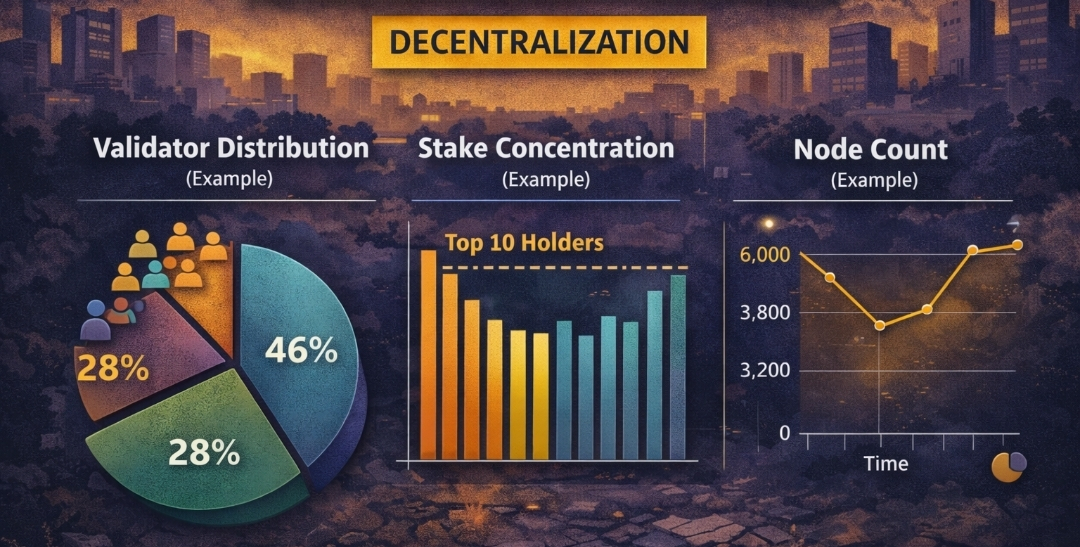
Decentralization is the part everyone says they care about… until it costs them. Because real decentralization is messy. It’s slower decisions. More debate. More “why is this taking so long?” But it’s also what keeps a chain from turning into a company database with extra steps.
When I think about Plasma here, I don’t think “perfect decentralization.” I think “does the design keep space for many operators over time?” That depends on boring stuff: node demands, validator entry, and how rewards and power stay spread out. If running a serious node takes a monster server and a private connection, decentralization shrinks. It always does. If staking and voting power clumps into a few hands, decentralization shrinks again. Slowly, then suddenly.
The healthiest systems keep the “seat at the table” from becoming a VIP lounge. They make it possible for new validators to join. They make it worthwhile for smaller operators to stay. They make it hard for a few players to run the show without everyone noticing. Decentralization is like air in a room. You don’t notice it when it’s there. You panic when it’s not. So Plasma’s balancing act is less about claiming purity and more about keeping that air flowing while the chain moves fast and stays hard to mess with.
Risk: Where This Balance Can Slip
Any chain that pushes speed risks cutting corners, even by accident. Faster finality can stress networks. High throughput can pressure node costs. Complex systems can hide bugs.
And decentralization can fade quietly. Not with a headline. With “small” choices. Bigger hardware needs. A few validators becoming “too important.” Teams relying on the same infra providers. Stuff like that. Also, security isn’t just consensus. It’s everything around it. Wallet UX. Bridges. App code. Human error. If Plasma grows fast, the weak link might not be the chain. It might be what people build on top of it.
So the risk isn’t “Plasma is unsafe.” The risk is that the balance needs constant care. Like tuning a guitar. You tune it once, play a set, and it drifts again.
Final Thought
If you want a fair take, it’s this: Plasma (XPL) reads like a chain trying to be practical about the trilemma, not poetic. Speed as fast finality, but not at any cost. Security as real deterrence, not slogans. Decentralization as a living goal, not a checkbox. I’m not here to clap. I’m here to watch the edges. Because the truth is, the best chains don’t “solve” trade-offs. They manage them in public, over time, with fewer surprises. And in crypto… fewer surprises is underrated.

