
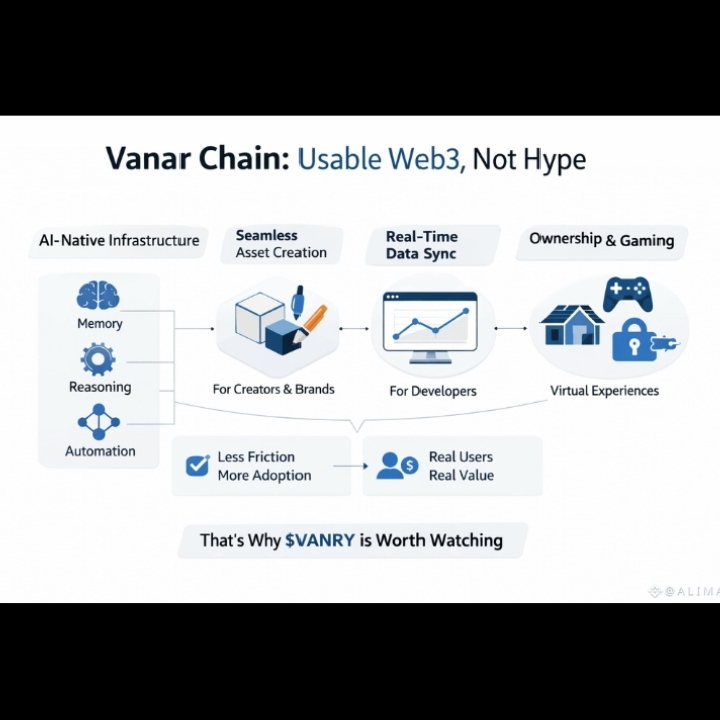
Most people still evaluate blockchain networks using familiar metrics — speed, scalability, and transaction throughput.
I used to do the same.
But the deeper I researched Vanar, the more I felt those metrics explain performance… not purpose.
Vanar does not feel designed simply to process transactions faster. From my perspective, it appears structured to stabilize digital environments where automated interaction operates continuously, with minimal human correction.
That distinction changes everything.
Because historically, infrastructure does not become valuable when it performs well during controlled activity. It becomes valuable when it continues functioning reliably during unpredictable, high-frequency interaction.
And autonomous digital environments are exactly that.
The Coming Shift Toward Continuous Digital Activity
Most blockchain ecosystems today are still built around human behavior patterns. Users initiate transactions manually, adjust strategies when costs fluctuate, and tolerate occasional execution delays.
Autonomous systems operate under completely different conditions.
AI agents coordinating payments, real-time gaming engines processing ownership transfers, automated marketplaces and executing digital asset trades, and algorithm-driven financial services all operate continuously.
They require predictable execution environments where infrastructure behaves consistently regardless of activity intensity.
Even small instability variables — transaction reordering, cost spikes, or execution delays — can cause automated systems to produce inconsistent outcomes or halt entirely.
From my analysis, several Vanar design decisions appear intentionally structured to remove those instability layers rather than simply improving performance benchmarks.
Transaction Ordering as Logical Infrastructure
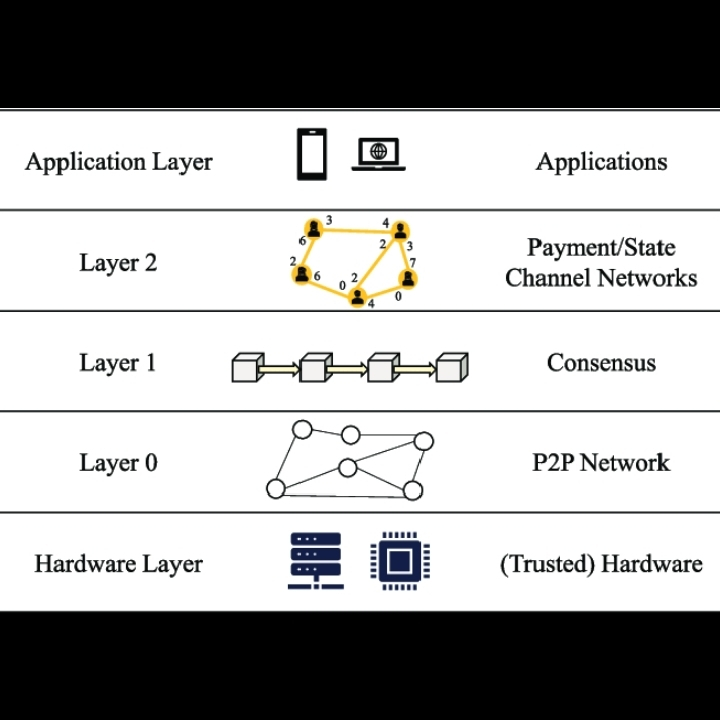
One architectural decision that significantly reshaped my understanding of Vanar is its emphasis on FIFO transaction ordering.
For human-driven ecosystems, transaction sequencing inconsistencies can often be corrected manually. Users can resubmit transactions, adjust parameters, or adapt behavior after errors occur.
Autonomous systems cannot.
When multiple automated agents interact simultaneously, unpredictable transaction ordering can change financial outcomes, break gameplay logic, or disrupt algorithmic decision frameworks.
By enforcing predictable execution sequencing at the infrastructure level, Vanar removes a complexity layer developers would otherwise need to solve inside application logic. From my perspective, this transforms transaction ordering from a technical feature into behavioral infrastructure.
Cost Predictability as Environmental Stability
Another element that stands out is Vanar’s dollar-anchored fee structure. Transaction costs remain extremely low while maintaining predictable pricing rather than fluctuating aggressively with token market volatility.
Fee stability is often framed as user convenience.
In autonomous environments, it becomes operational survival.
Automated systems depend on precise cost modeling. When transaction costs spike unexpectedly, AI-driven services may pause execution, miscalculate pricing models, or trigger cascading logic failures.
Vanar’s dynamic FeePerTx adjustment mechanism which I explain earlier in detail also tell you the amount, recalibrated periodically using the market data, appears designed to balance adaptability with stability.
This allows automated applications to operate without constant recalibration — a foundational requirement for machine-driven ecosystems.
Cross-Chain Expansion as Execution Continuity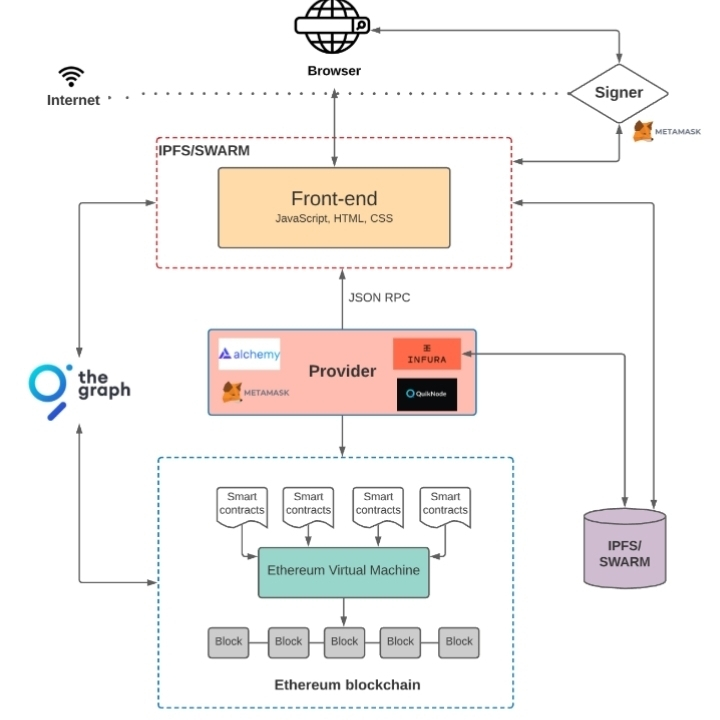
Vanar’s expansion toward Base and cross-chain execution appears particularly meaningful when viewed through environmental stability rather than ecosystem expansion narratives.
Autonomous applications wrarely operate within isolated networks. AI coordination systems, digital ownership layers, and automated payment environments often require synchronized execution across multiple chains simultaneously.
Each interoperability layer introduces latency, state inconsistency risk, and coordination complexity.
Vanar’s AI-first infrastructure philosophy suggests the network is built under the assumption that automated execution will become a dominant activity layer. Instead of simply expanding connectivity, it appears focused on maintaining consistent execution conditions across ecosystems.
Gaming as the Stress Test for Autonomous Infrastructure
Gaming provides one of the clearest demonstrations of why Vanar’s architectural priorities matter.
Unlike financial transactions that tolerate occasional delays, gaming environments require real-time interaction, predictable costs, and uninterrupted asset ownership logic.
Even minor infrastructure instability can break gameplay experiences entirely.
Vanar’s three-second block production, fixed low fees, and execution predictability align closely with these requirements. To me, gaming becomes less of a marketing vertical and more of a stress-testing environment for infrastructure reliability under high-frequency digital interaction.
Its connection to the Virtua ecosystem strengthens this perspective. Years of experience in digital collectibles and interactive environments provide behavioral insight into how users engage with persistent digital ownership, allowing infrastructure decisions to align naturally with real usage patterns.
AI-First Infrastructure Versus AI-Added Narratives
Many blockchain ecosystems are currently integrating artificial intelligence as an additional feature layer.
Vanar appears structurally different.
Rather than adding AI capabilities onto existing infrastructure, its execution stability, predictable transaction environment, and cross-chain coordination design suggest preparation for ecosystems where AI-driven interaction is a primary activity layer from the beginning.
Infrastructure built with automation as a default condition historically scales more naturally than infrastructure attempting to retrofit automation later.
Why Stability May Become the Real Competitive Advantage
Blockchain competition is often framed around performance races — who processes transactions faster, cheaper, or at higher volume.
But when infrastructure begins supporting autonomous economic coordination, priorities begin to change.
Reliability begins to outperform speed. Predictability begins to outperform flexibility. Execution stability begins to outperform raw throughput.
The Long-Term Implication Most People Overlook
Digital ecosystems are evolving toward environments where economic interaction happens continuously in the background. AI agents negotiating digital services, automated ownership transfers, machine-driven data markets, and persistent virtual economies are slowly transforming how value moves across networks.
In those environments, infrastructure instability does not create inconvenience.
It creates systemic failure.
If autonomous activity continues expanding, networks that remove behavioral unpredictability may gradually become foundational coordination layers for digital economies.
My Perspective
I no longer evaluate Vanar purely through AI or gaming narratives.
What stands out to me is how its architectural constraints align with environments requiring continuous, autonomous interaction.
The network feels designed less for short-term transaction competition and more for stabilizing digital ecosystems where activity never pauses.
This does not guarantee long-term adoption. Infrastructure success will always depend on developer participation, ecosystem growth, and real-world usage.
But historically, infrastructure that prioritizes environmental reliability tends to become structurally important when digital systems transition from human-paced interaction toward machine-driven coordination.
And if autonomous digital environments continue expanding, the most valuable blockchain infrastructure may not be the fastest or the loudest.