


For much of crypto’s history, stablecoins were treated as supporting actors. They were liquidity tools, bridges between trades, a place to rest capital before the next decision. Market participants understood their usefulness, but rarely imagined them as destinations. They were part of motion, not settlement.
That perception has been changing, slowly and unevenly, yet persistently.
What altered the trajectory was not innovation inside crypto. It was instability outside it.
In many regions, households and businesses discovered that access to dependable dollar exposure solved immediate problems. It simplified pricing. It protected savings. It reduced planning anxiety. What began as opportunistic usage matured into routine financial behavior.
And routine behavior is where infrastructure demand originates.
When people adopt a financial instrument because it is fashionable, usage expands and contracts with sentiment. When they adopt it because alternatives are unreliable, behavior tends to repeat regardless of headlines. The asset becomes embedded in daily life.
Stablecoins increasingly fall into the second category.
This distinction is critical. Speculative demand is loud but temporary. Functional demand is quiet but durable. The former generates visibility. The latter generates balance sheets.
If we are trying to understand where the next phase of blockchain development will concentrate, we should follow durability.
Look at how these digital dollars circulate today. They are used in remittances where local rails are slow or expensive. They appear in trade relationships where currency conversion risk complicates agreements. They function as working capital for freelancers paid across borders. They are stored by families who want insulation from inflation.
None of these activities require ideological commitment to crypto.
They require reliability.
Reliability changes expectations.
A trader tolerates volatility in infrastructure because positions are temporary. Someone using stablecoins as savings behaves differently. They expect constant access. They expect predictability in fees. They expect liquidity at inconvenient times, not only during market optimism.
They are less impressed by innovation and more attentive to consistency.
This is a harder audience to satisfy.
The moment stablecoins begin to resemble deposits, the question shifts from issuance to residence.
Where will this money live?
Under what conditions?
With what guarantees of continuity?
Absorbing deposits is not a marketing problem. It is an operational one.
This is where the strategy around @Plasma becomes interesting. The project appears less focused on dramatising growth and more focused on whether the system can support routine financial life if that growth materialises.
That is a very different posture from much of the industry.
It assumes success would be stressful.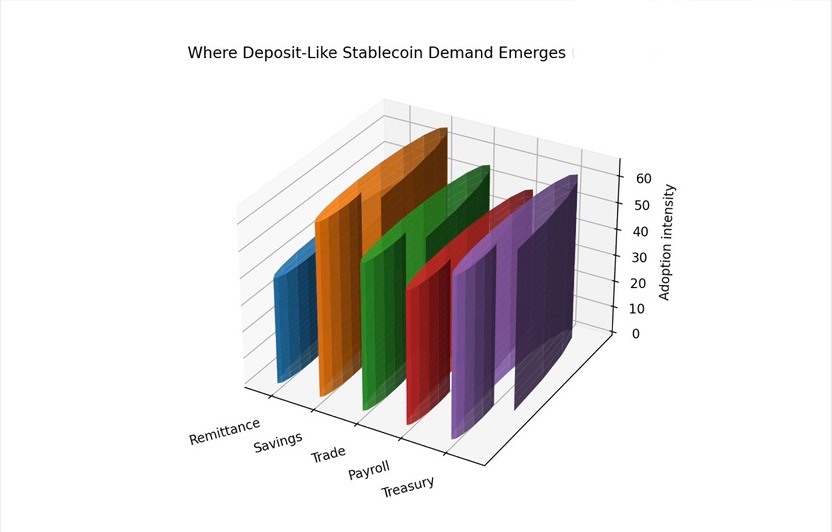
Systems designed primarily for episodic excitement often struggle with ordinary days. They handle bursts of speculation well but become fragile under persistent throughput. Fees fluctuate unpredictably. Liquidity fragments. Users adapt by reducing reliance.
Savings behavior does not tolerate that instability.
If capital is to remain, the environment must feel boring in the best possible sense.
Boring is underrated.
In finance, boring usually means repeatable, understandable, dependable. It means participants can form habits. Habits enable planning. Planning enables scale.
Remove boring and everything becomes temporary.
Plasma’s architecture increasingly reads as an attempt to engineer this ordinariness. Instead of optimizing for viral moments, the emphasis appears to fall on throughput, settlement confidence, and financial primitives that can operate continuously.
Continuous operation is what deposit-like balances require.
Another way to understand the opportunity is through opportunity cost. If users treat stablecoins as alternatives to bank holdings, they will compare environments accordingly. They will ask whether funds can earn yield, support credit, or move efficiently between obligations.
Idle money seeks productivity.
Lending, payments, collateralization these functions are not luxuries. They are expectations.
A chain that wants to host deposits must therefore prepare for a cascade of secondary services. Liquidity pools deepen. Borrowing frameworks expand. Risk management becomes professionalized. Over time, an ecosystem forms around preservation and utility rather than novelty.
This is how financial centers develop.
Importantly, the transition is gradual. There is rarely a single moment when participants declare that stablecoins have replaced traditional deposits. Instead, balances accumulate. Users leave funds in place longer. Transaction frequency normalizes. Volatility in behavior decreases.
The system starts to resemble plumbing.
And plumbing is powerful precisely because nobody notices it working.
What Plasma seems to recognise is that if this shift accelerates, the winners will be environments prepared for mundane reliability. They will be the places where large volumes of small, necessary decisions can execute without drama.
Drama is expensive for savers.
Of course, obstacles remain. Regulation will influence flows. Custodial preferences may evolve. Banks are not passive observers. Skepticism toward purely digital systems is reasonable, especially where legal protections are ambiguous.
But infrastructure maturity can narrow these gaps. The more predictable and legible operations become, the easier it is for participants — retail and institutional — to treat them seriously.
It is also important to resist exaggeration. Stablecoins will not empty traditional banks overnight. Financial habits change slowly. Trust takes years to build and moments to damage.
Yet directional trends matter.
If even a fraction of global demand for dependable dollars migrates onchain, the scale is enormous.
Preparing for that fraction is already significant work.
What gives the Plasma thesis weight is its lack of theatrics. There is little suggestion that transformation is imminent. Instead, the network appears to be building quietly, refining mechanics that would allow it to function normally if volumes increase.
Normality, again, is the goal.
Participants often misunderstand this. They expect infrastructure projects to advertise ambition aggressively. But in finance, credibility often emerges from understatement. Systems that promise less than they can deliver tend to survive longer than those that promise miracles.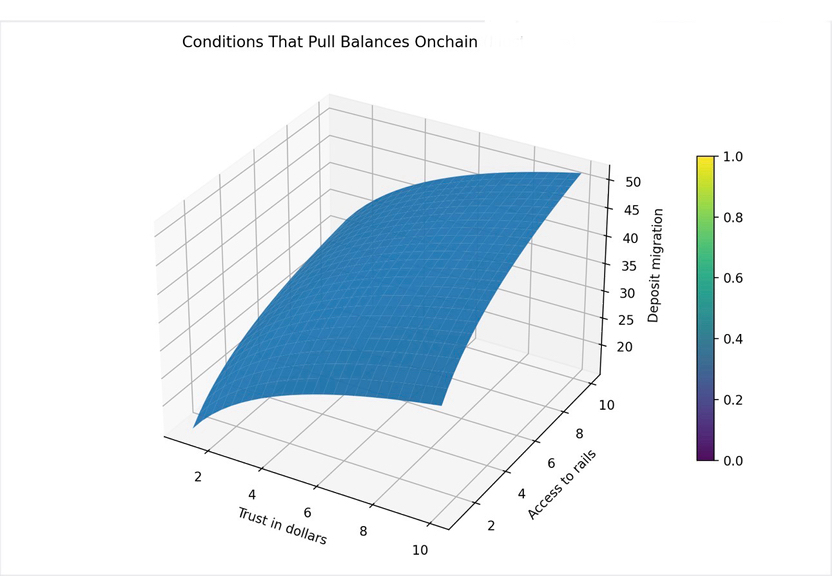
Measured positioning can be strategic.
After spending time observing stablecoin behaviour globally, it becomes harder to dismiss the deposit narrative. People want instruments that hold value, travel easily, and remain accessible. If blockchain environments can supply those properties consistently, migration will continue.
Not explosively.
Incrementally.
Incremental change compounds.
Plasma is attempting to stand where that compounding might arrive. It is designing for the possibility that digital dollars will need a home capable of everyday endurance.
Whether it succeeds will depend on execution under pressure. Markets eventually test everything. But preparing for endurance instead of spectacle is already a meaningful signal.
In the end, the real competition is not for attention. It is for trust.
Trust is built through thousands of uneventful confirmations. Through nights when systems remain online. Through moments when liquidity appears exactly where expected.
If stablecoins are becoming deposits, those confirmations will matter more than announcements.
Plasma’s bet, as far as one can tell, is that the future belongs to infrastructure that can host routine economic life. If that future arrives, readiness may outweigh charisma.
And readiness is something you can build long before anyone applauds.