
As a trained oil and gas reserves engineer, I was taught to live by one ratio: Reserves ÷ Production Rate.
In the energy world, this tells you exactly how long your inventory lasts before the wells run dry. But when you apply this engineering logic to Bitcoin, the math gets aggressive.
1. The "Strict Reservoir" Reality
In oil, high prices solve their own scarcity. If crude hits $150, we drill more, find new fields, and revise reserves upward.
Bitcoin doesn't care about the price. * Supply: Hard-capped at 21 million.
New Discoveries: Zero.
Reserve Revisions: Impossible.
2. The Math of the "7.9x" Coverage Ratio
Let's look at the depletion logic currently hitting the market:
ETF Holdings: ~1.3M BTC (and growing)
New Annual Issuance: ~164K BTC (post-halving)
The Ratio: 7.9x
This means institutional demand is currently sitting on nearly 8 years' worth of new supply. When long-duration buyers absorb multiple years of future production in a single cycle, the asset doesn't need a "narrative" to reprice—it just needs time.
3. The Market Structure Shift
We aren't just seeing a price pump; we are seeing capital concentration. * BTC Dominance: Rose from ~38% in 2023 to ~60% today.
This isn't "crypto" fever; this is a flight to the highest-conviction asset on the planet.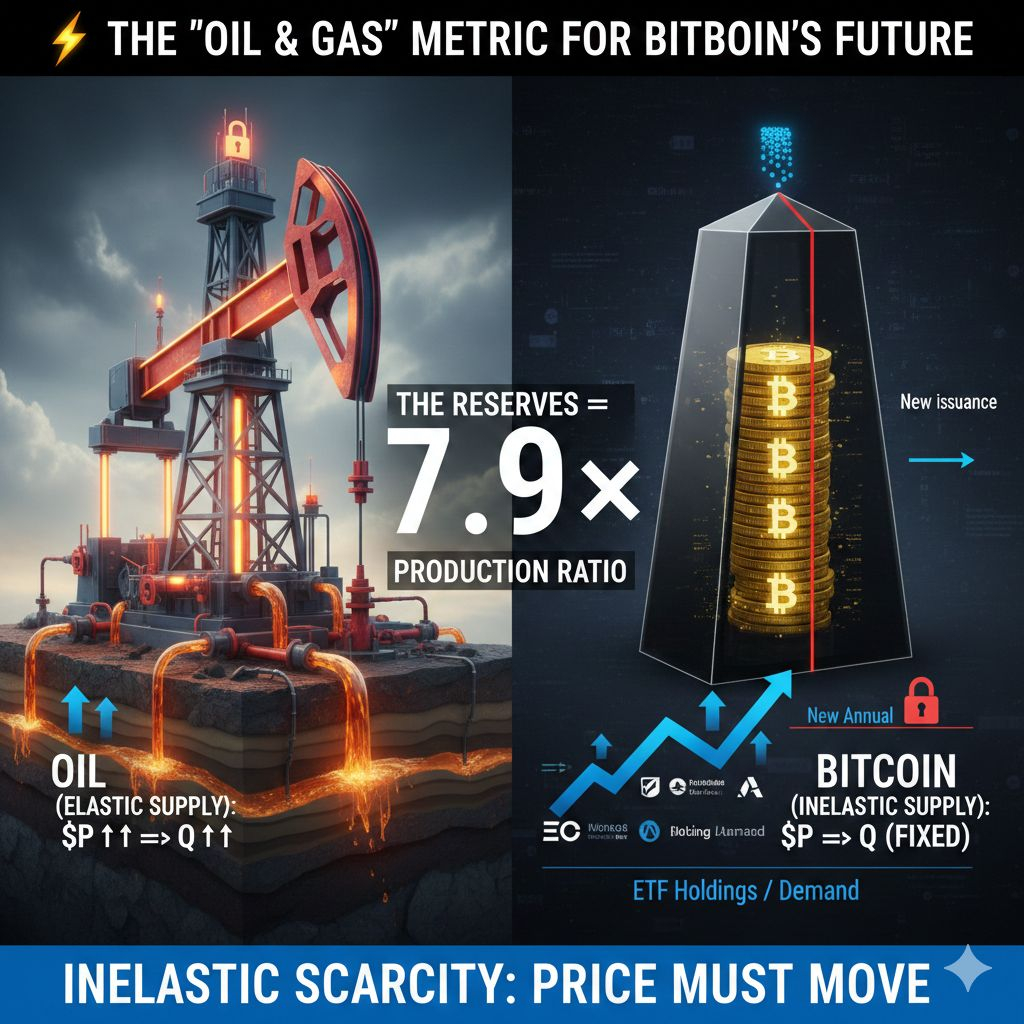
The Bottom Line
Yes, OG holders will sell into strength. Yes, the path will be volatile. But game theory suggests large holders distribute gradually, while patient institutional flows provide a persistent "net absorption" floor.
Short-term price is noise. Long-term, if absorption continues to outpace new supply, the clearing pressure has only one direction to go: Up.
What’s your take? Do you think the ETFs have permanently broken the traditional 4-year cycle math? Let's discuss below. 👇
#bitcoin #BTC #MacroView #InstitutionalCrypto #scarcity
