

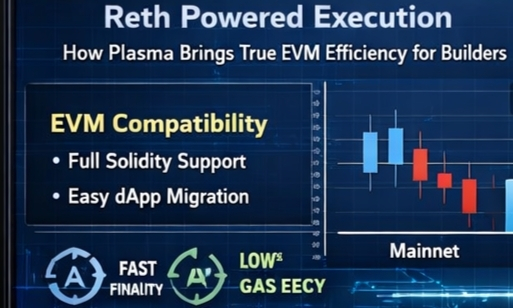
@Plasma Most developers choose EVM chains because the environment feels familiar. Solidity works the way they expect, existing tools are easy to use, and deployment does not require learning a completely new system. But builders today are no longer satisfied with compatibility alone. They want execution that feels smooth, predictable, and fast enough to support real users. This is where Plasma’s execution layer starts to make a difference.
Plasma keeps the entry point simple. Teams coming from Ethereum do not need to redesign their contracts completely. This saves valuable time, allowing developers to concentrate on product growth and hands on testing instead of technical rewrites. This saves time during early development and allows smaller teams to move faster without heavy technical adjustments.
The real shift appears in how transactions are processed behind the scenes. Many EVM environments slow down once activity increases, which forces builders to think about gas limits and performance trade offs earlier than they want to. Plasma’s Reth based execution layer is designed to keep things steady even as usage grows. Rather than chasing bold speed claims, the focus is on consistency. Developers can plan better when performance stays predictable during scaling.
For builders working on interactive platforms such as gaming or social experiences, stability matters just as much as raw performance. When execution becomes smoother, user actions feel more responsive and less delayed. Small improvements at the infrastructure level can change how an application feels in everyday use. Instead of waiting for transactions to settle unpredictably, developers can design with more confidence.
Another important detail is how this setup supports long term growth. Some networks feel fast in the beginning but struggle to keep the same performance once more users arrive. Plasma’s approach focuses on maintaining balance as activity increases. Builders do not have to constantly rethink their architecture because the execution layer is built with gradual scaling in mind.
Security also benefits from a cleaner execution process. Stable infrastructure gives builders more confidence. With consistent results during testing, teams can move forward without second guessing how their code will perform later. This helps teams push updates with less stress and reduces the chances of errors during deployment.
What stands out most for many builders is the overall experience. Plasma does not try to change how developers write smart contracts. Instead, it improves how those contracts run once they are live. This difference may sound small, but it changes daily workflow. Faster feedback during testing, fewer slowdowns during launches, and a stable environment all contribute to better productivity.
As more builders look for networks that combine familiarity with real performance, execution design becomes more important than marketing claims. Plasma’s Reth powered layer shows that EVM compatibility does not have to come at the cost of efficiency. By focusing on how execution actually feels in practice, it gives developers a space where they can build without constantly worrying about technical limitations.