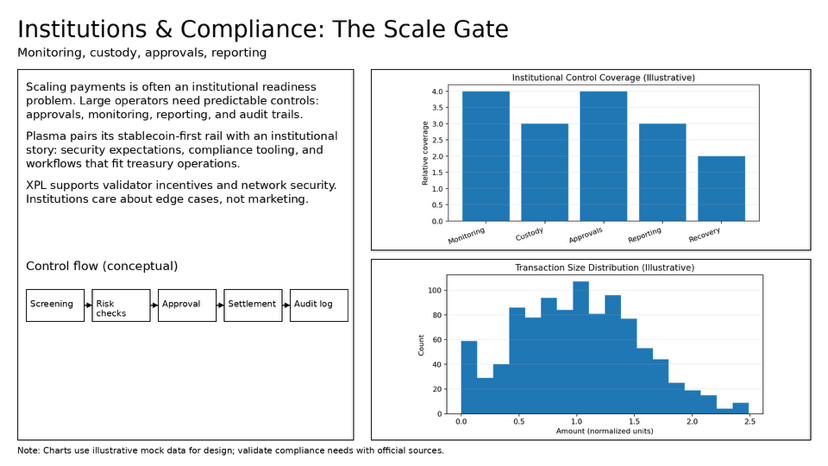
I’ve been thinking about why Plasma keeps describing its strategy as an ecosystem thesis instead of a “faster chain” story, and it’s made me rethink what drives adoption in payments. My first instinct was that this is mostly a throughput problem: if transfers get cheap and quick enough, usage follows. The more I watch how money moves in real life, the less I buy that. Payments are a bundle of trust, habit, compliance, and user experience, and if any one piece feels odd, people treat it as a curiosity and move on. Plasma’s bet starts with the rail. It describes itself as a layer-1 blockchain purpose-built for stablecoins, emphasizing near-instant transfers and fee-free stablecoin payments, alongside security to satisfy institutions. I read that focus as an admission that payments don’t need endless features; they need predictable behavior under load. When Plasma explains stablecoin payments, the examples are deliberately ordinary—cross-border transfers, retail checkout, payroll, and business-to-business settlement. But the rail doesn’t create a payment experience on its own, and the wallet layer becomes decisive. I used to think wallets were just a thin wrapper—like a nicer screen on top of crypto rails. Now I think they’re the distribution layer for normality. If a wallet makes people stop and puzzle over fees, which network to use, or whether a payment can be reversed, stablecoins will stay “crypto stuff.” But if paying feels like sending a message—tap, confirm, done—stablecoins suddenly compete like real money: on convenience, reliability, and whether a merchant can take it without hassle. The third leg is institutions, and I’ve come to see it as the gatekeeper for scale. Institutions aren’t just ramps; they’re custody policies, treasury approvals, audit trails, fraud controls, and legal confidence across jurisdictions. Two outside shifts make this ecosystem framing feel more relevant now. First, stablecoins have grown large enough that mainstream research puts them around the hundreds of billions in circulation and forecasts a path toward the trillions. Second, rules have started to harden. In Europe, MiCA created a uniform framework for crypto-assets, which pushes service providers toward clearer licensing and disclosure expectations. In the U.S., the GENIUS Act established a federal framework for “payment stablecoins,” with reserve and oversight requirements. That doesn’t eliminate uncertainty, but it changes the risk calculus for large payment operators. In that context, compliance isn’t window dressing; it’s part of the product. Plasma’s partnership with Elliptic is explicitly about monitoring and compliance capabilities meant to help regulated exchanges and payment providers onboard safely. I also notice the wider industry converging on the same constraints: Coinbase waived fees on PayPal’s stablecoin and enabled direct redemptions as part of a push toward real payment flows, and Fiserv has said it plans to add a stablecoin for integration across its existing banking and merchant network. None of this proves Plasma’s thesis, and I’m wary of treating any single chain as inevitable, but the argument feels grounded: rails, wallets, and institutions have to mature together, or stablecoin “payments” stays stuck as a demo instead of becoming boring infrastructure.