
There’s a quiet moment that happens after you tap to pay. A pause. You look at the screen. The cashier looks at the screen. Everyone waits for that small word to appear: confirmed.
In crypto, that word has always carried a little uncertainty underneath it. Most people don’t think about it, and honestly, most of the time it doesn’t matter. But when payments start trying to behave like everyday money, that uncertainty becomes more visible. It feels different.
Plasma steps into that gap. Not loudly. Just with a different assumption about what confirmation should mean.
When “Probably” Is Not Enough:
Traditional blockchains rely on probabilistic finality. The idea is simple in theory. A transaction is included in a block, then more blocks build on top of it. With each additional block, the chance of reversal drops.
On Bitcoin, a new block appears roughly every ten minutes. After six blocks, around an hour later, the transaction is considered extremely secure. On Ethereum, blocks come much faster, around every twelve seconds, so confidence builds within a few minutes.
But notice the pattern. Confidence builds. It doesn’t lock instantly.
For large transfers, that delay can be acceptable. For traders moving funds between exchanges, a few minutes is just part of the process. But in a retail setting, time stretches. Thirty seconds can feel long. Two minutes feels awkward. An hour is out of the question.
The deeper issue isn’t speed alone. It’s ambiguity. A merchant accepting a crypto payment often makes a judgment call. Is one confirmation enough? Two? Five? The decision carries a small but real risk. And even if the probability of reversal is low, it is not zero.
That subtle doubt changes behavior. Merchants hesitate. Systems add extra buffers. Simplicity fades.
Plasma’s Deterministic Approach:
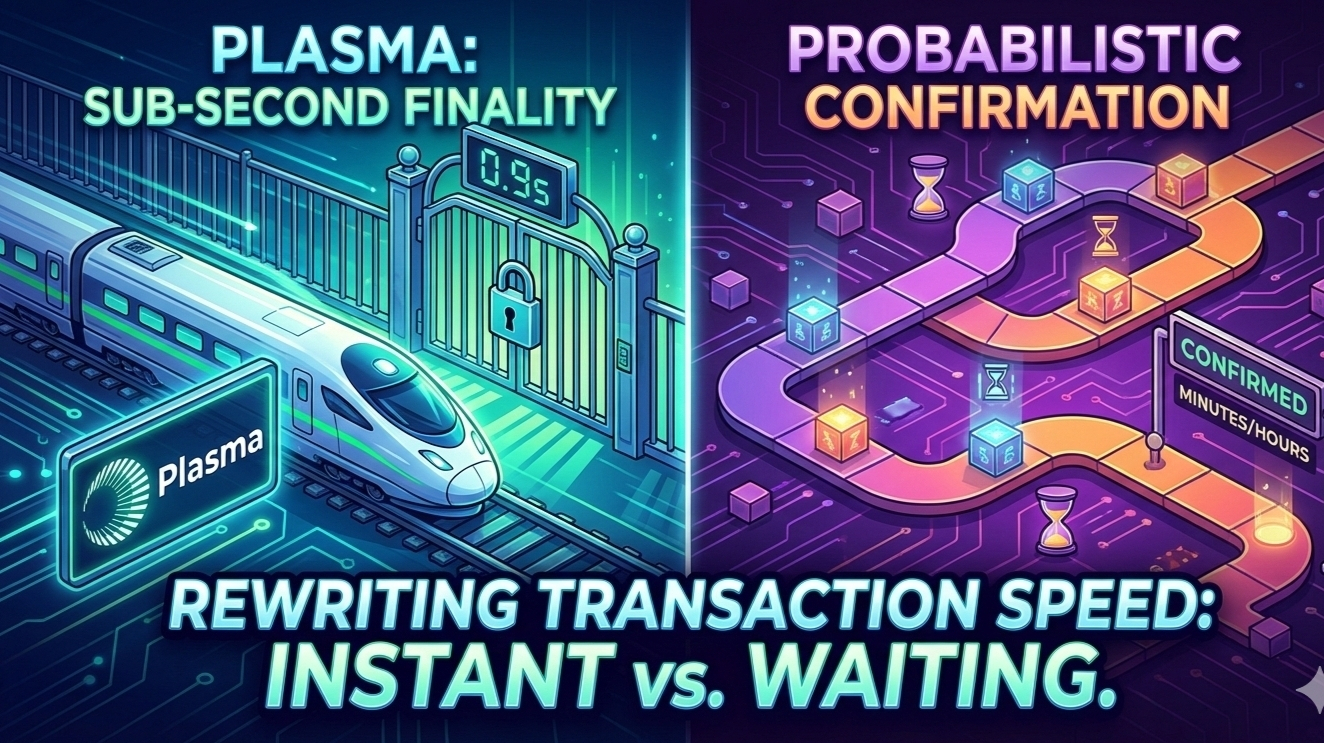
Plasma takes a different path. Instead of waiting for probability to shrink, it aims for deterministic confirmation. In practical terms, once the network validates a transaction, it is final. No stacking confirmations. No “almost final.”
The network targets sub-second finality, meaning confirmation in under one second. To put that into perspective, many card payments at a physical terminal take two to three seconds to approve. Some modern blockchain networks achieve block times of one to five seconds, but economic finality can still depend on additional confirmations.
Plasma’s model tries to collapse that waiting period. The goal is simple: the moment you see confirmed, the story ends there.
That requires a more structured validation process. Deterministic systems narrow the ways a transaction can be processed. They define clear rules around state transitions and validator behavior. It’s less open-ended than purely probabilistic consensus models.
And that narrowing is the point. By limiting uncertainty inside the system, Plasma aims to remove it from the user experience.
What This Feels Like in Practice:
Imagine buying something small. A coffee. A digital subscription. Maybe an in-game item that costs less than ten dollars.
With probabilistic finality, the merchant might accept the payment after one confirmation, absorbing minimal risk because the value is low. For higher amounts, they may wait longer. The decision varies.
With deterministic confirmation, there is no sliding scale. Either the transaction is valid and final, or it isn’t. That clarity simplifies the flow. No risk calculation at the counter. No hidden tolerance levels coded into payment apps.
If Plasma maintains this under real traffic loads, the experience could feel almost invisible. Payments just complete. The process becomes background noise.
But systems behave differently under pressure. If network congestion increases, or validator coordination becomes strained, the promise of sub-second finality has to hold. If it doesn’t, expectations can shift quickly. People get used to speed faster than they forgive its absence.
Institutions See Finality Differently:
Retail payments are one side of the picture. Institutions operate with a different lens.
When a financial entity moves ten million dollars, the number sounds large. In context, for a global bank, it may be a routine liquidity adjustment. Still, that movement must be legally and operationally final. There can’t be ambiguity.
Traditional financial systems define settlement clearly. Once funds are transferred through certain clearing networks, they are irrevocable. That certainty forms part of the legal framework.
Plasma’s deterministic confirmation aligns more closely with that expectation. Immediate finality reduces settlement windows. It removes the need to wait for statistical safety.
But institutions also care about governance. Deterministic systems often rely on tighter validator coordination. If the validator set is smaller or more structured, the security assumptions change. Instead of worrying about chain reorganizations, the concern may shift toward validator collusion or governance concentration.
Risk doesn’t disappear. It moves.
The Trade-Offs Beneath the Speed:
Fast and final sounds ideal. And in many contexts, it is. But speed always comes with design constraints.
To achieve sub-second finality, networks typically reduce certain forms of decentralization or introduce stricter validator rules. Coordination must be efficient. Communication delays must be minimal. The system becomes more engineered, less emergent.
There is also the relationship with underlying settlement layers. If Plasma anchors to a base chain for additional security, that connection introduces dependencies. Delays or instability at the base layer may not stop daily transactions, but they can influence long-term confidence.
Scalability raises further questions. A network might claim thousands of transactions per second. That number only means something when tied to real-world conditions. Hardware requirements, validator distribution, network latency – all of these shape performance.
If traffic spikes sharply, can sub-second finality remain steady? Early signs may look promising, but sustained performance over years is the real measure.
A Different Philosophy of Confirmation:
What Plasma represents, at its core, is a shift in philosophy. Instead of accepting probabilistic confirmation as normal and building user experience around it, it starts with the assumption that payments should feel final immediately.
That assumption changes architecture. It changes trade-offs. It even changes how risk is perceived.
Whether this model becomes dominant remains uncertain. Crypto infrastructure evolves in cycles. Ideas that seem perfectly suited for one era sometimes struggle in another.
Still, the focus on deterministic finality highlights something the industry has been circling for years. Payments are not just technical events. They are human interactions. They carry expectation, rhythm, and trust.
If Plasma can maintain its foundation under scale and governance pressure, it may not feel dramatic. It may simply feel natural.
And perhaps that is the real measure of progress in payments. Not how loudly a system announces itself, but how quietly it works when no one is thinking about it.
@Plasma $XPL #plasma