

Something about Vanar has changed, and it didn’t happen on Twitter. It happened in rooms where people don’t talk about candles, daily gains, or which token doubled overnight. They talk about certainty, durability, and systems that still make sense five years later. Sitting in a room full of traditional venture capitalists recently made that contrast painfully clear. In that world, money is called assets, speculation is called mispricing, and value is something that must survive regulation, policy, and operational friction. That experience made Vanar’s recent behavior suddenly click.
While many saw Vanar’s parallel appearances on Binance Square and at AIBC World Eurasia as routine marketing, the reality is more deliberate. This wasn’t scattershot promotion. It was a controlled narrative split. On one side, Vanar maintained relevance inside crypto-native channels. On the other, it quietly inserted itself into conversations that define how AI infrastructure will be evaluated, regulated, and funded globally. That distinction matters more than most people realize.
Inside crypto spaces like Binance Square, the discussion is transactional. People want to know the price of $VANRY, the size of the giveaway, or the timing of the next incentive. Vanar’s presence there serves a specific purpose: continuity. It signals that the network is active, visible, and not abandoning its base. But this is not where long-term valuation is decided. This is where attention is maintained, not where strategic legitimacy is built.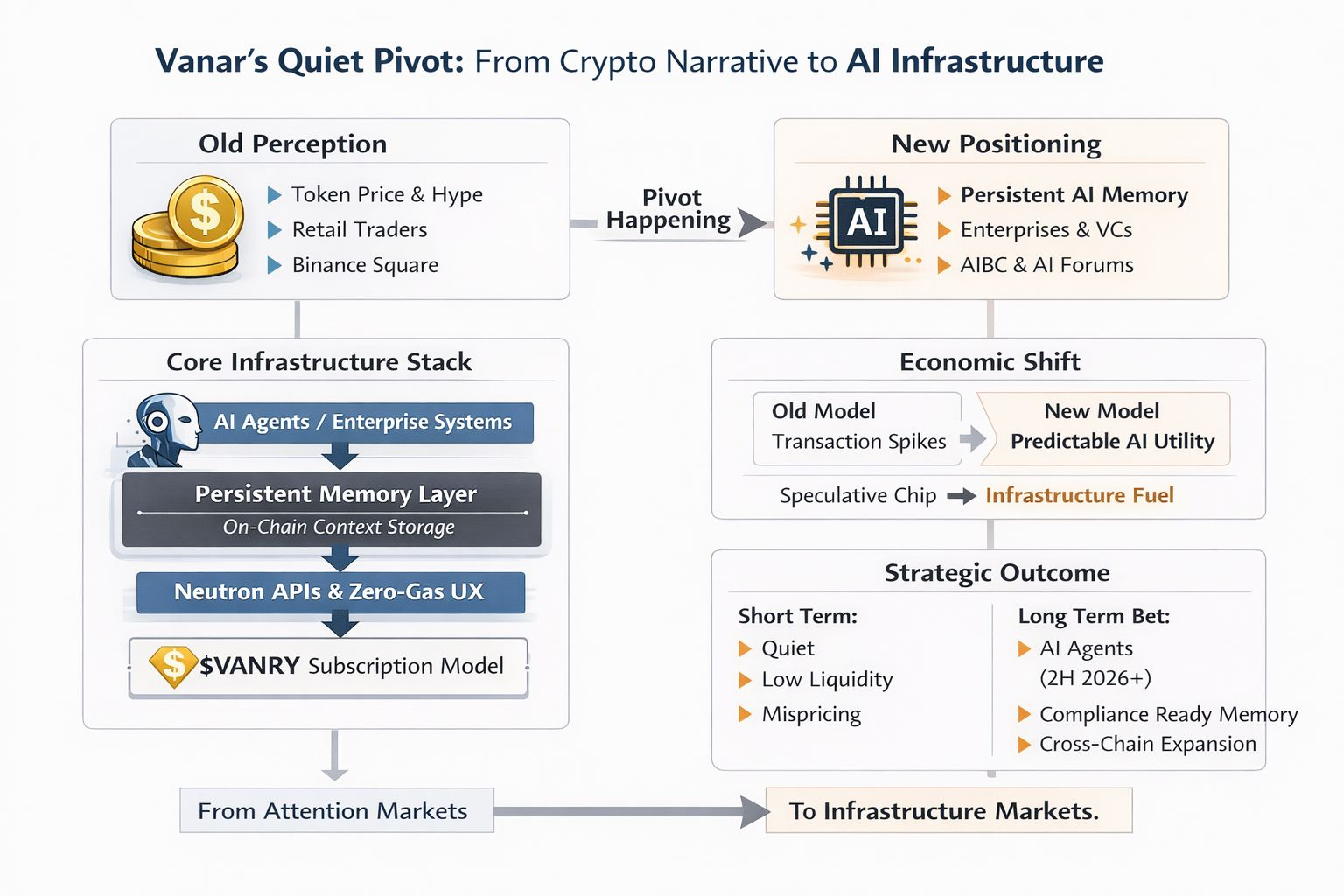
The real shift is happening outside that loop. At AIBC Dubai, the discussion wasn’t about token velocity or liquidity mining. It was about responsible AI, persistent decision storage, auditability, and memory as infrastructure. Vanar wasn’t selling a chain. It was selling a concept: persistent AI memory as a foundational layer. In those rooms, that idea lands differently. It reframes Vanar not as another Layer 1 competing on throughput, but as a systems-level infrastructure provider operating at the intersection of AI, data integrity, and compliance.
This is where the idea of “persistent memory” becomes Vanar’s most underappreciated asset. Most blockchains are excellent at storing data, but storage is not memory. Memory implies context, continuity, and the ability to reason over time. For AI agents, enterprise automation, and regulated industries, this distinction is critical. Recomputing context off-chain introduces fragility. Vanar’s approach organizes memory at the protocol level, reducing technical debt and enabling systems that evolve instead of constantly resetting.
The market, however, does not reward patience. $VANRY trading around the low single-cent range with a market cap near sixteen million dollars reflects the current reality. Liquidity is thin, sentiment across altcoins is suppressed, and incremental capital is cautious. This is not a failure of narrative; it is a classic infrastructure vacuum period. The market struggles to price systems that are being built for problems that haven’t fully surfaced yet.
Vanar appears to be betting that the second half of 2026 marks an inflection point, when AI agents transition from experimental tools into production infrastructure. The ongoing integration of Neutron APIs and persistent memory frameworks looks less like feature shipping and more like stress testing for that future. If enterprises begin anchoring reasoning, decision logs, or compliance memory on-chain, the brand credibility built today will matter far more than any short-term price action.
What makes this strategy uncomfortable is also what makes it powerful. Vanar is deliberately choosing the slowest audience to persuade: policymakers, traditional capital, and enterprise AI decision-makers. This is not a viral cycle; it is a cognitive one. These shifts take months, sometimes longer, but when they land, they create defensibility that speculation cannot replicate. Discourse power in these circles is worth more than a thousand demos.
Parallel to this, Vanar’s consumer-first design philosophy quietly addresses one of Web3’s biggest unsolved problems: friction. Using Web3 today is still harder than moving broadband service. Wallet setup, seed phrases, gas fees, and chain abstraction remain massive barriers. Vanar’s emphasis on zero-gas interactions and account abstraction is not a technical flex; it is an adoption strategy. Infrastructure should absorb complexity so users don’t have to understand it, just like no one needs to understand fiber routing to use the internet.
This philosophy extends into Vanar’s economic design. Instead of relying on unpredictable transaction spikes, Vanar is shifting toward subscription-based AI utilities where $VANRY becomes a recurring operational input. Products like persistent memory layers and AI reasoning services create predictable, repeat demand. This mirrors how cloud services are budgeted in Web2: monthly, measurable, and justifiable. In this model, the token stops being a speculative chip and starts behaving like infrastructure fuel.
Cross-chain expansion further reinforces this positioning. If Vanar’s memory layer becomes useful beyond its native ecosystem, $VANRY demand no longer depends on a single chain’s activity. Instead, Vanar starts to resemble an AI infrastructure vendor with settlement at its core. That is a materially different valuation model from a typical Layer 1 competing for developers with grants and slogans.
None of this guarantees success. Subscription models only work if the product delivers real value. Persistent memory must save time, reduce cost, or improve decision quality. Developer tooling must be reliable, documented, and predictable. Scale will require not just technology, but onboarding, education, and ecosystem density. Vanar still has to execute. But the direction is coherent, and coherence is rare in this market.
What stands out most is that Vanar is no longer optimizing for applause. It is optimizing for recall. Not how many tweets it sends, but whether decision-makers remember the phrase “persistent memory” when designing AI systems months from now. On February 11, 2026, Vanar didn’t chase attention; it changed rooms.
In a market obsessed with speed, Vanar is betting on inevitability. And while that path is quieter, it’s also the one that tends to outlast the noise.

