
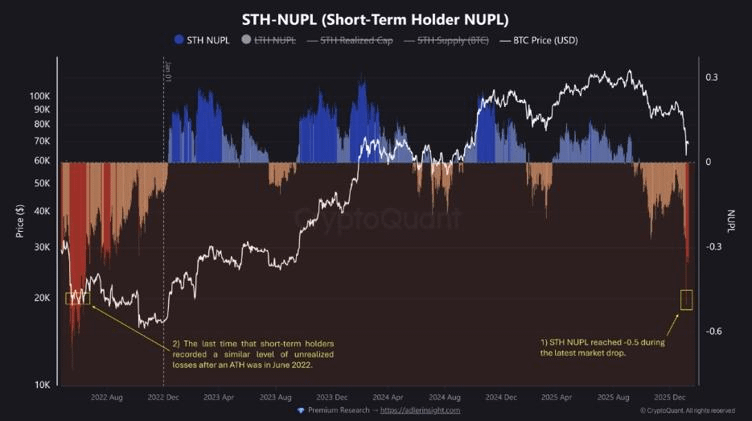
Il NUPL degli Holders a Breve Termine (STH) di Bitcoin è sceso a circa –0.5, un livello che storicamente segnala intense perdite non realizzate tra i compratori recenti. Ma cosa significa effettivamente e perché è importante?
Prima di tutto, Cos'è il NUPL STH?
NUPL (Profitto/Perdita Non Realizzati Netto) misura se i detentori si trovano, in media, in profitto o in perdita.
Sopra 0 → i detentori sono per lo più in profitto
Sotto 0 → i detentori sono per lo più in perdita
Quando ci concentriamo sugli Holders a Breve Termine (monete detenute <155 giorni), stiamo guardando i partecipanti più reattivi del mercato — trader e acquirenti recenti che sono più propensi a vendere in preda al panico durante i ribassi.
Quindi, quando STH NUPL scende a –0.5, significa:
Una grande parte dei compratori recenti è profondamente in perdita
Il sentiment di mercato tra i giocatori a breve termine è estremamente negativo
La paura domina il processo decisionale
Storicamente, questo è il punto in cui le vendite emotive raggiungono il picco.
📉 Perché –0.5 è importante
Livelli così profondi non accadono spesso.
Momenti precedenti in cui STH NUPL ha raggiunto profondità simili:
Metà 2022 dopo il crollo ATH
Condizioni di mercato ribassista in fase avanzata
Periodi di uscite forzate e capitolazione
Questi momenti erano caratterizzati da:
Vendita in preda al panico
Esaurimento al dettaglio
Mani deboli che escono dal mercato
Accumulo silenzioso da parte di partecipanti più forti
È importante notare: queste zone si sono storicamente formate vicino ai minimi macro, non all'inizio di nuovi crolli.
🧠 Psicologia dietro la capitolazione
La capitolazione non è solo un evento di prezzo, è un evento emotivo
È quando:
I trader perdono convinzione
Il sentiment sociale diventa aggressivamente ribassista
Le narrazioni di “è finita” dominano
Ironia della sorte, questi sono gli ambienti in cui gli investitori a lungo termine iniziano ad accumulare, non a distribuire.
Perché?
Perché i mercati si muovono da:
Euforia → Distribuzione
Paura → Accumulo
Quando il dolore a breve termine raggiunge il picco, spesso si forma un'opportunità a lungo termine.
📊 Riflessione sul quadro generale
Quando:
I detentori a breve termine sono profondamente in perdita
La paura domina il sentiment
La pressione di vendita sembra esaurita
Spesso siamo più vicini a una finestra di accumulo di denaro intelligente che a una fase di rottura strutturale.
Il mercato punisce i compratori tardivi al vertice... e premia gli accumulatori pazienti durante il massimo disagio.