
Thinking back to the early days of crypto. If you were around in 2017, you likely remember BNB as a handy token to hold strictly for discounted trading fees on the Binance exchange.
Fast forward to today—February 2026—and the ecosystem is almost unrecognizable. We are no longer just looking at an exchange token; we are looking at the lifeblood of a sprawling, interconnected network designed for mass mainstream adoption. BNB has shed its "crypto-native only" skin and aggressively pivoted into powering the real-world economy.
Here is a closer look at how BNB is structurally and economically dominating the decentralized future.
🏙️ The High-Speed Multi-Chain Architecture
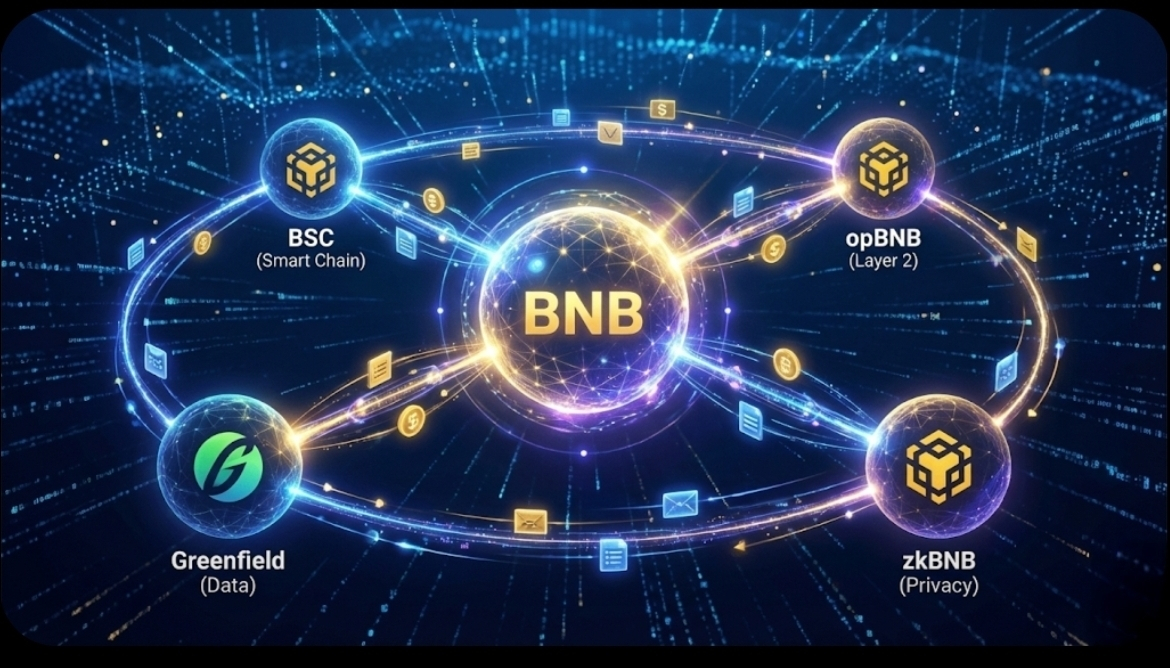
We no longer just talk about the "Binance Smart Chain." The architecture has evolved into a cohesive, interconnected trinity known as the BNB Chain ecosystem, processing massive daily volume through a highly optimized setup.
BSC (The Mainnet): Following the massive Fermi hard fork in January 2026, the main execution layer is faster than ever. Block times have been slashed to a blistering 0.45 seconds with sub-second finality. The network is currently rolling out a dual-client strategy (adding a high-performance Rust-based Reth client alongside Geth) to push toward a staggering 20,000 TPS.
opBNB (Layer 2): This optimistic rollup handles millions of users with virtually zero gas fees, making it the perfect home for high-frequency trading bots, arbitrage, and micro-transaction gaming.
BNB Greenfield: The decentralized storage network that finally brings the "data economy" directly on-chain, allowing developers to build data-heavy Web3 applications natively.
💸 The Settlement Layer for the Masses
The biggest narrative shift for BNB Chain in 2026 is its pivot from highly speculative "yield farming" to serving as the ultimate infrastructure for real-world money and frictionless usage.
The network has quietly become one of the largest settlement layers for stablecoins globally. Because of the sub-second finality and near-zero fees, everyday users and businesses are utilizing the network for cross-border payments and seamless fiat on-ramps. It is an ecosystem that prioritizes massive transaction volume and simple, Web2-like User Experience (UX) over ideological purity.

🏦 The RWA and AI Revolution
While decentralized finance (DeFi) continues to mature into a deep-liquidity infrastructure, two specific sectors are exploding on the network right now:
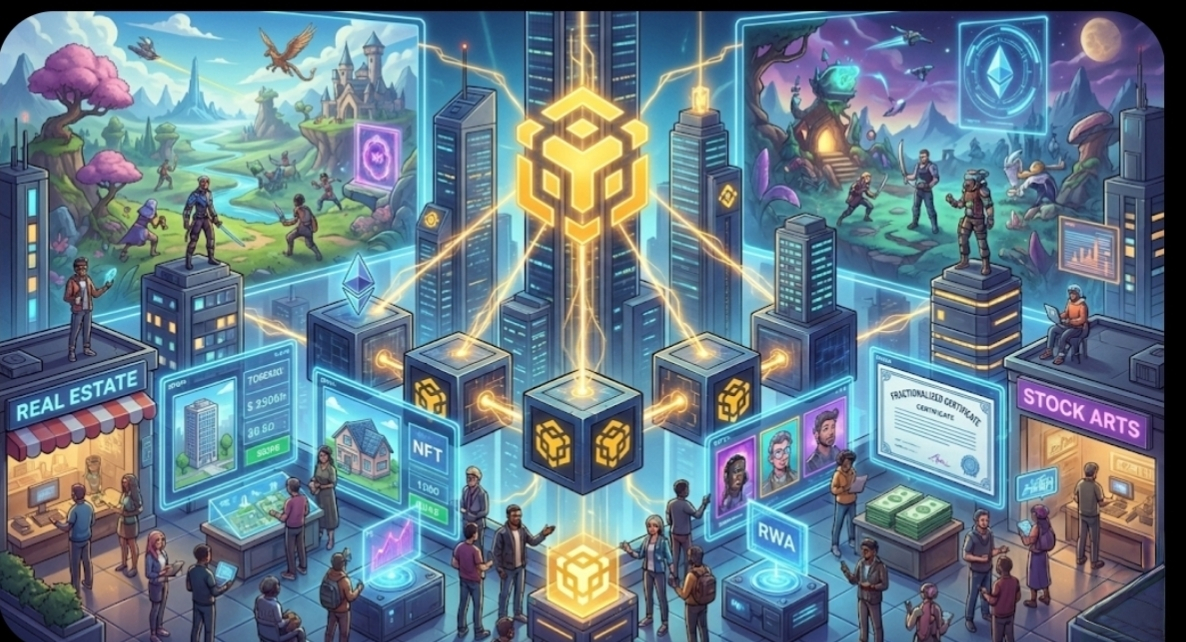
Real-World Assets (RWAs): BNB Chain has heavily pushed for retail-friendly RWA integration. With RWA scale pushing past the $1.8 billion mark, traditional finance is migrating on-chain. You can find simple asset tokenizations and yield-bearing off-chain assets trading natively, all secured by BNB.
Artificial Intelligence: There are over 60 AI projects currently live on the ecosystem. The 2026 roadmap is rolling out AI agent middleware, allowing autonomous AI programs to have their own on-chain identities, hold assets, and execute logic—all fueled by the BNB network.
🔥 The Unstoppable Deflationary Engine
Underpinning this massive technological and economic growth is BNB’s fiercely deflationary tokenomics. The network is fundamentally designed to make the asset scarcer over time, marching steadily toward a permanent maximum supply of 100 million tokens.
Just last month, the network executed its 34th quarterly Auto-Burn, permanently removing over 1.37 million BNB (valued at roughly $1.28 billion) from circulation. This objective, auditable formula acts alongside the BEP-95 Real-Time Burn, which continually destroys a ratio of the gas fees collected in every single block. As network activity, stablecoin transfers, and high-frequency trading explode, this real-time burning mechanism works around the clock, continuously shrinking the total supply against rising demand.
As we navigate 2026, BNB has definitively proven itself. It is a high-speed, multi-chain settlement layer, a hub for real-world assets and AI, and a deflationary powerhouse