
In the ever-changing world of blockchain infrastructure, several networks fight on lower costs and higher throughput. Fogo goes about the problem otherly. It starts with a more basic reality rather than just concentrating on software optimization:
Latency is a physics problem, not only a code issue.
Data has to go across physical distances. Networks add time. Hardware varies in capability. And in distributed systems, even slight changes add up.
Fogo designs its building around these limits.
Performance-First Attitude
Most blockchains are made to be as decentralized as possible over a wide area. This boosts censorship resistance but also adds time delays between validators for communication.

Fogo offers a fresh viewpoint:
If performance-sensitive applications need deterministic execution, network topology has to be regarded as a top-notch design factor.
Fogo builds agreement in a way that lowers wide-area latency during important activities instead of assuming worldwide dispersion is always ideal.
Regional Agreement
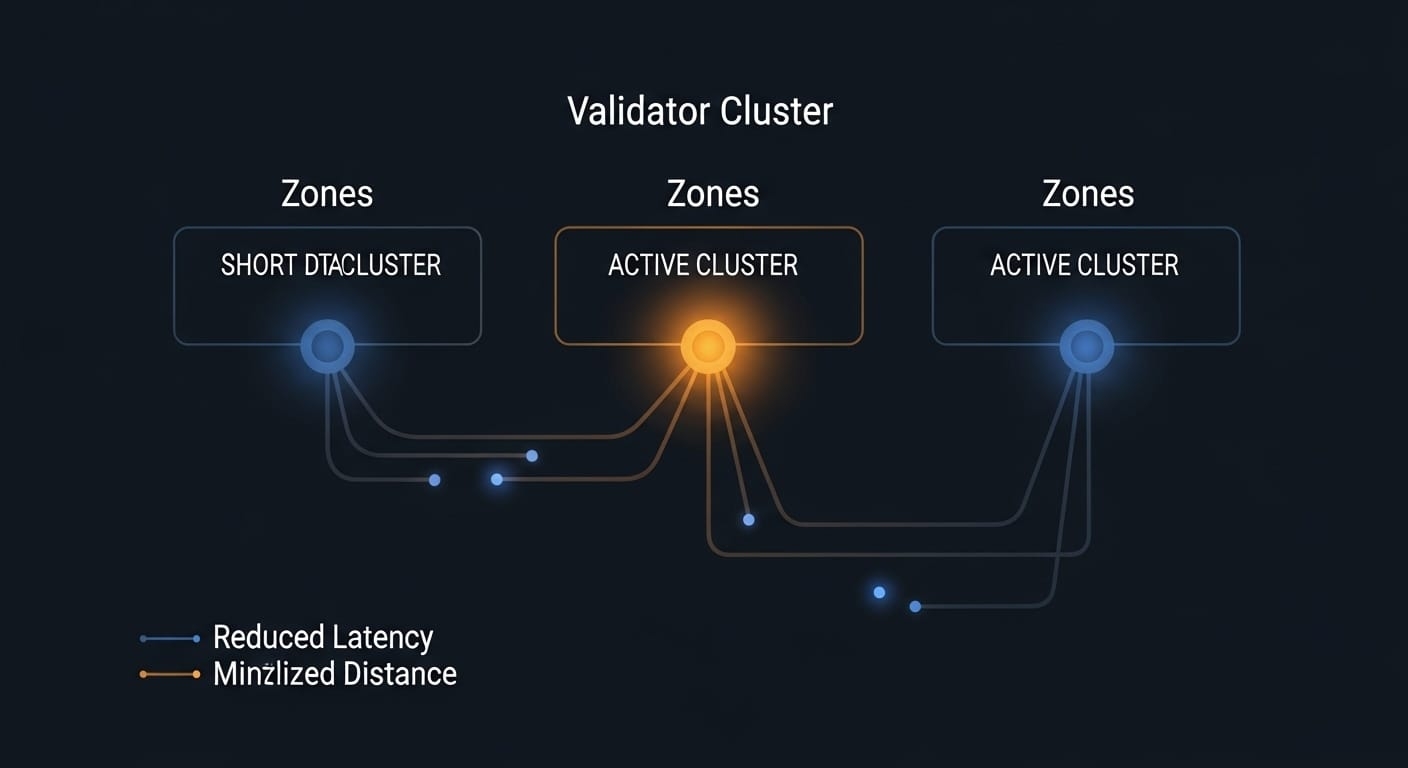
Localised consensus via validator zones is among Fogo's main design choices.
Validators are arranged into areas, which are physically close to one another. One zone starts functioning for consensus voting and block production during a particular era. Other regions stay in sync but are not right away vital.
Why it's important
Validators' physical proximity means:
Time to spread messages gets shorter
Round-trip network latency becomes consistent.
Long-distance routing helps to reduce variance.
Confirmation of blocks balances
Fogo constricts the active route rather than depending on a geographically dispersed quorum for every block, therefore greatly lowering latency effect.
This is about organizing decentralization differently rather than ignoring it.
Performance Enforcement
Speed is not only about simple throughput. It's all about consistency.
By standardizing its validator implementation and enforcing explicit operational standards, Fogo lowers performance variance. Doing so helps to reduce the influence of sluggish outliers that would otherwise lower network performance.
In many distributed systems, the slowest participant determines overall responsiveness. Fogo's approach tries to relieve that bottleneck.
The aim is consistent quorum behavior instead of theoretical peak performance.
Compatibility in Execution
Fogo develops a parallel processing and account-based architectural high-performance execution environment. This helps developers who know similar models move more quickly and profit from lower latency.
Fogo keeps consistency with a proven execution method so that it can concentrate on maximizing the consensus and networking path instead of rewriting the runtime layer.
This mix lets it aim for low-latency areas without requiring developers to learn whole new ways of doing things.
Streamlined Communication - Sessions
Constant user confirmations can cause friction for trading and high-frequency settings.
Fogo adds a Sessions standard to allow application interactions temporary and limited permissions. These meetings:
Do you have a time-limited schedule?
Have little power.
May be cancelled
Improve flow efficiency
This facilitates better user experiences without ever jeopardizing control.
In situations when speed and responsiveness affect fairness directly, sessions are very helpful.
Throughput versus Determinism
Many talks on blockchain center on transactions per second. Throughput by itself, though, is insufficient to determine market-based system usability.
Fogo gives top priority to:
Little end-to-end latency
- Deterministic order
Lower variance in execution
Regular block timing
Milliseconds affect the quality of execution in financial contexts. A deterministic system improves fairness between participants and lowers uncertainty.
Financial Organization
Fogo's financial structure matches operational standards with validator rewards. Validators have rigorous performance requirements; hence, reward systems aim to encourage dependable infrastructure involvement.
The model tries to find a balance between:
Compensation for Validators
Ecosystem development incentives
Network resilience
Fee effectiveness
Long-term stability is the priority rather than short-term forecasting.
Tradeoffs and Considerations
Every design decision offers trade-offs.
Giving performance and operational consistency first priority will help to guide Fogo:
Increases validator criteria
Reduces software variation.
Concentrates on particular application scenarios.
It is not trying to be a ubiquitous solution for all distributed applications.
It presents itself as a unique infrastructure for latency-sensitive industries rather than the other way around.
Fogo Fits Where
Fogo is meant for cases where exact timing is crucial:
Order management systems
derivatives on the chain
Auctions happening right now
Market-making equipment
Performance comes first; it is market-focused and built around physical facts.
In conclusion
Fogo marks a conscious change in the direction of blockchain building.
Rather than aiming for headline throughput numbers, it revises the accepted route itself. It aims to provide a more deterministic and consistent execution environment by reducing the influence of regional latency and enforcing validator performance criteria.
Adoption and long-term robustness determine whether this paradigm will become a fresh norm or stay a particular solution.
One thing is certain, though:
Fogo depends on engineering expertise, not speculations.