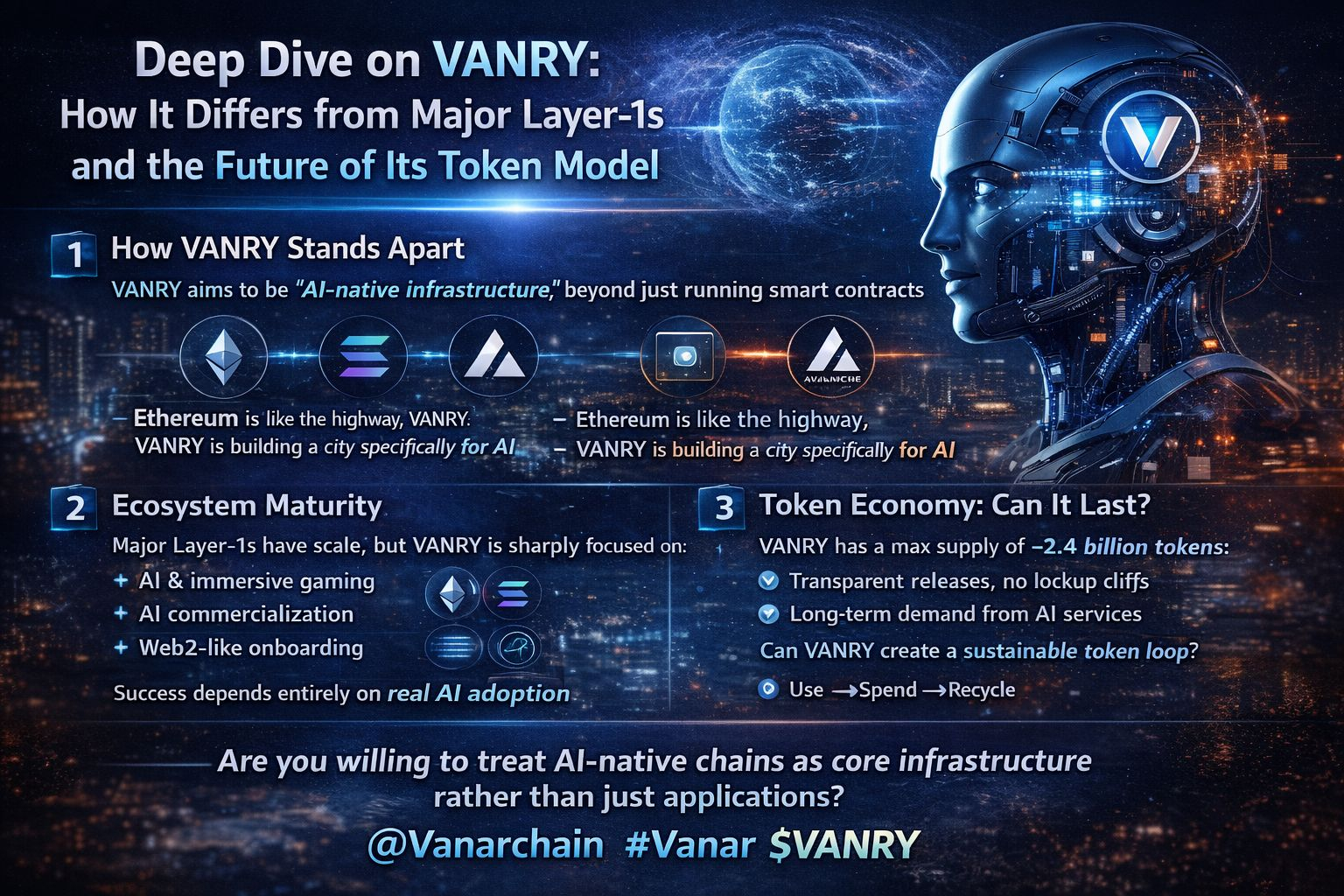
When analyzing VANRY, the key question is simple:
Is it just another Layer-1 riding the AI narrative, or does it have a genuine chance to carve out a real role in the blockchain landscape?
This isn’t about short-term price moves—this is about fundamentals.
1. How VANRY Stands Apart from Mainstream Layer-1 Chains
Ethereum dominates smart contracts with unmatched developer depth, but scaling remains expensive and complex.
Solana focuses on speed and low latency, ideal for consumer and trading use cases, though hardware demands and stability concerns exist.
Avalanche pushes modularity with customizable subnets.
So where does VANRY fit?
VANRY is positioning itself as AI-native infrastructure.
Instead of just running smart contracts, it aims to integrate:
AI reasoning directly with blockchain services
Efficient data processing and computation
Subscription-based AI tools built into the ecosystem
Think of Ethereum and Solana as highways.
VANRY wants to be a city built specifically for AI applications.
This creates strong differentiation—but also higher risk due to a smaller ecosystem.
2. Ecosystem Maturity Comparison
Top Layer-1s win on developer count, DeFi liquidity, stablecoin usage, and total on-chain capital.
VANRY takes a vertical approach, focusing on:
Gaming and immersive environments
AI service commercialization
Web2-like user onboarding
Instead of competing everywhere, it concentrates on building a closed-loop AI + Web3 economy.
This focus is strategic—but success depends entirely on real AI adoption.
3. Token Economy: Can VANRY Be Sustainable?
A Layer-1 token survives long term only if:
It has real-world utility
Demand is continuous
Supply is managed effectively
Use Cases
VANRY functions as gas, staking, and governance—standard L1 roles.
But the differentiator is AI service consumption using the token.
If AI tools require VANRY, demand becomes functional—not speculative.
Demand Drivers
Traditional L1 demand comes from:
DeFi collateral
NFTs
Stablecoin transfers
VANRY targets:
AI subscriptions
On-chain data services
Game economies
If these use cases scale, demand becomes organic.
If not, trading speculation dominates.
Supply and Inflation
With ~2.4B max supply and high circulation, VANRY has:
Pros:
Transparent emissions, fewer unlock shocks
Cons:
Price relies on real demand, not token lock-up hype
If burning or consumption mechanisms expand with AI usage, VANRY could achieve a sustainable use → spend → recycle token loop.
4. Risks and Reality Check
VANRY is far smaller than Ethereum or Solana in both scale and adoption.
Its success depends on vertical AI breakthroughs, not broad ecosystem competition.
If AI-native chains become essential infrastructure, VANRY benefits early.
If AI remains mostly off-chain, demand could fade.
This makes VANRY a sector bet, not a guaranteed winner.
5. Final Verdict
Compared to major Layer-1s, VANRY is:
Not the fastest
Not the biggest
But one of the most specialized
Its token economy hinges on one question:
Will AI tools create real on-chain usage?
If yes → VANRY becomes a functional infrastructure token.
If no → it stays a narrative-driven asset.
In today’s fragmented Layer-1 competition, broad strategies struggle.
Deep vertical positioning may still win—and VANRY is betting everything on AI infrastructure.
Are you willing to treat AI-native chains as core infrastructure rather than just applications?
That belief will decide how you view VANRY’s future.