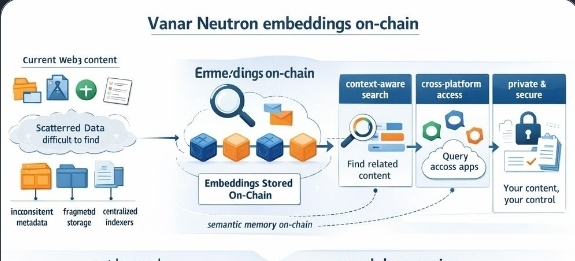
Vanar Chain starts from a different assumption than most blockchains. The problem is not only speed. The deeper issue is that blockchains store data without understanding it.
That limitation shows up quickly in real use cases. Documents become hashes. Records lose context. Automation stops at simple if then logic. Vanar’s architecture tries to close that gap.
Here is how the system actually processes data.
Data is compressed, not ignored
Most chains either store raw data expensively or push it offchain. Vanar uses Neutron to compress large data objects before anchoring them onchain.
• Documents, media, and structured records are reduced into compact, verifiable representations.
• The chain does not carry the full weight of the data.
• It still retains cryptographic proof and reference integrity.
This keeps costs predictable while preserving trust.
Data is given semantic structure
Compression alone is not enough. Data needs meaning.
Neutron treats stored information as structured objects rather than opaque blobs.
• Relationships between data points are preserved.
• Context is maintained across updates.
• Historical state remains traceable.
This raises an important question. If a contract can see context, should it behave differently than one that only sees raw inputs?
Reasoning happens onchain
Kayon adds the reasoning layer.
Instead of sending data to external AI services, Kayon retrieves and computes against onchain data in real time.
• Logic runs within verifiable boundaries.
• Outputs can trigger smart contract execution.
• Decisions remain auditable.
This is where automation becomes practical, not speculative.
Logic triggers real workflows
When data can be understood and reasoned over, new workflows emerge.
• PayFi systems can react to verified documents.
• Tokenized assets can enforce compliance automatically.
• AI agents can operate on live, trusted data instead of static transactions.
At this point, the chain is no longer just executing code. It is coordinating decisions.
From theory to utility
What stands out is the move toward usage models.
• Products are integrating subscriptions.
• Tools like myNeutron are tied to actual workflows.
• Token utility connects directly to infrastructure usage.
Final reflection
The real shift is subtle. Vanar is not trying to make blockchains faster. It is trying to make them aware.
If the next phase of onchain activity depends on systems that understand data, not just execute instructions, this type of infrastructure may matter more than raw throughput ever did.