
There's this assumption we carry around, usually unexamined, that price and progress move in the same direction. That a project building real infrastructure, signing enterprise partners, shipping code that actually does something new—that project's token should reflect that momentum. It's a clean, intuitive story. And like most clean, intuitive stories about crypto markets, it keeps bumping into messy reality.
Take Vanar. In March 2024, VANRY traded at $0.382. Today it's hovering around $0.006 . That's not a pullback. That's a 98% drawdown from all-time highs, depending on which data source you use—some show ATH at $0.382, others show $0.3824, the difference is noise at this point . Down 90% if you're being generous. Down more than that if you're being precise. Either way, the number stops mattering after a point. What matters is the gap between what the project has become and what the market says it's worth.
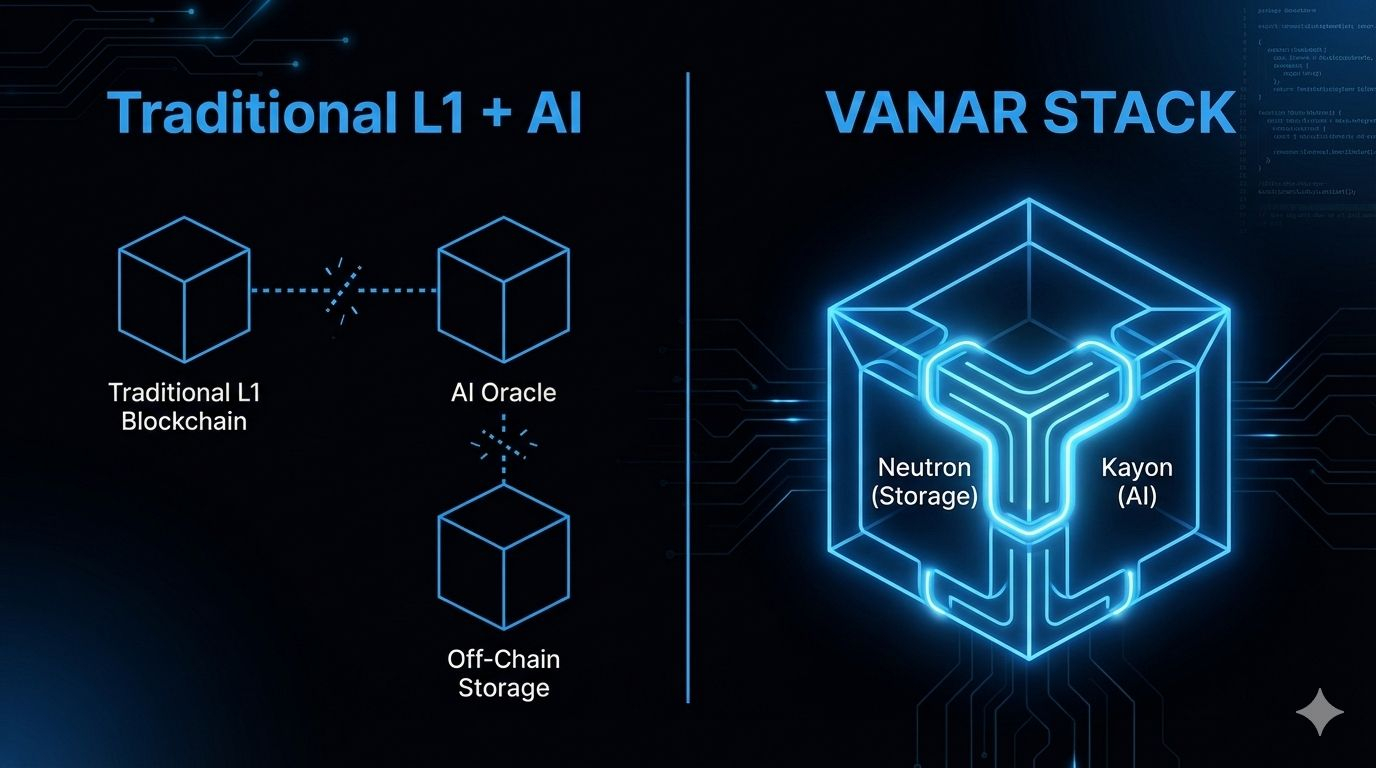
I spent last week reading through Vanar's technical documentation and following up on partnership announcements. The "Vanar Stack" isn't marketing fluff. Neutron, their semantic memory layer, compresses files at 500:1 and stores them on-chain as "Seeds" . That means documents, legal records, complex datasets—they live on-chain permanently, accessible to AI without oracles or brittle API links. Kayon, the reasoning engine, lets smart contracts actually read and act on that data . A contract can verify an invoice's contents and trigger payment automatically, all on-chain, no off-chain middleware required.
This is the kind of infrastructure that makes me reconsider what I thought was possible. Or at least that's what I thought until I looked closer at the adoption numbers.
The honest criticism first, because it matters: none of this guarantees anything. Vanar operates in the most crowded corner of crypto—AI-focused L1s. Bittensor does the decentralized model marketplace thing. Fetch.ai (now part of ASI) does autonomous agents. Solana, Sui, Aptos—they're all adding AI modules or positioning as high-performance chains for compute . Vanar's EVM compatibility gives it a developer onboarding advantage, sure. Ethereum devs can migrate existing apps and immediately access Neutron and Kayon. But compatibility isn't differentiation. And mainnet activity, while growing, isn't yet at the scale that would justify dismissing the competition.
The market cap sits around $49 million as of February 2026 . That's small enough that a few large holders could move price meaningfully. It's also small enough that real adoption could move price meaningfully. Two sides of the same coin.
Worldpay processes $2.3 trillion annually across 150 countries. They're using Vanar for dispute resolution—pulling immutable "data seeds" from Neutron to verify transaction details instantly, reducing chargeback friction . Google Cloud provides carbon-neutral infrastructure. NVIDIA is in the mix for AI compute . These aren't press release partnerships where a logo appears once and vanishes. They're integrations that generate transaction volume. And transaction volume, on Vanar, means $VANRY burns.
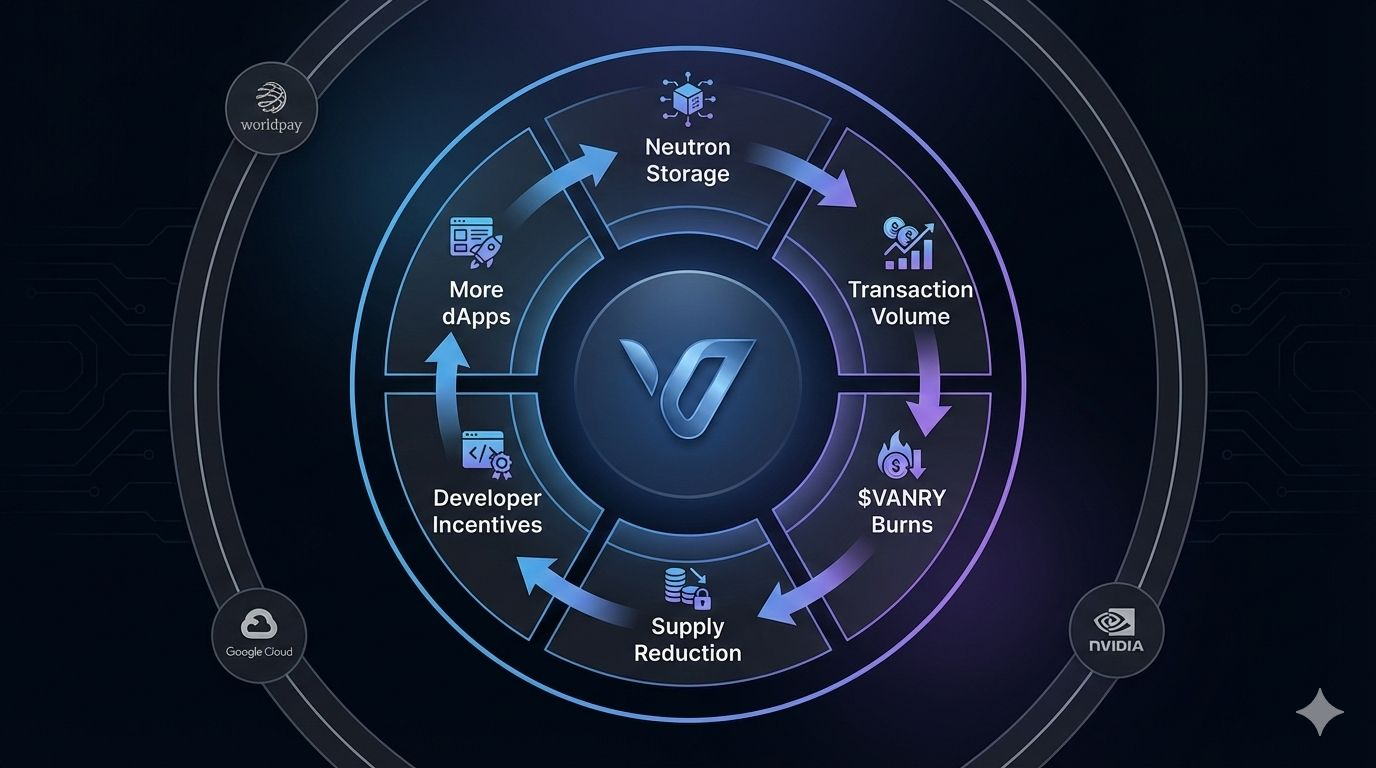
This is where the flywheel starts to take shape, quietly. Neutron adoption drives transaction volume. Volume drives burns. Burns reduce supply. Reduced supply, if demand holds or grows, puts upward pressure on price. But more importantly: more transactions mean more data stored on-chain, which means more utility for Kayon to reason over, which means more sophisticated dApps become feasible, which attracts more developers, which builds more use cases, which drives more transactions . A leads to B. B enables C. C makes D possible. D changes what builders think is worth building.
The skeptic's first question is obvious and fair: if this infrastructure is so real, why does VANRY trade 60% below its 200-day moving average ?
Macro conditions explain part of it. The Crypto Fear & Greed Index recently sat at 18—extreme fear. Altcoin season index at 27, favoring Bitcoin over everything else . VANRY's 90-day drop of 54% aligns with broader risk-off sentiment across small-cap alts . When markets are fearful, they don't distinguish between "speculative meme coin" and "shipping real infrastructure." They just sell.
But macro is only part of the story. The other part is timing mismatch. Neutron and Kayon are live. The subscription model for premium AI tools launched Q1 2026 . But enterprise adoption cycles move slowly. Worldpay integrating Vanar doesn't mean Worldpay's entire volume moves on-chain tomorrow. It means pilots, testing, gradual expansion. Developer activity? Hundreds of active contributors, over 100 DApps, 70% usage growth . Those are real numbers. They're just not yet reflected in price because markets price narrative faster than they price gradual, unglamorous build-out.
I keep coming back to an analogy that frames it cleanly: imagine two highways. One is a general-purpose road—cars, trucks, motorcycles, everything shares lanes, congestion inevitable. That's most L1s. The other is a dedicated express lane for autonomous vehicles, with its own on-ramps, its own traffic management, designed specifically for self-driving fleets. That's Vanar. Both highways move vehicles. But the express lane enables things the general road can't—platooning, coordinated routing, instant vehicle-to-infrastructure communication. You don't see the value until you imagine a future where autonomous vehicles are common. Vanar's bet is that AI agents and data-intensive dApps are those autonomous vehicles. And when they arrive in numbers, they'll need infrastructure built for them, not retrofitted.
That future isn't hypothetical anymore. Pilot Agent, Vanar's natural-language wallet interface, is live. You can interact with DeFi by talking to it . World of Dypians rewards players in $VANRY, with over 30,000 active users . These aren't testnets. They're production applications generating real transactions.
Which brings me to why this moment matters specifically. Vanar is post-TGE, post-rebrand (from TVK to VANRY), post-migration, with mainnet live and integrations active. The narrative around AI and crypto has cooled from peak hype, which means projects with actual infrastructure are easier to distinguish from those with only whitepapers. And the current Creator Campaign on Binance Square is surfacing exactly this kind of analysis—projects where the gap between tech progress and market perception creates asymmetric information .
Plain language: Vanar has built infrastructure that lets developers store data on-chain permanently and have AI reason over it automatically. Worldpay, Google Cloud, and NVIDIA are involved. Transaction volume creates token burns. The token price is 90% below where it traded when the project was less mature. Either the market is correctly pricing something I'm missing, or it's incorrectly pricing something the market hasn't noticed yet.
If I were watching Vanar closely from here, I would track three indicators. First, Neutron transaction volume—specifically, whether the Q1 2026 subscription model drives measurable increases in on-chain activity . Second, the number of deployed dApps using Kayon for AI reasoning, not just basic token transfers . Third, enterprise partnership expansions—whether Worldpay, Google Cloud, or NVIDIA move from pilot integrations to scaled deployments .
One prediction, falsifiable within 6–12 months: if Neutron-powered applications reach 200 deployed dApps by Q1 2027, VANRY will trade above its 200-day moving average regardless of broader market conditions. The infrastructure exists. The question is whether builders use it.