
Every cycle has a new “magic combo.” Right now it’s AI + on-chain. Sometimes it’s legit. Sometimes it’s just a fancy wrapper around an off-chain app.
With Vanar Chain, I’m leaning positive, because the pitch is specific: Neutron for semantic memory, Kayon for on-chain reasoning, and a consumer-facing memory product called MyNeutron.
That’s a stack, not a single buzzword.
Still, I’m not buying anything on vibes alone, I’m looking for what can be verified and reused by others.
Normal storage is like throwing files in a drawer. “Semantic memory” is when the drawer stays organized and searchable, even later, even across apps.
Vanar says Neutron transforms raw files into compact, queryable, AI-readable “Seeds” stored on-chain.
That’s the important part.
Not just “we saved your PDF,” but “this PDF can be asked questions like a knowledge object.”
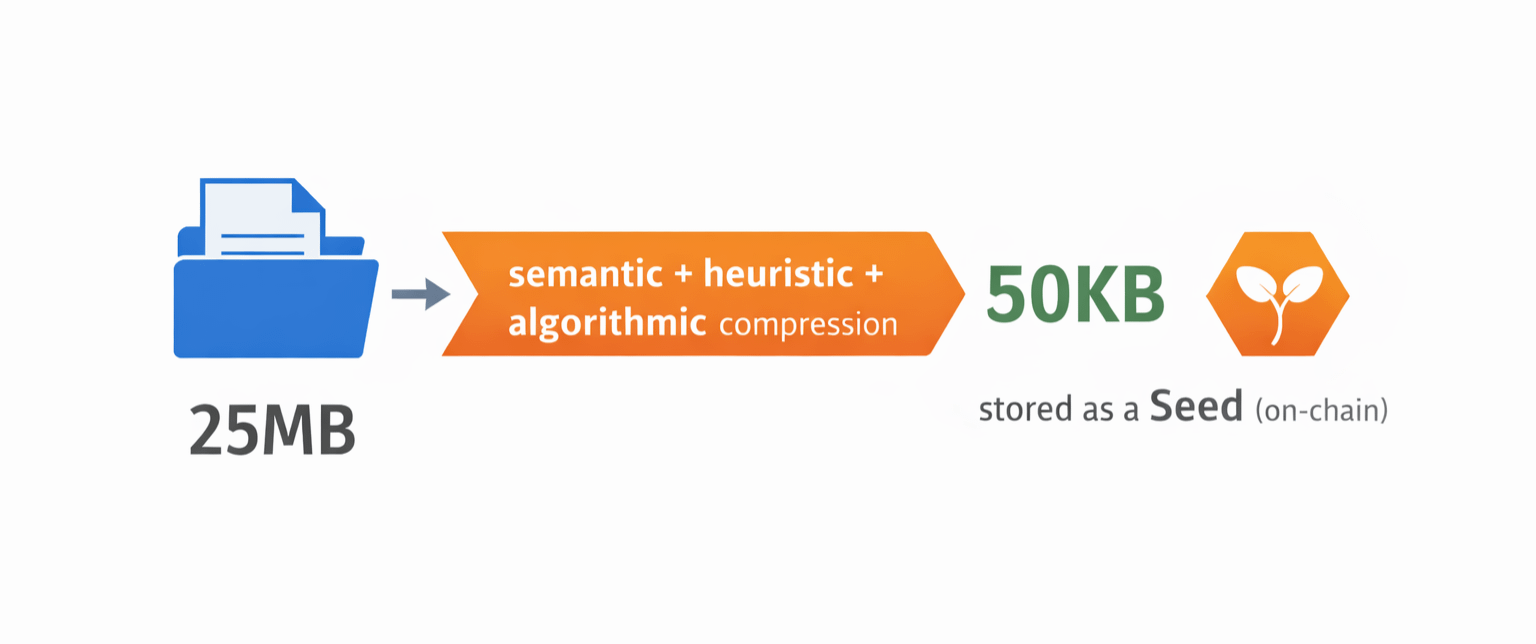
And the detail that made me pause : Vanar claims Neutron can compress 25MB into 50KB using semantic, heuristic, and algorithmic layers.
If that holds up in real usage, it changes what “on-chain data” can mean, because storage size is usually the killer.
Let’s not do the fantasy version where validators run huge models like it’s nothing.
Chains are great at rules, shared state, and verification.
Heavy AI inference is a different beast.
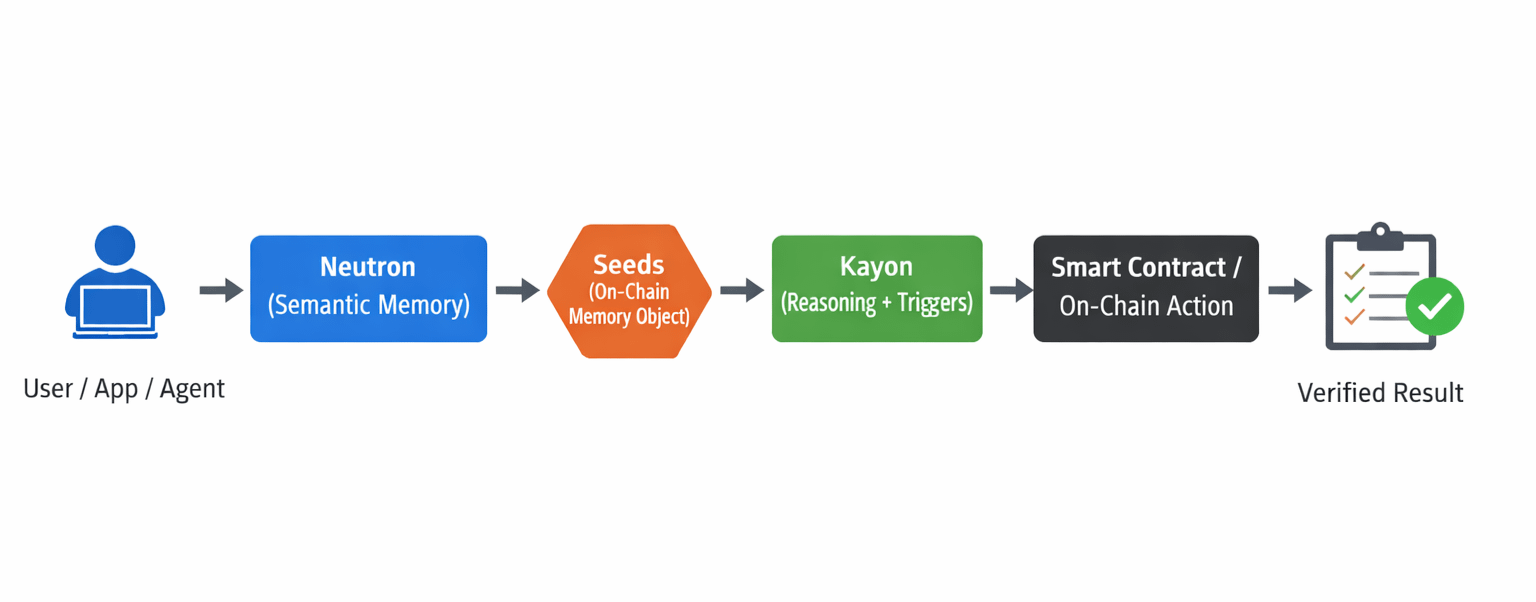
Vanar frames Kayon as a contextual reasoning engine that turns Neutron Seeds and enterprise data into auditable insights, predictions, and workflows, with APIs that connect to explorers, dashboards, ERPs, and custom backends.
The word “auditable” matters.
That’s the line between “trust our chatbot” and “you can inspect how this decision was formed.”
Also, their docs describe Kayon AI as a gateway to Neutron, connecting to sources like Gmail and Google Drive to turn scattered data into a private, searchable knowledge base.
That makes this feel more like a usable product direction, not just chain theory.
When I judge this stuff, I keep it simple:
Can I verify it?
If Seeds are truly on-chain objects (not just off-chain blobs), that’s a real step.
Can I reuse it?
If another dApp can read the same Seeds and build workflows, that’s differentiation.
Is there market attention?
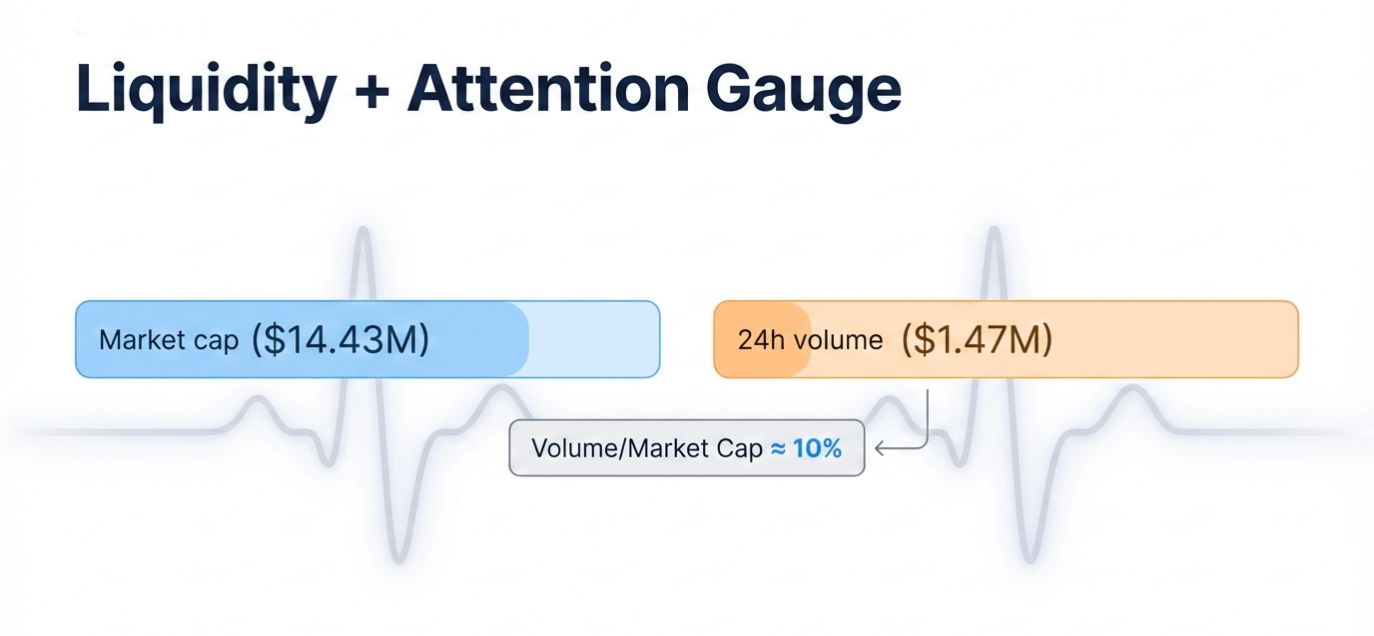
Not proof, but it’s a pulse check. Binance lists VANRY around $0.006297, with about $14.43M market cap, $1.47M 24h volume, and 2.29B circulating supply (this moves, obviously).
Most projects trip in boring ways : memory ends up off-chain, reasoning ends up off-chain, and the chain becomes a receipt printer.
Vanar’s best shot is that it’s trying to make the memory and query layer first-class, with Seeds you can reference and a reasoning layer designed around auditability.
If they keep this open and composable, they dodge the usual trap.
What I’d watch next :
I’m not asking for miracles. I want proof you can touch:
i. Public demos where the same Seed can be used across apps
ii. On-chain flows where a Kayon-triggered action is reproducible by others
iii. Clear examples showing what’s on-chain vs what’s just “connected data”
And yes, MyNeutron matters here.
If it really makes portable, user-owned AI memory practical (not just a concept), that’s a strong signal the stack is turning into something people actually use.
So, hype or real differentiation?
I’d call it promising differentiation with a clear path to proving it.
Vanar is betting that “memory that works” (Seeds) plus “logic you can audit” (Kayon) is the missing layer for on-chain apps.
If the tooling stays verifiable and composable, this isn’t just noise, it’s a direction.