
The confirmation popup lingered for seven seconds at 3:47 PM last Thursday. I had just submitted a small swap on a Solana-based DEX, nothing fancy, 0.8 SOL worth of a memecoin. The wallet showed "confirmed" almost instantly, but the on-chain explorer stayed stuck on "processing" until I refreshed twice. By the time the balance updated in the DEX interface, the price had slipped 1.4%. My thumb hovered over the retry button, but I closed the tab instead. That small delay—those seven seconds—turned a quick trade into a lesson in patience I didn't ask for.
I have watched this pattern repeat across chains. You sign the transaction, the RPC node tells you it's in, the UI celebrates with a green checkmark, yet the actual settlement lags. Sometimes it's network congestion, sometimes validator propagation, sometimes just the way blocks get bundled. Traders absorb it quietly. We adjust slippage tolerances higher, set limit orders instead of market, or move smaller sizes to test waters. The cost isn't always gas; it's missed entries, widened spreads, or the mental tax of second-guessing every click.
The worst part is how normalized it feels. We tell ourselves sub-second finality exists somewhere, but in practice, even fast chains force compromises when load spikes. Developers tolerate it because porting means rewriting, users tolerate it because alternatives feel slower or more expensive. Everyone pays in time or edge.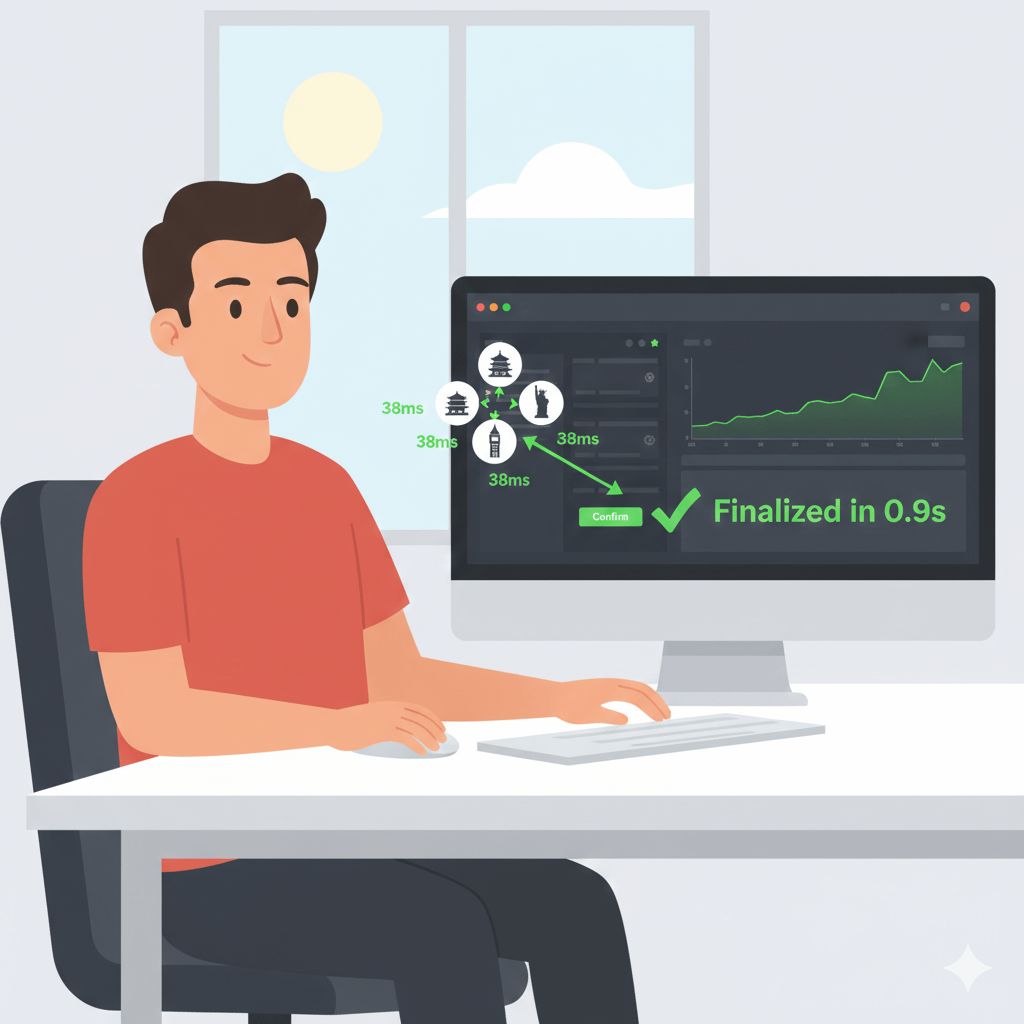 #fogo
#fogo
That's when Fogo became relevant. It functions like a high-frequency trading co-location setup in traditional finance. Instead of waiting for global consensus to propagate across distant nodes, it colocates active validators in key financial hubs—Tokyo, London, New York—while keeping backup nodes elsewhere for resilience. The difference is subtle but operationally meaningful: block times target around 40 milliseconds, with finality hitting sub-second in most cases I've seen.
I first noticed it when bridging a test amount over. Connected my wallet to their explorer dashboard around 11:12 PM my time. Signed the transfer. The progress bar filled in under two seconds, and the receiving balance updated without a manual refresh. No " awaiting finality" spinner that drags on. The dashboard showed block 47,812 processed in 38 ms according to the metrics panel. That number stayed consistent over the next dozen interactions.
What changed is the multi-local consensus approach. Validators are grouped regionally, so propagation happens within low-latency zones rather than worldwide hops. When a transaction hits, it gets processed locally first, then gossiped efficiently using an optimized Firedancer client—basically a high-performance rewrite of the Solana validator stack. The user sees a near-instant "finalized" status in the wallet or dApp interface. Gas stays low, around 0.000005 to 0.00001 SOL equivalents in my trials, but the real shift is predictability: no sudden jumps in confirmation time during moderate load.
The explorer reflects this too. Instead of a chain of pending blocks, you see tight clustering—blocks arriving every 40-50 ms, rarely deviating. I ran a simple loop sending micro-transactions; out of 50, 47 confirmed under 100 ms end-to-end. The three outliers were still under 400 ms. Compare that to waiting 1-3 seconds on other SVM chains during similar tests.
This matters because speed without reliability is just noise; reliability without speed keeps DeFi feeling second-class to TradFi terminals. That's where $FOGO enters: it is used as the native gas token for all transactions and as stake to secure validator slots in those colocated clusters. Over time, this creates a mechanical dynamic where higher stake concentration in low-latency regions improves collective performance, pulling more economic activity toward efficient participants.
Validators earn $FOGO rewards proportional to their uptime and geographic contribution to consensus speed. Users pay gas in $FOGO, creating constant demand for settlement. Stakers delegate to preferred regional clusters, aligning incentives toward latency reduction rather than just raw compute. It's not about speculation; it's about rewarding the infrastructure that makes sub-40 ms blocks sustainable.
That said, the curated validator set introduces a dependency. If a major hub—like the New York cluster—faces an outage or coordinated downtime, fallback to global backups could spike latency back toward 200-500 ms temporarily. We've seen hints during testnet stress; one regional flap added noticeable jitter until rerouting kicked in. It's a tradeoff for speed: tighter coupling to physical locations means physical risks matter more.
I've interacted with Fogo's dashboard and swapped on a couple early dApps for about five weeks now. The difference is measurable—trades land closer to intended prices, less second-guessing slippage. I hold a small position from the initial bridge. I'm observing, not predicting. #fogo $FOGO @Fogo Official