

Every serious market participant has felt that split second of doubt after pressing confirm. You’re not thinking about technology in that moment. You’re thinking about whether the system will treat you fairly. In crypto, that emotional gap between action and confirmation is still one of the biggest friction points. It’s small on paper, but it carries real psychological weight. Fogo starts from that exact feeling. Instead of chasing headlines about speed, it focuses on something more personal: making on-chain execution feel stable enough that users stop worrying about the machine underneath.
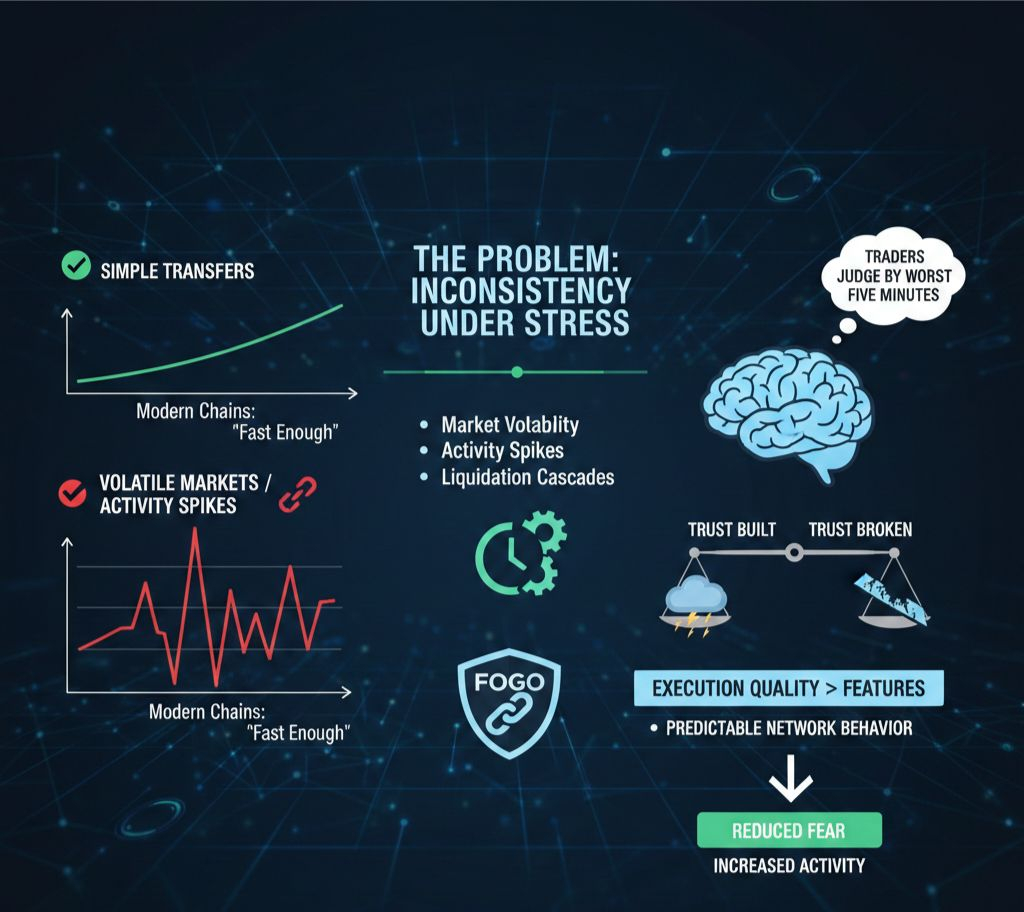
The core problem Fogo is addressing in this cycle is not raw slowness. Most modern chains are already “fast enough” for simple transfers. The real issue is inconsistency under stress. When markets get volatile, when activity spikes, or when liquidations cascade, networks reveal their weakest moments. Traders don’t judge a chain by its best-case performance. They judge it by its worst five minutes. That’s where trust is either built or broken. Fogo’s thesis is that crypto has matured to the point where execution quality matters as much as features. If users can’t predict how the network behaves during chaos, they will price in fear, and fear reduces activity.
Fogo builds on the Solana Virtual Machine because the SVM already proved it can handle parallel execution and heavy throughput. This is a practical decision, not a philosophical one. Developers already understand the tooling. Infrastructure already exists. Migration is possible without forcing teams to start from zero. In a cycle where builders are tired and capital is selective, lowering friction is not a bonus — it’s survival. Fogo isn’t trying to reinvent the runtime. It’s trying to refine the environment where that runtime lives, focusing on predictability instead of novelty.
The infrastructure design shows that focus clearly. One of the ideas behind Fogo is organizing validators into zones so that consensus does not always depend on the entire globe at once. Physical distance matters in distributed systems. Signals still travel at the speed of physics. By structuring validator participation in a controlled way, Fogo is trying to reduce the chance that a slow edge of the network drags everyone else down. For a trader, this translates into something simple: fewer surprise delays when activity spikes. It’s an attempt to engineer calm into a system that normally thrives on chaos.
Another layer of the design is performance enforcement at the validator level. Fogo leans on a Firedancer-style architecture that separates tasks across dedicated CPU cores. That sounds technical, but the emotional impact is easy to understand. When markets heat up, most systems start to wobble because too many processes compete for attention. Fogo is trying to remove that competition inside the machine itself. The goal is not to brag about numbers. The goal is to keep the experience boring during the exact moments when users expect drama. In finance, boring is a compliment.
Token economics are intentionally familiar. Fees follow a structure people already understand from Solana: base fees, optional priority fees, and burning mechanics. Inflation is steady and predictable, with rewards flowing to validators and stakers. This is not experimental monetary design. It’s a signal that Fogo wants to reduce uncertainty rather than add another layer of speculation. Markets often reward familiarity because participants can model it. When people understand the rules, they are more willing to commit capital and time.
Ecosystem growth is where the emotional test begins. Technology alone does not create loyalty. Users stay where their habits form. Early reports around Fogo’s launch point to a deliberate attempt to arrive with real activity rather than empty promises. The presence of trading-focused partners and liquidity participants suggests the project is targeting environments where execution quality is not optional. That positioning matters. A chain that attracts serious financial actors from the beginning shapes its culture differently than one built purely around incentives.
In the competitive landscape, Fogo sits next to chains that also promise high performance, but its angle is narrower and more focused. Solana remains the giant in the SVM world, with deep liquidity and strong network effects. Fogo is not trying to replace that ecosystem overnight. Its bet is that there is room for specialization — a network optimized for moments when latency is not an inconvenience but a cost. Other fast chains compete on architecture or developer models. Fogo competes on the emotional experience of execution: how it feels when the market is moving faster than you are.
The risks are real and cannot be ignored. Zoned consensus introduces operational complexity. If governance around zones becomes messy, performance gains could come at the cost of fairness perception. Hardware-heavy validator requirements can slowly centralize participation, which creates social fragility even if technical performance improves. And the harsh truth of this sector is that incumbents adapt. If larger competitors solve the same latency problems, Fogo must rely on ecosystem loyalty, not just engineering.
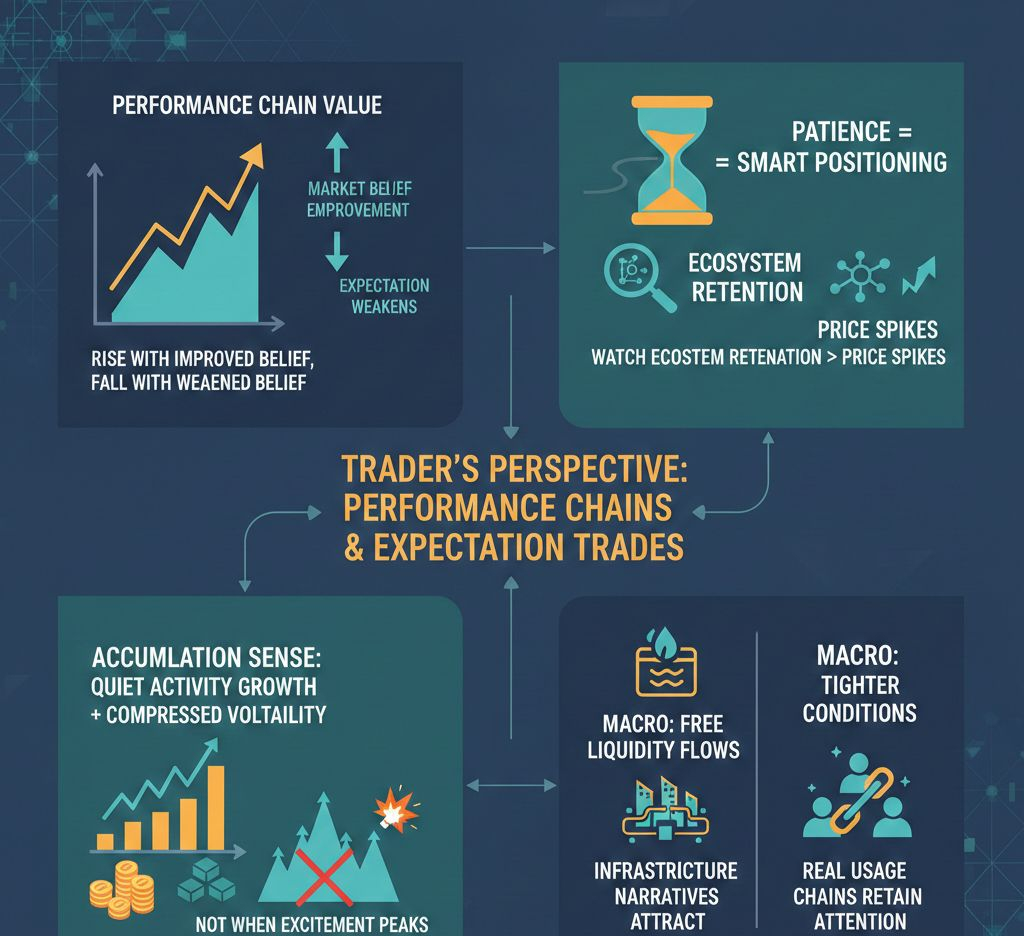
From a trader’s perspective, performance chains behave like expectation trades. They rise when the market believes the experience will improve and fall when that belief weakens. Smart positioning usually comes from patience. Watching ecosystem retention matters more than watching price spikes. Accumulation tends to make sense when activity grows quietly while volatility compresses, not when excitement peaks. Macro conditions also play a role. When liquidity flows freely, infrastructure narratives attract attention. When conditions tighten, only chains with real usage keep that attention.
Here’s the contrarian angle: extreme speed can unintentionally widen the gap between professional and casual participants. The faster a system becomes, the more advantage flows to actors with superior infrastructure and routing. If not handled carefully, performance can feel unfair instead of empowering. Fogo’s challenge is not only to be fast but to feel fair. Users must believe that better execution improves their safety, not just someone else’s edge.
The realistic path forward for Fogo is grounded in behavior, not benchmarks. If developers build applications that people return to daily, and if those users notice that stressful moments feel calmer than on other networks, adoption can compound quietly. Performance becomes meaningful only when it changes habits. The market eventually rewards habits more than promises.
Final reflection from a trader’s lens: the projects that survive cycles are not always the loudest. They are the ones that remove a small fear users didn’t realize they were carrying. If Fogo can consistently reduce that hesitation between clicking confirm and receiving execution, it earns something deeper than hype. It earns trust. And in markets shaped by memory and emotion, trust is the rarest asset of all.
