
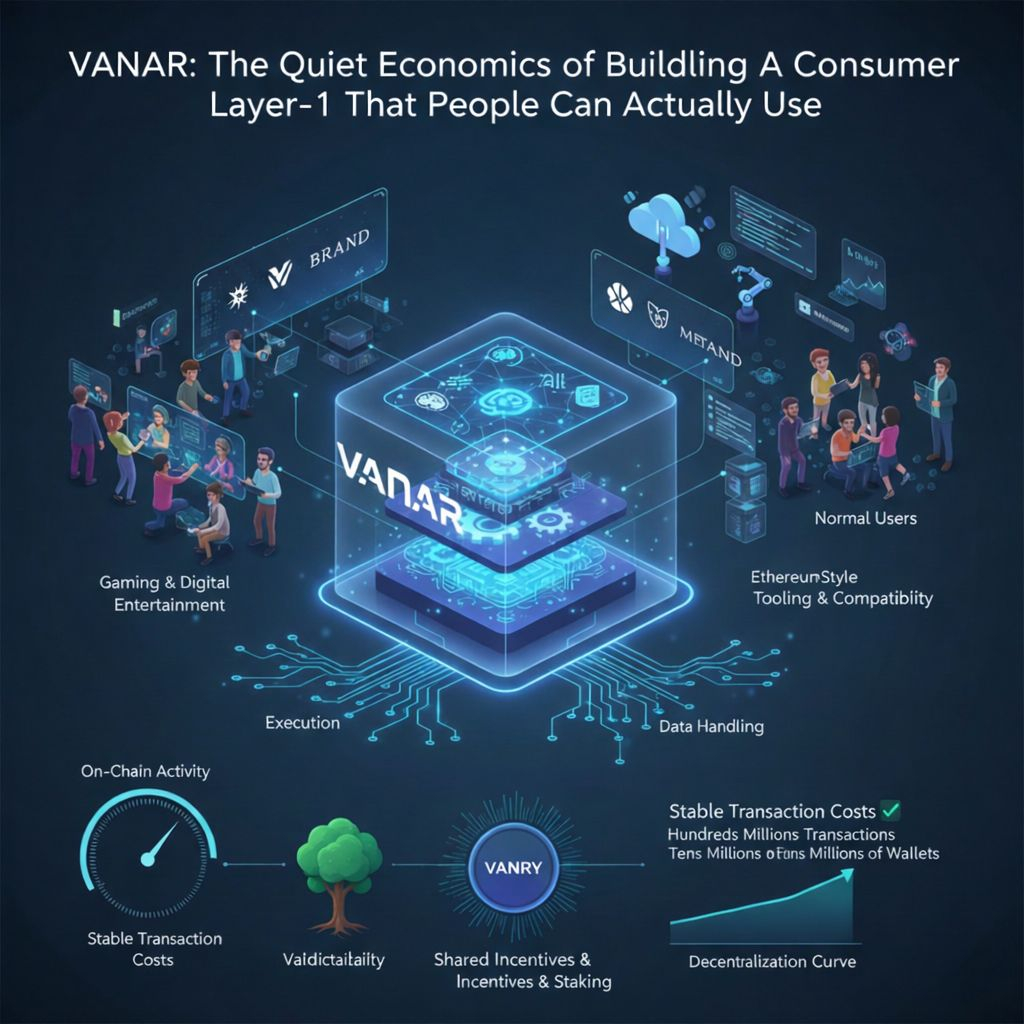
Crypto infrastructure is entering a phase where the conversation is shifting away from abstract performance races and toward a simpler question: can normal users live inside these systems without friction? The market has matured enough to recognize that adoption is not created by peak benchmark numbers but by environments where applications behave predictably under everyday load. Vanar sits inside this transition as a Layer-1 that frames its identity around consumer usability rather than technical spectacle, targeting industries like gaming, digital entertainment, AI services, and branded ecosystems where the tolerance for instability is extremely low.
The network’s design reflects the assumption that consumer platforms generate complex data flows that cannot be treated as an afterthought. Instead of presenting the blockchain as a single execution engine, Vanar is structured more like an application infrastructure stack. Execution, data handling, and intelligent logic are positioned as interconnected layers, attempting to reduce the operational burden developers face when storing, verifying, and moving application state. This matters because consumer software fails not when it lacks features, but when maintenance costs quietly compound. A chain that lowers those hidden costs becomes attractive to teams building long-lived products rather than short-lived experiments.
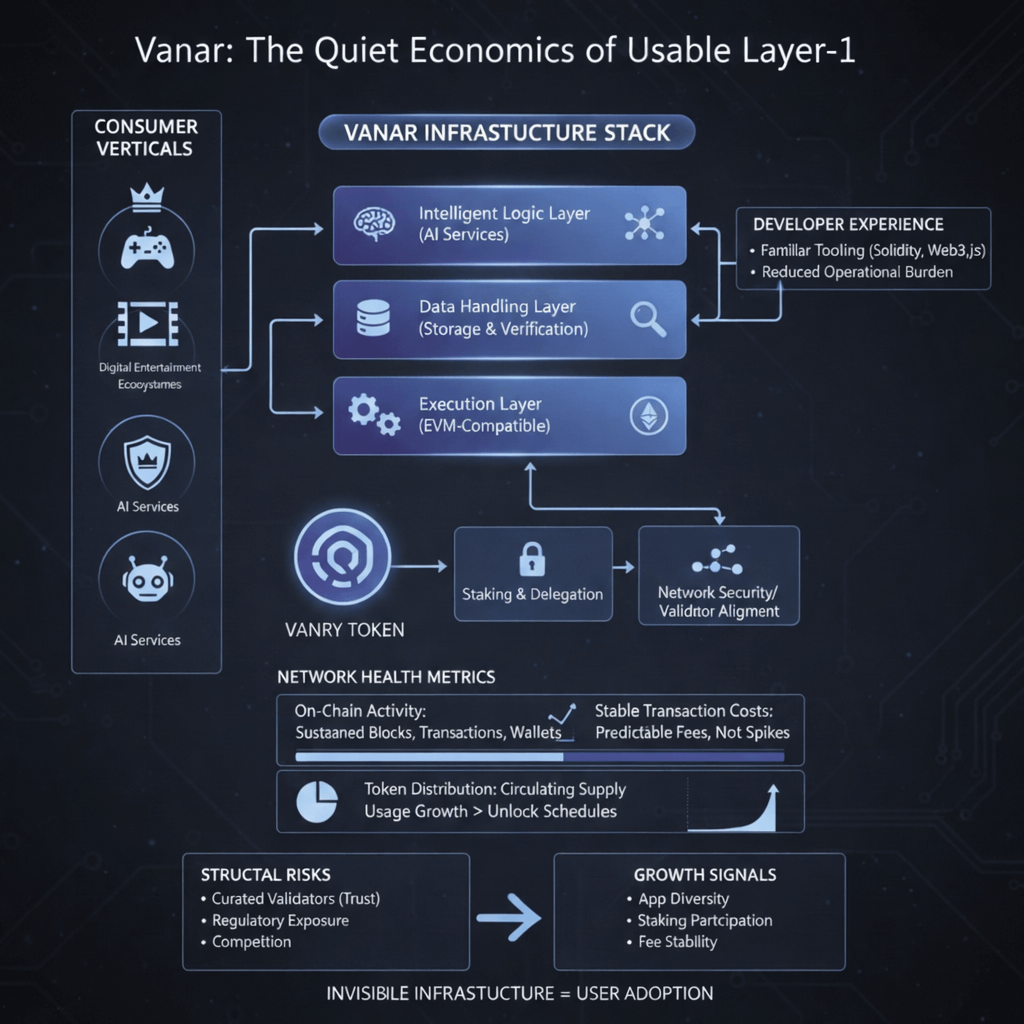
Compatibility with familiar Ethereum-style tooling is another signal that the project is optimizing for practical adoption. Developers rarely choose infrastructure based on ideology; they choose it based on hiring realities, audit availability, and integration speed. By staying within an environment that many teams already understand, Vanar reduces the cognitive and operational tax required to deploy applications. For consumer platforms, time-to-market is an economic factor. Every additional layer of friction between idea and release increases the chance that a product never ships.
The VANRY token functions as the coordination mechanism that ties the system together. Transaction fees, staking, and delegation connect network security directly to token participation, aligning validators and users around shared incentives. The validator structure emphasizes operational reliability during growth, favoring curated participation that can maintain stable performance while the ecosystem expands. This design introduces a visible trade-off: stronger early predictability at the cost of a decentralization curve that develops gradually. For builders serving mainstream audiences, predictability is often valued more highly than ideological purity, especially when product stability directly affects user retention.
On-chain activity offers a practical lens into whether the infrastructure is being exercised beyond marketing language. Explorer metrics show sustained block production and transaction counts in the hundreds of millions, alongside tens of millions of wallet addresses recorded over the network’s lifetime. These numbers should not be misinterpreted as daily active users, but they indicate that the chain is operating under continuous load rather than existing as a dormant platform. Equally important is the relative stability of transaction costs, because consumer-facing applications break when fees become unpredictable. Consistency is more valuable than occasional speed peaks.
Token distribution also shapes ecosystem psychology. A supply profile where most tokens are already circulating reduces the fear of sudden dilution events overwhelming organic demand. Participants tend to behave more rationally in markets where supply trajectories are visible, because pricing becomes tied more closely to usage growth than to unlock schedules. For developers and liquidity providers, that environment is easier to model and less prone to distortion.
Vanar’s market relevance depends on whether its vertical focus translates into repeat behavior. Gaming networks, branded digital environments, and AI-driven platforms generate durable value when users return for utility rather than incentives. If applications built on Vanar encourage interaction that feels natural rather than financially engineered, the network benefits from activity that persists through changing market moods. Infrastructure becomes credible when it hosts habits, not just campaigns.
The same consumer focus introduces structural risks that cannot be ignored. A curated validator framework concentrates governance responsibility and creates a trust dependency that must be managed carefully as the ecosystem grows. Partnerships with brands and real-world services expand regulatory exposure, especially when data handling or payment flows intersect with compliance expectations. Competition is equally real: established ecosystems already compete for the same developers and audiences, meaning execution quality must consistently exceed expectations to justify migration.
Looking ahead, the strongest signals will come from distribution patterns inside the network. Healthy growth would show transactions spreading across multiple independent applications rather than clustering around a single activity source. Broader staking participation and validator diversity would indicate resilience rather than reliance on a narrow core. Fee stability under rising load will matter more than headline throughput claims, because consumer adoption punishes inconsistency faster than it rewards technical bragging rights.
The deeper takeaway is that Vanar is attempting to normalize blockchain infrastructure for environments that cannot tolerate drama. Its architecture prioritizes familiarity, operational stability, and data efficiency in a way that aligns with how mainstream digital platforms actually function. Whether that strategy succeeds will depend on the ecosystem’s ability to keep generating real usage rather than episodic attention. If applications continue to create transactions rooted in genuine interaction, Vanar’s design gives it a path to become infrastructure that feels invisible to end users. In consumer technology, invisibility is often the clearest sign that the system is working.
