
One thing I’ve noticed in crypto is this habit of forcing a single token to do every job. Pay fees, secure the chain, fund growth, reward users, signal hype… all at once. It can work, but it also makes the whole system twitchy.
Vanar Chain seems to be going for a cleaner split.
The way I read it, Vanry sits inside a two-part setup: one part is the “keep the chain running fast and stable” side, and the other part is “make the token feel useful inside apps, day to day.” If that separation holds, the economy gets easier to reason about, and easier to build on.
And honestly, that’s the real point.
Not vibes. Not slogans. Just a chain economy that doesn’t collapse into one messy lever.
Vanar is EVM-compatible, so Solidity devs can build without switching languages or rewriting everything from scratch.
Speed is a core promise, but it’s not hand-wavy.
Vanar’s docs say block time is capped at a maximum of 3 seconds. That kind of timing matters because users have zero patience, and product teams don’t want to design around “wait… confirm… wait again.”
For throughput, Vanar points to a 30,000,000 gas limit per block. If you’re thinking about apps that need lots of tiny actions (gaming loops, social interactions, micro-payments), that gas headroom plus short blocks is a practical combo.
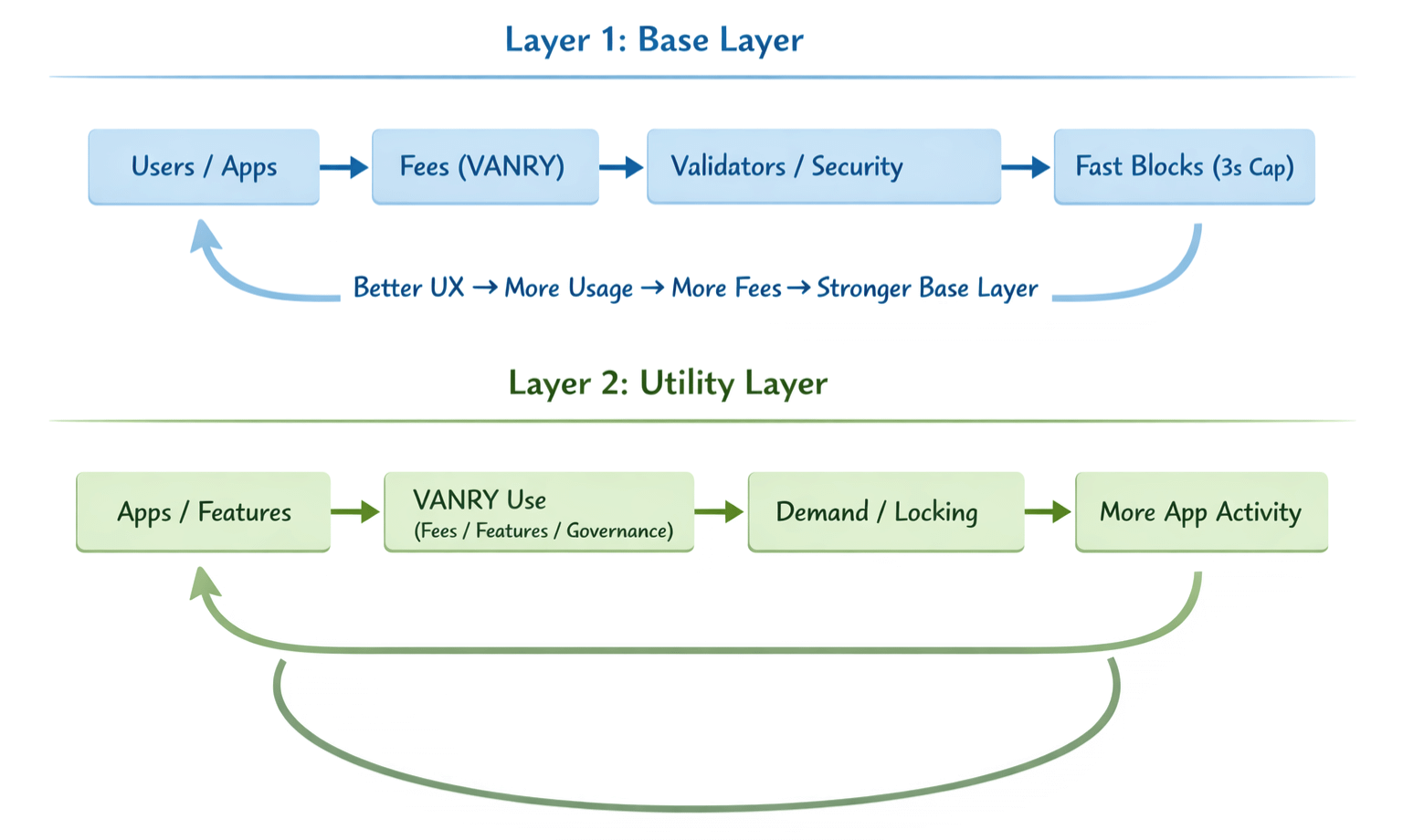
My simple way to picture Vanar’s dual-layer economy :
 I’m going to describe this the way I’d explain it to a friend who’s smart but not deep in crypto.
Layer 1 is the boring backbone.
Transactions get confirmed quickly (that 3-second cap), the chain keeps producing blocks, and the base incentives keep validators doing their job.
Layer 2 is where “use” shows up.
Apps are supposed to create reasons to spend VANRY (fees, features), and reasons to hold or lock VANRY (governance, staking style alignment).
The image in my head is simple: Layer 1 builds the road, Layer 2 is the traffic.
And yeah, traffic can be fake. But real traffic feels different. You can tell when people keep coming back.
Layer 1, the boring but important part: fees, speed, security :
If I had to pick one design choice that screams “we want normal apps,” it’s this: fixed fees.
Vanar’s docs describe fixed fees as a way to keep gas costs predictable in dollar terms. That means builders can price things like regular software, not like a rollercoaster.
They also talk about fairness in processing. Validators are expected to seal blocks using the chronological order of transactions as received in the mempool.
Again, not flashy. Just a clear rule.
The whitepaper sets a very specific target: fixed transaction costs reduced to about $0.0005 per transaction. I’m not treating that like a pinky promise for every network condition, but it tells you what “success” looks like in their design.
Also worth noting (because it’s a detail people skip): Vanar describes a fee-update workflow where transaction fees get updated every 5 minutes based on the market value of the gas token, supported by a VANRY token price API.
So the user experience can stay roughly stable even if the token price moves around.
On consensus, the docs describe a hybrid approach that’s primarily Proof of Authority (PoA), complemented by Proof of Reputation (PoR), with the Vanar Foundation initially running validators and later onboarding others through reputation.
That’s a trade.
It’s not “fully open from day one.” But it lines up with the goal of performance and controlled scaling.
Layer 2, where VANRY needs to feel useful, not just tradable :
This is where I get picky, because a lot of “token utility” writing is basically… hand-waving.
Binance’s VANRY page describes the token’s role around transaction fees, governance participation, and unlocking special features.
That gives you a clean baseline: spend + influence + access.
Now the numbers, because numbers keep us honest. As shown on Binance (page updated in real time), VANRY is around:
$0.00602 per VANRY
$13.79M market cap
$1.78M 24h volume
2.29B circulating supply
And the supply ceiling matters too, since the same Binance page lists a 2.40B max supply.
I’m not saying “buy” or “sell.” I’m saying: if Layer 2 is working, demand should come from usage, not just chart-watching.
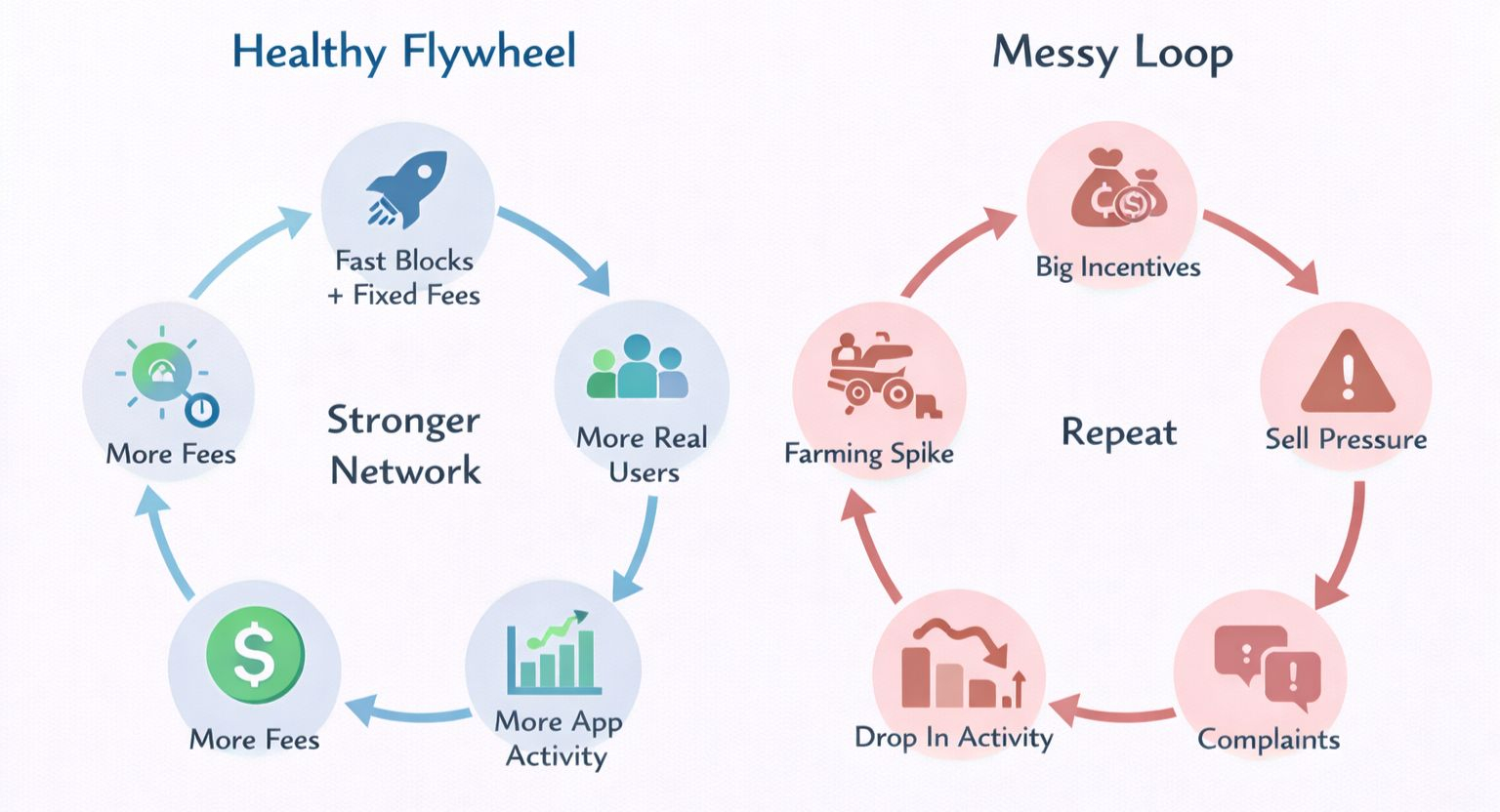
The nice version of the story is pretty clean.
Fast confirmations (3 seconds max) make apps feel responsive, fixed fees make costs predictable, predictable costs make builders more confident, more builders ship more apps, and more apps create more real activity.
Now the messy version (because there’s always one):
if activity is mostly reward-driven, you get a surge of farming, then incentives cool off, then usage drops. People act shocked, even though we’ve all seen it before. Fixed fees reduce some bidding chaos, but they don’t magically create loyal users.
So yeah, I’m watching retention more than “spikes.” Here’s what I’ll be watching next (and why I’m still optimistic) :
If I’m tracking Vanar over the next stretch, I keep a short checklist:
Do fees stay close to that $0.0005 target in real usage, not just in slides.
Does the 3-second cap keep holding up as activity grows.
Do we see apps that need micro-actions (games, social, consumer flows), because that’s where cheap predictable fees actually matter.
How does the token supply story play out as VANRY sits near 2.29B circulating and 2.40B max.
Overall, I’m still optimistic.
The blueprint feels grounded: fast blocks, fixed fees, clear rules, EVM familiarity.
If Vanar keeps stacking real app usage on top of that base layer, this “two-layer” setup could end up being one of the more usable models in the L1 crowd.